United States 29 January 2008
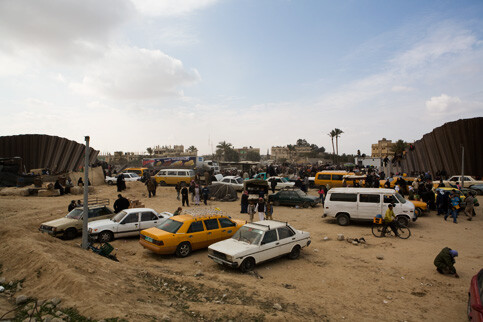
Palestinians walk into Egypt over the Israeli built wall on the southern border of the Gaza Strip after it was destroyed by Hamas, 26 January 2008. (Matthew Cassel)
Today, more than any other day in my life, I am proud to be Palestinian.
Let me explain. Nation-states mean little to me. They represent artificial boundaries, legal restrictions, “No Entry” signs, and collective brainwashing into the “uniqueness” of cultures that only humans acknowledge. What fish has ever stopped swimming as it approached that most invisible “water line” separating one country from another? What migratory bird’s instincts made it hesitate for even the briefest of moments as it crossed from Canada to the US to Mexico, heading south for the winter? Show me a flower, even in the most private garden, that doesn’t mix its aroma with the flowers in the garden next door, with the highest “security fence.”
Such boundaries are unnatural. And because they are unnatural, I have never related to them. Yes, I have long advocated Palestinian rights, but my own national identity is tangential to my passion. I advocate Palestinian rights because they are human rights that are violated for the sake of these artificial boundaries. But today, as I see the Palestinian people represent the finest in people power, I am proud to be Palestinian. I am proud to be part of a people that refuses to submit to unnatural limits on our most basic freedoms: the freedom to eat, to drink, to grow.
The International Court of Justice declared the Wall illegal, but did not have the power to bring it down. The Fourth Geneva Convention declared collective punishment illegal, but did not have the power to stop it. International law declared the occupation illegal, but did not have the power to end it. And then Palestinians, possibly the most downtrodden of all peoples today, brought the wall down.
Yet, ecstatic as I am, I am not naive. I know this is only a temporary breach, and I know national leaders will take credit for this achievement. Egyptian President Hosni Mubarak has already claimed that he “allowed” the Palestinians into Egypt because Gazans were starving, even as his security forces arrested 500 demonstrators in Cairo for protesting the siege. And Dov Weissglas, advisor to Israeli Prime Minister Ehud Olmert, referred to the strangulation of Gaza as if he were doing Palestinians a favor: “It’s like an appointment with a dietitian. The Palestinians will get a lot thinner, but won’t die.”
But Palestinians are dying from the “diet” imposed upon them by the illegal occupier. A World Food Program study conducted last year revealed that half the Palestinian population is “food-insecure.” Indicators of malnutrition include being underweight, wasting, and stunted. Also as a result of the restrictive Israeli measures, Palestinian still-births in the West Bank rose by 52 percent in 2007. There are no such figures available for the Gaza Strip.
And even as I am writing this, news comes in that Israel has killed Mohammad Harb, the Gaza leader whose forces blew up sections of the wall, allowing Palestinians to stock up on essentials. Harb paid with his life for the temporary freedom of my people, the people who democratically elected him as their representative, despite immense pressure from Israel and the US to “elect” a peon of the occupation. So I do not want to forget. Harb was the people’s choice, and it is people power that brought the wall down.
And that is one model we can all emulate, wherever we are. If disenfranchised Palestinians could bring down a wall constructed by the region’s most heavily-armed nuclear power, backed by the world’s uberpower, then all oppressed peoples, everywhere, can do it too.
Today, for a brief moment, it feels great to be Palestinian.
Nada Elia teaches Gender and Cultural Studies at Antioch University-Seattle. She is a founding member of RAWAN (Radical Arab Women’s Activist Network) and currently serves on the national steering collective of INCITE! Women of Color Against Violence.
Related Links