The Electronic Intifada 15 June 2004
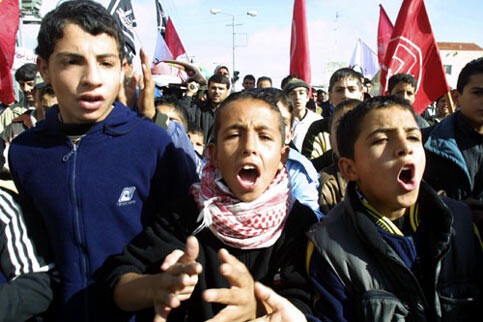
A still from A Stone’s Throw Away
Both of the films A Stone’s Throw Away and The Children of Ibdaa investigate the thoughts and lives of a handful of children from the Deheisheh refugee camp, an impoverished refugee town on the outskirts of Bethlehem. Together, they illustrate that what drives Palestinians to commit violence, and how children need something to make their lives meaningful given the humiliation and lack of opportunity that come with living under Israeli military occupation.
“Before [the intifada], my friends and I used to have fun. We went to the mountains, played football and went swimming. Now we can’t do anything. If they lift the curfew for four hours, and we want to swim for three, we can’t. They will shoot at us when we are going home. We’ll risk our lives,” Ibrahim, age 13, explains in A Stone’s Throw Away. His friend Khaled, aged 14, tells how he and his friends can’t meet to practice football anymore. “So we throw stones,” he says.
The camera follows the boys as they spend their days tempting fate by throwing stones at the Armored Personnel Carriers (APCs) that announce that the camp is under curfew — nobody is allowed outside. Unable to regularly attend classes because of the curfews, Ibrahim says, “This year my grades won’t be any good. Last year, I got As and Bs. This year I hope it won’t be less than Cs. Sometimes when I am studying, the soldiers come. They start shooting and I can’t study.” A younger boy pipes in, “Once they announced the exams, then a tank came and started shooting. A child was injured.”
Unable to pursue an education uninterrupted by curfews and violence, the boys seem to be without hope and resort to a fatalistic attitude after the death of their friend Kifah. Shot during a protest against the recent deaths of five children in Gaza, Kifah is just one of many who have been killed in Deheisheh camp during the intifada. Rami says, “I will never forget Kifah. Every day before school, I used to meet him on the street. One day I didn’t find him. … Then I remembered he was martyred. In class I imagined that he would come. He is just late, he’ll be here soon.” Cracking a rare smile while remembering Kifah’s sense of humor, Rami adds, “Now in class we don’t laugh anymore.”
The kids have little to work towards as they idle away their days, unable to go to school or move around the camp for fear of getting shot. The tragedy of their situation is reaffirmed during one of the rooftop interviews with Rami, during which some explosions are heard in the background. Off camera, the filmmaker says, “come here,” as Rami instinctively ducks his head. But then he adds, “No, it is normal here.”
A life in which curfews, violence, and martyred friends are the norm causes Khaled to say, “Before I was afraid, but now I don’t care about anything. I lost the will to live when I lost my friend; I wish I could follow him.” He used to dream of being a football star or a journalist, but that changed after the death of Kifah. In a poignant last scene in which he is struggling to fly a Palestinian flag fashioned into a kite, Khaled adds, “All of us think about saving money and buying arms to fire at the settlements. To have weapons to kill Israeli soldiers. We don’t care about school anymore. We don’t care about anything but buying arms and to avenge the death of Kifah and other martyrs.” Not a particularly optimistic film, it seems more likely that these boys a stone’s throw away from death than they are from freedom.

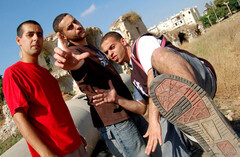
A still from The Children of Ibda’a
One of the performers explains, “Of all the Jews, I consider the settlers to be unique because they don’t want peace,” referring to the people who inhabit Jews-only settlements built on land illegally grabbed from the Palestinians by the Israeli government. “As one of the Palestinian people, I am not vengeful towards the Jewish people. It is possible that a Christian, a Jew and I sit together. But we can’t sit with someone who wants to kill us,” he says.
Similarly, Sanabel, who says she thinks about her family’s original village of Zakariyya all the time, says she wouldn’t mind living alongside Jews. Smuggling them through checkpoints, the filmmaker takes Sanabel and a few of her fellow dancers to their families’ original villages, some for the first time. The green, pastoral scenery of Zakariyya greatly contrasts the densely populated, dusty Deheisheh camp, where “there is no place for kids to play, no place for gardens,” as performer Tamara explains.
Ibda’a, which in Arabic means to create something from nothing, is a positive way for kids to communicate their struggle and feel active in communicating to the world the plight of their people. Dancer Manar says, “There is hope inside of me to return to my homeland. There is something inside of me that says struggle, fight to return to your homeland. Something tells me to send my voice to the entire world so that they know who the refugees are — what is Deheisheh camp, what is Palestine, and what is our struggle.”
Fusing traditional dance forms with a current narrative, the choreography performed by Ibda’a tells a story of an agrarian people who are fighting against a crushing colonialist force. Ghassan, another Ibda’a troupe member, explains, “I dance with the group about my grandparents and my great-grandparents.” The children of Ibda’a are third generation refugees, living in a camp that was originally inhabited by those who fled or were expelled from their homes in 1948, and who thought they would only have to leave their villages for a week or two.
Unlike the Rami, Khaled, and Ibrahim of A Stone’s Throw Away, the dancers of Ibda’a smile and seem hopeful for the future. One of the Ibda’a girls says, “After I present a show I have delivered our message. They know that there are children of the stone who know how to do more than throw stones.” Another performer dreams of becoming a journalist “so that the voice of our people can reach the entire world,” she says.
However, like Rami and his friends, the Ibda’a performers understandably live in fear. The same boy who says he is not vengeful towards Jews confides, “Right now my ambition is that I have a voice with which to defend Palestine. But the thing that I am afraid of is that someone more powerful will silence me.” Like Rami, Khaled, and Ibrahim, the children are wise beyond their years. But fortunately they have one safe way to enjoy being children.
A recent graduate of the School of the Art Institute of Chicago, Maureen Clare Murphy is Arts, Music, and Culture Editor for EI
Related links