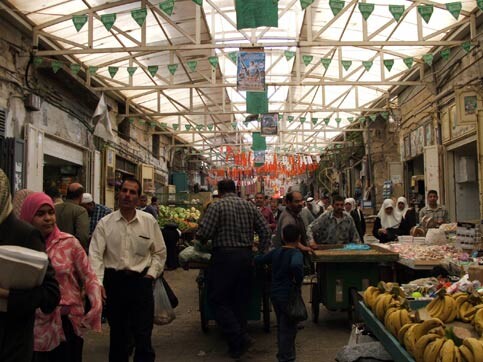
The souk during a bustling day in Nablus’ Old City.
The West Bank city of Nablus has historically boasted itself as the commercial and business center of Palestine. The West Bank’s largest city, it dates back some 4,500 years. However, Nablus’ economy, cultural heritage, and population have come under attack during the past four years of Israeli violence. Its Old City walls have acquired a new layer of history in the political graffiti and martyr posters honoring the scores of mostly young men from Nablus who have committed suicide bombings or, far more frequently, were killed by Israeli violence.
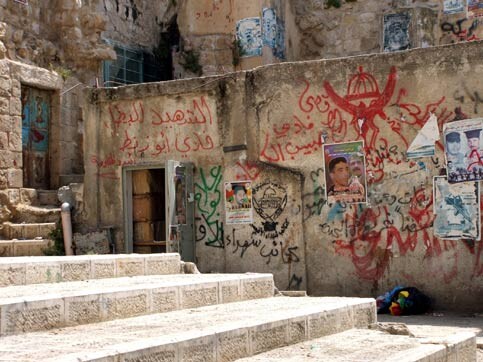
A wall in the center of the Old City, covered in political graffiti and martyrs’ posters
Of its population of around 332,000, the Nablus district has seen 365 deaths during the first four years of the current intifada as a result of Israeli violence, and scores more have been imprisoned. Nablus has also seen the worst of Israeli closures. The Palestine Red Crescent Society has recorded that Nablus was subjected to 4,804 hours of curfew between June 2002 and September 2004. Israeli forces control all movement to and from Nablus through Huwwara checkpoint, which is one of the most notorious checkpoints in the occupied territories.
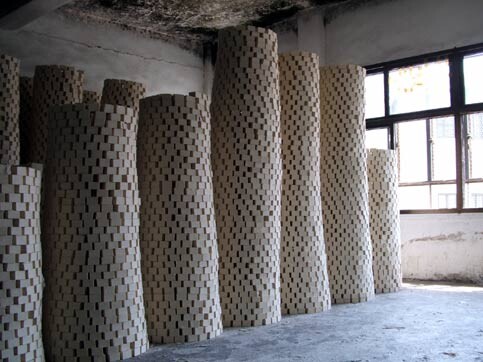
Towers of cut soap air out before they are boxed for shipping
The combined factors of closure, movement restrictions, and violence have decimated Nablus’ economy. According to the UN, “Municipal revenues from the vegetable market, for example, dropped 90 percent since 2000 — from NIS [New Israeli Shekel] 5.19 million to NIS 509,290.” The city’s famed soap industry has been particularly hard hit. While there was once as many as 80 soap factories manufacturing in Nablus, there are only three fully operating today.
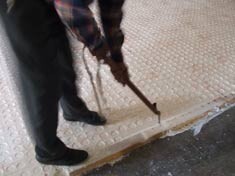
A demonstration on how soap is cut after being branded with the manufacturer’s stamp
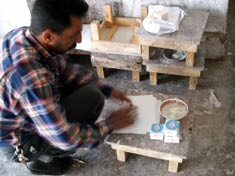
A bar of soap is expertly wrapped
The Mafahteen (Two Keys) factory has been in operation for hundreds of years, and currently employs some 40 workers, who either mix the soap ingredients, cut the dried soap into bars, wrap the soap in paper with the factory’s stamp, or box the soap so it can be shipped within the West Bank, Jordan, Syria, and the Gulf states. They are happy to give tours to the few visitors who trickle into Nablus nowadays, and give as souvenirs the hand-wrapped soap manufactured in the building.

Nablus’ grand archways give its Old City a magical feel
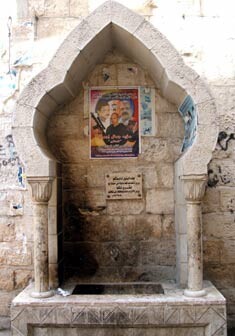
A poster honoring a young man who died during the intifada, posted on the side of a mosque
A worker at the Two Keys factory explains that it has been difficult for factories to stay open because of the collapsed economy. The Israeli army has closed some, and one was even exploded by a missile dropped by an F-16, in the heart of Nablus’ ancient Old City during Israel’s “Operation Defensive Shield” in April 2002. Also destroyed or damaged during that operation were three historic mosques (two of them converted Byzantine churches), 260 historic houses, the 18th-century eastern entrance to the old market, and seven Roman cisterns. Palestinians sealed another factory owned by the same family as the Two Keys factory in an effort to keep the Israeli army from occupying the building. Plenty of business keepers in the Old City are able to tell stories of Israeli troops occupying their factories.
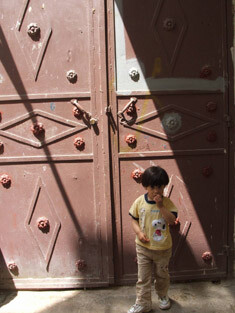
A young child dwarfed by doors and shadows
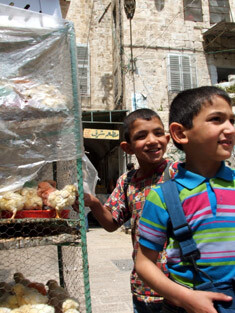
Schoolboys taking advantage of a nice day in Nablus
Not only has the development of Nablus’ economy been hindered by Israel’s movement restrictions and intensified violence during the last four years, but Nablus’ children have been hard-hit as well. Lack of access to food as a result of curfew and economic hardship has resulted in malnutrition among children, and the education process has been disrupted by curfew and violence. Teachers report that since the intifada, children are having a harder time concentrating in class. A Save the Children study found that “children live in a near constant state of fear. Their reference points for normal life have changed; they know the language of violence at a very young age,” and as a result exhibit the psychological symptoms of increased aggression and stubbornness, shortened attention spans, bedwetting, and nightmares.

A stately building in Nablus’ old city
Despite all that it has suffered in the past four years, the impressive Old City of Nablus still clings on to any remaining magnificence it can. But visitors to Nablus will immediately notice the silenced faces of those pictured in the martyr posters, and the bullet holes in the buildings. And unsurprisingly for a city under siege, its sites of antiquity are not being properly preserved and maintained. Garbage is littered over the remains of a city long forgotten; its ancient arches now sprouting vegetation and its former majesty now dwarfed by the nearby houses.
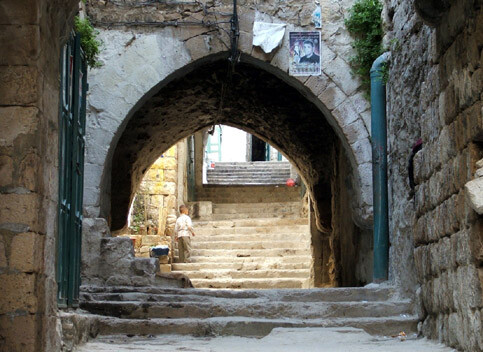
The last four years of voilence and repeated Israeli incursions have tarnished the Old City’s elegance
Both Nablus’ historical heritage, preserved in its irreplaceable structures, and its future, found in the city’s children, are threatened by politics beyond their control. Like how the damage done to its architecture cannot be erased, Nablus’ children are experiencing potentially irreversible developmental problems because of Israel action in the suffering city. As the Old City of Nablus’ historic sites are being consumed by violence, the city’s future remains in question as the next generation lives in the limbo, uncertainty, and instability that come with protracted conflict.
Maureen Clare Murphy, currently living in the occupied Palestinine, is Arts, Music, and Culture Editor for the Electronic Intifada