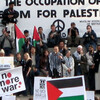
Thousands of protesters demanding an end to the occupation of Iraq and Palestine took to the streets Saturday in London, Athens, Paris and other cities around the world, chanting slogans against the United States and Britain. The following photo reportage of the protest in London was made by Azem Bishara. Read more about Photostory: London protests against occupation of Iraq and Palestine
As Palestinians marked the third anniversary of the intifada, at the Tel Aviv District Court, member of the Palestinian Legislative Council, Marwan Barghouti, who was detained by Israel since April 2002, presented his closing arguments. Read more about Marwan Barghouti: "Why don't you refuse?"
Kathleen Christison and Bill Christison30 September 2003
As we watched helplessly, the two Caterpillars, with pneumatic drills on their long dinosaur arms, systematically punched holes in the front of the house, then in the roof. Billows of dust began to rise as pieces fell off the house, then more as the roof began to fall in. The water tank on the roof was first dented, then punctured, sending out a large spray of water that was visible even from our distant perch. It all took only a few minutes. In fact, only an hour passed between the arrival and the departure of the Caterpillars, probably only 20 minutes from start to finish of the actual demolition. Kathy and Bill Christison write about just one day spent defending Palestinian homes. Read more about Defending Palestinian homes: Tears amid the rubble
Through a simple campus lecture, Edward Said precipitated a rupture at Ohio’s Oberlin College. But like many things in his life, the debate did not touch the substance of Said’s theory or politics. Instead, his enemies were obsessed by what he stood for — a Palestinian nationalism that scared them because it was not easily stereotyped or dismissed. Through this vignette, I also learnt about the limitations and myopia of liberal campus politics. Naeem Mohaiemen remembers Edward Said. Read more about Edward Said: Campus hysteria in the face of truth
“There is no excuse for us not to aspire to the courage and clarity that Dr. Edward Said embodied. There is no excuse for us not to envision a better future and to work together with diverse Others for its realization. There is no excuse for any of us to let despair, anger, jealousy or fear poison us or slow us down. And there is no time to waste in honoring and sustaining the legacy of Dr. Said. As an American poet, May Swenson, said about deep sorrow following a great loss: ‘Don’t mourn the beloved. Try to be like him’.” EI co-founder Laurie King-Irani reflects on the lessons to be learned from Dr. Edward Said’s life and vision. Read more about Edward Said: A lesson that will not die, a vision that cannot fail
On September 25, 2003, I received the somber news of the passing of Palestinian Professor Edward Said, at the age of 67. I like many others felt an unbearable loss of one Palestinian hero who had influenced and inspired my quest to ameliorate the long, unjust and unabated suffering of the Palestinian people. Professor Said was one of a kind. Educator and writer Leila Diab remembers Edward Said. Read more about Professor Edward Said's Ninth Symphony plays on
Picking up a work by Edward Said is never intellectually or emotionally easy. Following Said through one of his thrusts into the meaning of the intellectual, of being an Arab or a Palestinian, or exploring with Said what it truly meant to be political is an experience so deep, at times, so painful, so unflinchingly honest that one emerges from it reborn, enlightened, and often on fire. I speak from experience as a young student set aflame by Said’s work in the mid-1990’s. I did not know Edward Said personally. I saw him lecture at Harvard and in Southern California, and I met him once at a conference in Boston. I talked to him about the challenges of being sympathetic to the Palestinians in academia. He responded, with real compassion and even a flash of anger in his eyes, “keep fighting.” MPAC Communcations Director Sarah Eltantawi remembers Said. Read more about Edward Said: The Loss of an Irreplaceable Mentor
Various news organisations reporting on the killing of one Turkish and one Swiss member of the Temporary International Presence in Hebron (TIPH) have included the Israeli claim that it was Palestinian gunmen who opened fire on the TIPH vehicle. A TIPH spokesperson, reached by telephone in Hebron by The Electronic Intifada today categorically stated that TIPH had “No information on the shooting.” Read more about Advisory: TIPH reports "no information on the shooting" of two of its personnel
For Palestinians born in the Diaspora, Said’s writings stand at the centre of their attempts at making sense of the world and of their place in it as a dispossessed people. I am one such Palestinian. I discovered Said’s work as an undergraduate student at McGill University in the mid-nineties. Majoring in Political Science and Women’s Studies, my intellectual growth as a human being, a Palestinian, a Canadian, a writer, a committed peace activist, and a staunchly secular feminist, were all deeply impacted by his work. This summer I had a chance to attend a 4-hour-long unedited documentary interview with Edward Said at the Institute of Contemporary Arts in London. A.Y. May reports. Read more about Edward Said and the Contours of Palestinian Identity
September 24, 2003 — Today, an extraordinary event will take place in Geneva, New York: the dedication of the first US memorial to the victims of the Deir Yassin massacre. This event was organized by Deir Yassin Remembered, an international human rights organization, half of whose current board includes Jews. On April 9, 1948, members of the Irgun and the Stern Gang massacred over 100 Palestinian men, women and children in the village of Deir Yassin, near Jerusalem. The Deir Yassin massacre marked the beginning of the depopulation of over 400 towns and villages, and the exodus of 750,000 Arabs; it also marked the beginning of the Palestinian Nakba, or catastrophe, and the creation of a Palestinian diaspora in refugee camps and in neighboring Arab countries. Deir Yassin Remembered executive director Dan McGowan comments. Read more about Remembering Deir Yassin