All Content

Anschutz Group Pulls Ad for 'Examiner' After Protest


Denver billionaire Philip Anschutz’s Clarity Media Group, which owns the San Francisco Examiner and plans to launch the Washington Examiner on Tuesday, has pulled an advertisement promoting the two papers following criticism that the ad demonized Palestinian children, The Denver Post reported Saturday. The Electronic Intifada asked its readers to contact Examiner vice president of advertising Mark Wurzer and San Francisco Examiner managing editor Jim Pimentel to request that they pull the ad, according to the Post. 

Letter from Prison: My Interview with Israel's Shin Bet Intelligence Agency


Recently the Israeli authorities have begun searching for and arresting experienced International Solidarity Movement (ISM) and international activists. My arrest and attempted deportation is another example of this. Evidently the Israeli authorities find nonviolent resistance and active support of Palestinian rights to be threatening. Pat O’Connor has managed humanitarian aid programs in the Middle East and Africa, and volunteered with the International Solidarity Movement in the West Bank supporting non-violent Palestinian protest against the Wall. He is currently in detention at Maasiyahu prison in Ramle awaiting deportation. 

Lessons from South Africa for the peace process (2/2)


History has not given the Palestinian people much reason to trust the intentions of the government of Israel. While Ariel Sharon has repeatedly claimed to be driven by a commitment to peace, his actions have so far belied his words, particularly concerning its military occupation of Palestinian territories. In this second article of a two-part series, Adri Nieuwhof, Bangani Ngeleza and Jeff Handmaker revisit key factors that built trust amongst both parties to the conflict in apartheid South Africa, without eroding key principles of the liberation movement, and reflect upon these experiences in the context of the Israeli-Palestinian conflict. 

Lessons from South Africa for the peace process (1/2)


Despite some initial optimism following the outcome of the Palestinian presidential elections, there has been no obvious progress towards peace negotiations. This is of little surprise, since the conditions for holding negotiations simply do not exist and possibly have not even been thought through by either party. While opportunities for peace talks are fast disappearing as the region appears again to slide into outright confrontation, the writers, former anti-apartheid activists from the Netherlands, South Africa and Great Britain respectively, look back on this crucial period in South African history in the first of two articles in a series, to reflect upon and provide inspiration to the Palestinian struggle for liberation. 

East Jerusalem land confiscation considered anew


In response to a written appeal by ACRI’s Chief Legal Counsel Dan Yakir for an immediate repeal of the unpublished government decision to extend the Absentee Property Law to East Jerusalem and the surrounding villages, Israel’s attorney-general Menachem Mazuz made clear that he had no knowledge of the decision and had never been informed of its existence. He further added that the issue is under urgent consideration and that he will issue a statement regarding his position within the next few days. 

Spanish perspectives I: an interview with Ignacio Alvarez-Ossorio


John Collins is currently living in Madrid and conducting interviews with intellectuals, journalists, and activists about the Palestine solidarity movement in Spain. He recently spoke with Ignacio Alvarez-Ossorio, who teaches at the University of Alicante and who has published widely on the Palestinian issue. Professor Alvarez-Ossorio notes that until recently, Spanish intellectuals have paid very little attention to Palestinian politics, and that most reporters and writers do not understand the key issues in the Israeli-Palestinian conflict. 

No easy route from Egypt to Palestine


Unlike areas of the West Bank, the soldiers in Gaza are unseen. They remain cocooned deep within lookout towers behind ever extending military fortifications, including sandbags, electric fences, pill boxes and tanks. One can barely make out a megaphone, a tip of a machine gun, and occasionally, when all else fails to catch the attention of the hundreds of cars awaiting orders to move forward or back away, a distant wave of a hand. “Living in Gaza has become somewhat like being trapped inside a snow globe, except there is no colourful confetti to cloud the stark reality of occupation.” Laila El-Haddad reports from Gaza. 

Mandate of UN force in southern Lebanon extended until July


Calling for an end to “serious breaches” of the ceasefire between Israel and Lebanon, the Security Council today extended the mandate of the peacekeeping United Nations Interim Force in Lebanon (UNIFIL) for another six months and urged Lebanon to deploy an adequate number of security forces along the so-called Blue Line between the two countries. Acting on the recommendations of Secretary-General Kofi Annan, the Council unanimously adopted a resolution that continued the operation until 31 July. UNIFIL was established in 1978 to confirm the withdrawal of Israelis troops from its northern neighbour, restore international peace and security and help the Lebanese Government regain its authority over the area. 

Weekly report on human rights violations


This week, Israeli forces killed 20 Palestinians, 14 of whom were civilians, including 5 children and one woman. Two of the children were killed on the first day of Eid al-Adha. One of the victims was extra-judicially killed by Israeli forces. Israeli forces conducted a series of invasions into Palestinian areas. Israeli forces demolished three homes in Khan Yunis and razed at least 120 donums of agricultural land throughout the Gaza Strip. Israeli forces raided homes and arrested dozens of Palestinian civilians. Israeli forces destroyed a home and an apartment building in the context of retaliatory measures against Palestinian civilians. Israeli forces used two Palestinian civilians as human shields during military operations in the Gaza Strip. 

Audio: Panel discussion with Ali Abunimah and Norman Finkelstein in Chicago


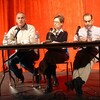
EI co-founder Ali Abunimah and Norman Finkelstein, professor of Political Science at DePaul University in Chicago discuss and debate the latest developments in the Palestinian-Israeli conflict. What is the significance of the election of Mahmoud Abbas and of Israel’s plan to “disengage” from Gaza? What are the latest developments on the ground in the occupied territories? Has the two-state solution failed and should we be seeking a single state as a way to fulfil the rights and aspirations of Israelis and Palestinians? The discussion, moderated by Martha Reese, was recorded at a forum held at Oak Park River Forest High School on 30 January 2005, an event organized by the Committee for a Just Peace in Israel and Palestine.