All Content

Unidentified armed men target UN club in Gaza

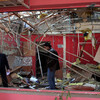
On Sunday morning, 1 January 2006, unknown armed persons blew up UNRWA Beach Club in Gaza City. The club and a nearby site of the Palestinian Civil Defense were severely damaged. A few hours later, another armed group kidnapped a member of a European Parliament delegation visiting Khan Yunis. The Palestinian Centre for Human Rights is concerned that the ultimate goal of such crimes is to convulse the internal security and security to cancel or interrupt the upcoming elections or hold them under unfair conditions. The UN club, which was established in the 1950s, servers UNRWA international and local staff. International staff no longer visited the club at night due to the current security situation. 

Alternative News Briefing


A booklet explaining key terms in Palestinian history from 1948 onwards is being distributed among Arab schoolchildren in Israel for the first time. “We are trying to break the stranglehold of the Education Ministry on the information given to our children, which is always presented from a Zionist perspective,” said Asad Ghanem, head of political science at Haifa University and one of several academics behind the initiative. Called “Belonging and Identity”, the booklet includes entries on 99 major personalities, places and landmarks in the Palestinian story, as well as explanations of the most important concepts employed in political debates about the region’s future. 

More than just school


Amal leads the morning parade at Shatie Elementary School. Dressed in her brown uniform and beret she is at the fore as, behind her, a thousand Gazan schoolchildren line up neatly in rows, clapping and chanting. After the parade she is in charge of ensuring they all file back quickly into their classrooms. This daily ritual is representative of the kind of order school brings to the lives of children living in Gaza. Amal is eleven years old; her parents, like those of many other children at Shatie, which caters solely for refugee children, are impoverished and unemployed. The camps in which Amal and most other students live are crowded, amongst the most densely populated places on earth, with many families having nine or ten children. 

Turning the page, again


Under a traditional leadership, with a stagnated political environment of internal hegemony and external military occupation, elections have been used over the years to entrench the already entrenched polity. Add to this the multi-pronged foreign interventions into Palestinian society � politically, economically, and socially � and elections have become watered down to the point where they are no longer enough of a force to turn the pages of history. Our future can only be shaped by our own hands. Are we ready, not only to turn the page, but to rip out and then rewrite the last chapter of the chronicle that has imprisoned us in occupation like never before?! 

Al Mezan calls for immediate relase of kidnapped worker and family in Gaza


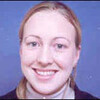
One day has passed since Kate Burton was kidnapped and at the time the PNA [Palestinian National Authority] is still unable to identify the place of kidnappers. Kate Burton is British of 24 years old; she has been working as International Coordinator at Al Mezan Center for Human Rights for the last three months. Ms. Burton has also taken part with the UNDP [United Nations Development Programme] in the Gaza Strip where she maintains excellent relationships with Palestinians. She actively supported the Palestinian cause, and worked hard on backing up Palestinians and exposing Israeli violations against Palestinian civilians. 

WaSPR Delegation Diary 5: Living In Isolation and Under Siege in Hebron and Bethlehem


As stipulated by the 1997 Hebron Protocol, Hebron is divided into the H1 and H2 areas. The H2 segment is where the Jewish settlers live amongst the Palestinian population, and it is currently the segment of the city under curfew. Agoraphobia, the fear of leaving one’s home, is common amongst the Palestinian residents of H2. There they are surrounded by six settlements within the center of the city. The Palestinians in H2 become isolated within enclaves and are faced with daily harassment and violence. They become isolated from city services as well, and this is where Medecins Sans Frontieres and the International Committee of the Red Cross/Crescent come in. 

Photo of the Day: Christmas with Banksy


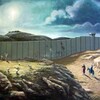
Photo of the Day is a BNN feature which offers a photograph on a day, and calls it “Photo of the Day”. This is not to imply that this is a regular feature, nor that this photo is truly the mother of all photos for the day in question. Usual disclaimers apply. You’ll remember Banksy from his amazing summer graffiti project on Israel’s West Bank Barrier. Well Santa is back with Vandalised oil painting #031, 2005. Good job mate, the truth has to be spoken in weird ways in times when people aren’t listening to common sense. 

Photostory: Christmas in Palestine


Last month, Israel finished building the wall and new security terminal that cut links between Jerusalem and the West Bank town of Bethlehem. The new security terminal, however, seems to be scaring away tourists and damaging Bethlehem’s already battered economy. In 2002, when the tension was at its worst, the number of visitors to Bethlehem dropped to an estimated 15,000, according to the municipality’s figures. There’s been a steady climb since, though: 100,000 in 2004 and 252,000 so far this year. Authorities have been frustrated by the timing as well as by delays caused by security checks, which are longer than anyone expected. Foreign visitors are now required to get off their buses and submit to a series of searches that can take up to an hour. 

The Writing on the Wall: Claire Anastas


The Writing on the Wall is a series of interviews with Palestinians who live close to the Wall. Van Teeffelen asked three questions: How is your daily life influenced by the Wall and the checkpoints? What does freedom mean to you? What are your sources of energy? Claire Anastas is a Palestinian civilian living opposite Rachelas Tomb in Bethlehem. “In 2002, there was a lot of shooting. We lived in a cross fire. My children were paralyzed of fear and could not even use their hands. During some of the shootings the bullets entered our house. We did not know where to hide. Each night my children were waiting when the shooting would start.