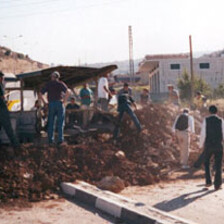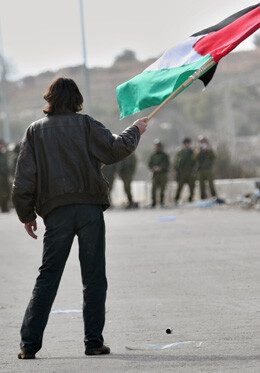
A Palestinian man participates in a demonstration against the wall at al-Khader, February 2008. (Luay Sababa/MaanImages)
At his apartment in al-Khader, Samer shows me a map of the al-Khader area located on the western edge of Israel’s “Greater” Jerusalem. The wall will cage the villagers of Battir, Wadi Fukin, Husan, Nahallin, and will cut off residents of al-Khader and Beit Jala from their fertile lands. Roughly 40,000 Israeli settlers inhabit this region of the West Bank with some 20,000 Palestinians. Once the wall is completed, al-Khader residents will only be able to access their land through a pedestrians-only turnstile located south of the village. The farmers will require permission from from Israel to bring vehicles and large equipment to their land through a gate 20 kilometers from the village. Samer tells me that two houses next to the wall have received demolition orders, because the owners built their houses without Israeli permission.
The wall runs along the oldest part of al-Khader. Samer and I decide to visit it and a tunnel under construction near Route 60, part of Israel’s parallel road system in the West Bank built to benefit its settler population at the expense of Palestinian freedom of movement. Along the way we are greeted by residents who know Samer from their shared childhood in the village or political activity during the first Palestinian intifada in the late ’80s. I notice that the two men working on the road leading to the tunnel are taking our pictures with their mobile phones. After 500 meters I can see the tunnel, and the wall. We walk to the massive iron gate section of the wall next to the tunnel. Once the wall is finished Israeli forces will be able to enter al-Khader through this gate. I realize that I have passed this wall on the other side several times. Last time I took a picture of a Volvo truck delivering sand-colored bricks to soften the look of the immensely ugly concrete wall. It turns out that al-Khader is completely invisible from Route 60.
This area of the wall differs from other sections I have seen snaking through the West Bank. It is composed of ugly gray eight-meter high concrete elements. Here, it resembles the wall we had close to the village where I grew up in the Netherlands, built to block the non-stop noise of the intensive traffic on a busy highway. With an estimated height of seven meters, the concrete elements bend about 60 degrees towards the road. Several schools are adjacent to the wall on the al-Khader side attended by about 2,700 schoolchildren of all ages.
While we walk through the streets of old al-Khader, we meet someone who invites us to visit his balcony with a view of the wall. Route 60 was built on the land of the people who own the houses in the old street that runs parallel to it. Now, with the construction of the wall next to the road, they are cut off from their land. Our host used to have sheep, however with his land now on the other side of the wall he was forced to sell them. He now works as a laborer in the nearby Israeli settlement to provide an income for his family.
Meanwhile, the wall that cuts off the al-Khader residents from their land is almost finished. The residents of al-Khader have raised their voice in their weekly nonviolent demonstrations. “What else can we do?” sighs Samer with a soft voice.
Adri Nieuwhof is a consultant and human rights advocate.