Grassroots Palestinian Anti-Apartheid Wall Campaign 21 May 2008
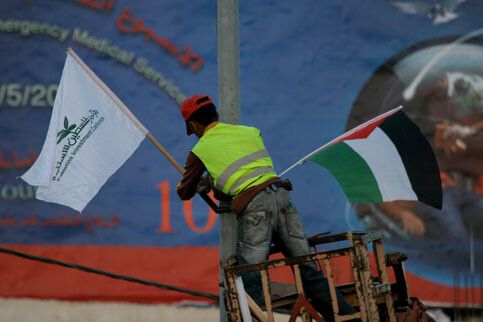
A Palestinian flag and a flag for the Palestine Investment Conference is hung on a street light in al-Khader village near the West Bank city of Bethlehem, 19 May 2008. The conference is expected to draw hundreds of investors and entrepreneurs from the Middle East. (Haytham Othman/MaanImages)
With the Palestine Investment Conference (PIC) underway in Bethlehem and the celebrated reforms and development projects proposed last year by the Salam Fayyad appointed government, understanding development in Palestine is more important than ever. Both the PIC and the Fayyad development programs have already elicited severe criticism from Palestinian civil society, political opposition and local communities. “Development or Normalization?” is the first report that examines in detail the economic and political implications of the most recent development schemes and the role international institutions have in shaping the development program of the Fayyad government.
The current approach to development, which is entirely removed from the needs of Palestinian communities, aims to normalize relations with the occupation, treating it as development partner in projects across the West Bank. Not only do these projects often run contrary to international law, but also they serve to further entrench the occupation while at the same time placing Palestinian economic growth in a subjugated role. As such, these programs both fail to provide sustainable growth and undercut the Palestinian struggle.
“Development or Normalization?” argues that the general concepts found in this development strategy were produced by international institutions and implemented with the help of the Fayyad government. The report then demonstrates in three case studies the implications of carrying out development with the occupation. The areas covered are: the Bethlehem tourism projects, the Jenin Industrial Estate, and the JICA projects for the Jordan Valley. In Jenin, for example, international donors are being asked to fund a project which, at very best, provides Palestinian workers with wages just barely above the international line of absolute poverty. In Bethlehem, tourism projects have been put forward that integrate Israel’s illegal wall into their workings.
These findings have serious implications, not only for development and economic growth, but also on account of the deteriorating political situation. While peace talks have stalled, development projects continue that implicitly recognize expanded borders, annexations and settlements.
- Download the full report [PDF - 650 KB]
Related Links