The Electronic Intifada 30 April 2008
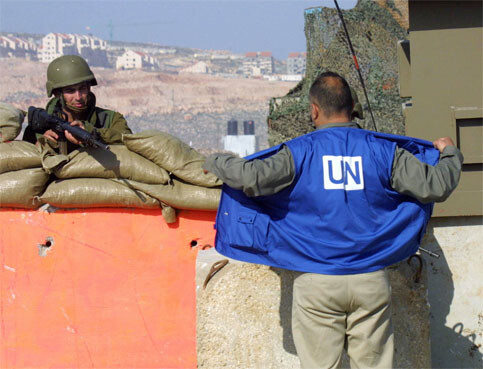
A UN staff member being checked by Israeli soldiers at a checkpoint. (UNRWA)
JERUSALEM, 30 April (IRIN) - Increased Israeli restrictions on the checkpoints around East Jerusalem have caused more delays and more lost man hours for UN staff in March 2008 than in all of 2007, the UN’s Office for the Coordination of Humanitarian Affairs (OCHA) has reported.
In the Humanitarian Monitor for March, released on 24 April, OCHA said “operations were significantly affected” and almost daily UN vehicles were delayed and even turned back by Israeli soldiers at checkpoints south of Jerusalem.
Israeli soldiers have increasingly insisted on searching UN vehicles at the checkpoints as a condition for being allowed through, despite the fact that Israel signed the 1946 Convention on the Privileges and Immunities of the UN which normally prohibits such searches.
“Movement of UN staff between the West Bank and East Jerusalem has been increasingly restricted over the years, starting with the erection of checkpoints, the requirement that national staff carry permits, and the building of the wall,” Allegra Pacheco, the acting-head of UN OCHA in occupied Palestinian territory, told IRIN.
“Beyond challenging its own commitments under the convention, it is also challenging the neutrality of the UN by demanding a search,” Pacheco said, adding that on 29 April she herself was delayed for over one hour after soldiers demanded a search of her UN vehicle.
Most of the delays take place as staff try to enter East Jerusalem, where nearly all UN agencies and non-governmental organizations (NGOs) have their headquarters or secondary offices.
Israel occupied East Jerusalem in 1967 and subsequently annexed it under Basic Law passed by the Knesset when Begin was premier, in violation of international law. The goal was to create one unified capital, no longer divided (as the city was from 1948 to 1967). Palestinians see East Jerusalem as their future capital, and the UN recognizes it as part of occupied Palestinian territory.
“It is becoming increasingly difficult to maintain large-scale, long-term humanitarian operations given the closures,” Christopher Gunness, a spokesman for UNRWA, the UN agency for Palestinian refugees, told IRIN, adding that “aid is becoming more expensive and work is becoming less effective.”
In the Nablus and Hebron districts, as well, UN agencies and NGOs said they have suffered from delays and other problems at the checkpoints.
Gaza blockade affecting UN staff
The crossing points to the Gaza Strip remained problematic. National UN staff members in Gaza are generally unable to leave the enclave, even on official UN duty.
“Getting our [Palestinian] staff out of Gaza is next to impossible,” a UN medical aid worker told IRIN.
Also, when permits are issued for these workers they tend to be valid for short periods of time or may be granted only as single entry passes.
International UN staff members have also been having a more difficult time obtaining documentation from the Israeli Ministry of Foreign Affairs, resulting in their inability to access the Gaza Strip and carry out their duties.
“Everyone who deserves a card gets one, and we would be happy to look into any specific cases of people who did not get one,” Aryeh Mekel, spokesman for the Israeli Ministry of Foreign Affairs, told IRIN.
This item comes to you via IRIN, a UN humanitarian news and information service, but may not necessarily reflect the views of the United Nations or its agencies. All IRIN material may be reposted or reprinted free-of-charge; refer to the copyright page for conditions of use. IRIN is a project of the UN Office for the Coordination of Humanitarian Affairs.
Related Links