The Electronic Intifada 19 April 2008
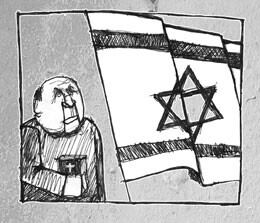
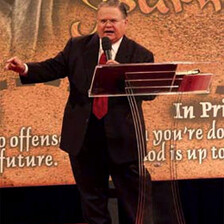
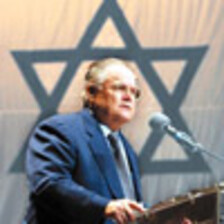
From the mobilizing might of CUFI and televangelists, to Jerusalem marches and the 65 million copy-selling Left Behind series, to be an American evangelical has become synonymous with fanatically pro-Israel politics. Nor is the image a purely domestic affair. In the Middle East, local Arab evangelical Christians have sometimes found themselves targeted by association.
However, there is now an increasingly confident and eloquent alternative emerging from evangelicals who are challenging the Christian Zionists with a biblical vision of justice for both Israelis and Palestinians. Despite lacking the resources of their self-confident, flag-waving co-religionists, incremental and discernible progress is being made.
Already by the mid-1980s there were signs of dissent. Evangelicals for Middle East Understanding was founded in part as a response to a concern about the “rising tide of western interpretation of the nation of Israel as the fulfillment of Biblical prophecy” that “threatens not only peace in the region, but also the Christian communities, especially those of the occupied Palestinian territories.”
Since then, there have been a number of successful and widely-read books by US and UK evangelicals that have not only provided an alternative theology, but, crucially, have also opened the eyes of many US evangelicals to the reality of Israeli land confiscation and other human rights abuses that they otherwise may never have heard about.
In the 1990s, Don Wagner (one of the key figures behind EMEU) published Anxious for Armageddon, and the British author and scholar Colin Chapman wrote Whose Promised Land?, a title later reissued during the second intifada and considered a go-to text for western Christians seeking to get to grips with the conflict for the first time.
More recently, US evangelical scholar Gary Burge has written Whose Land? Whose Promise?, which again combines theology with the experiences of Christian Palestinians under Israeli occupation. Another crucial British contribution has come from Stephen Sizer, who in three years has written two critical studies, Christian Zionism and Zion’s Christian Soldiers?
Aside from a growing body of literature, there have also been controversial and important interventions by leading evangelicals. In 2005, high profile US preacher Tony Campolo was both condemned and applauded for declaring that “you don’t bless Israel by equipping them with guns and tanks and planes to suppress the Palestinian people.”
Then last year, there was one of the strongest signs yet that this new approach was gaining the confidence to publicly go political. An impressively long list of leaders from the evangelical community — theologians, pastors and non-governmental organization directors — put their signatures to an open letter to US President George W. Bush that was also published in The New York Times. In their own words, they wrote:
“[T]o correct a serious misperception among some people including some US policymakers that all American evangelicals are opposed to a two-state solution and creation of a new Palestinian state that includes the vast majority of the West Bank. Nothing could be further from the truth. We, who sign this letter, represent large numbers of evangelicals throughout the US who support justice for both Israelis and Palestinians.”
This growing trend is emerging partly from the general movement among many US evangelicals (especially the young) away from the tick boxes of the religious right and toward a more mixed bag approach to hot-button political issues. Sojourners’ Jim Wallis for example, cited by Tim Watkin in February in a piece on this important shift, explained why he had joined others in signing the letter to President Bush:
“These evangelical leaders are clearly committed to the existence of the state of Israel, to its real security, and its protection from horrendous terrorist attacks — but also for justice and self-determination for the Palestinian people and their protection from the continual assaults of the Israeli Defense Forces.”
The “other evangelicals” are still faced with an uphill struggle. Financially speaking, the resources of the Christian Zionist mega-churches, TV star pastors and lobbyist groups dwarf those of the likes of EMEU and like-minded individual congregations. To have direct mailings, adverts, websites and full-time lobbyists at your disposal is a formidable advantage.
There is also the problem for those evangelicals calling for a justice-based peace that not only are they countering a powerful tendency within their own church, but they are also going against the grain in the US as a whole. Yet there is a sense that despite the brash self-confidence of the likes of Hagee, an alternative voice is finding a sympathetic hearing from a growing number of evangelicals, a transformation that could yet have a political, as well as theological, impact.
Ben White is a freelance journalist specializing in Palestine/Israel. His website is at www.benwhite.org.uk and he can be contacted directly at ben A T benwhite D O T org D O T uk. This commentary was originally published by The Guardian’s Comment is Free and is republished with the author’s permission.
Related Links
- Christian Zionists gain Israel’s inner sanctum, Bill Berkowitz (6 January 2008)
- US evangelicals at odds on embracing Israel, Bill Berkowitz (3 August 2007)
- Father of Christian Zionism leaves the building, Bill Berkowtiz (17 May 2007)