The Electronic Intifada 3 April 2008
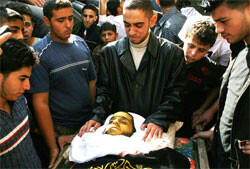
Na’el al-Kordi, who suffered from cancer, died in Gaza last year after being unable to leave for medical treatment due to the closures imposed on the enclave. (Wissam Nassar/IRIN)
A new report by the WHO on 1 April describes in detail five cases of patients who died either while awaiting an Israeli permit to exit the enclave or after having been denied one. Another 27 cases of patients unable to receive specialized care outside Gaza are also documented in the booklet.
Manenti chose to read to reporters the case of Amir al-Yazji, aged nine, who died from meningoencephalitis — an inflammation of the brain and central nervous system — while waiting.
However, the reasons for the lack of access to treatment go beyond just the Israeli permit system, the WHO said.
Strikes in recent years in the health sector; Israeli restrictions on imports to Gaza affecting the ability of the medical sector to bring in spare parts, medicines and other items; and the Islamist Hamas’s takeover of Gaza which affected coordination efforts — all come on top of a pre-existing need in the occupied Palestinian territory to refer patients abroad for tertiary care, as in many cases the treatments are not available locally.
The referrals abroad depend on Israel authorizing the patients’ departure. Since the Hamas takeover in June 2007, the Rafah crossing to Egypt has been mostly closed, meaning more and more patients need to leave through the northern Erez crossing with Israel.
In Amir’s case, the authorization was given too late, and he died just before being allowed out.
While Israel is currently allowing in more patients through Erez than it did before 2007, the proportional percentage of patients denied access has risen exponentially, the WHO said. In January 2006, only three percent were denied, while in December 2007 that number rose to 36 percent.
“The opening of the Rafah crossing, from a health perspective, is very important,” said WHO’s Manenti.
Israel blames Hamas
“Many of those denied access to Israel for security reasons, are able to leave to Egypt or Jordan using a bus, secured by Israeli security forces,” Col Nir Press from the Israeli liaison office in Gaza told IRIN. He blamed the Hamas regime in Gaza for much of the territory’s problems.
In response to the case of Amir, Press said the information provided by the WHO was not accurate, and that coordination problems on the Palestinian side are what prevented the child from accessing treatment in time. He also said that in other cases patients might have failed to show up or other issues, unrelated to Israel, emerged, causing the patients not to receive care.
In general, Israel says patients are only denied access on security grounds, though some patients have complained they have been forced to collaborate with Israel or be denied exit from the Strip, a claim the Israeli authorities reject.
Any improvements to the enclave’s health system require imports as well as access for humanitarian aid workers, both of which are hampered by the blockade on Gaza.
Manenti said three of his staff were prevented from leaving Gaza to attend a press conference in Jerusalem for the launch of the new report, and similar problems have been raised with regard to obtaining Israeli permits for professionals to enter the embattled territory.
A Human Rights Watch representative said Israel maintained “effective control over the Gaza Strip” and therefore it “must provide for the well being and welfare of the population.”
This item comes to you via IRIN, a UN humanitarian news and information service, but may not necessarily reflect the views of the United Nations or its agencies. All IRIN material may be reposted or reprinted free-of-charge; refer to the copyright page for conditions of use. IRIN is a project of the UN Office for the Coordination of Humanitarian Affairs.
Related Links