Al-Haq 23 September 2007
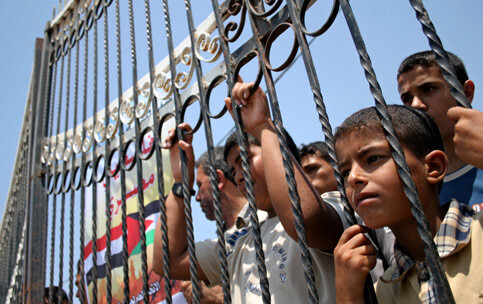
Palestinian protesters call for the re-opening of the Rafah Crossing, August 2007. (Hatem Omar/MaanImages)
As a Palestinian organization dedicated to the promotion and protection of human rights in the Occupied Palestinian Territory (OPT), Al-Haq is deeply concerned by the Israeli security cabinet’s unanimous decision on Wednesday, 19 September to declare the Gaza Strip an “enemy entity,” ostensibly paving the way for the imposition of collective penalties on the 1.5 million Palestinian civilians living in the Gaza Strip. These include intensifying the already severe border closures, limiting the provision of essential supplies, and dramatically reducing the supply of electricity, all of which will exacerbate the existing dire humanitarian crisis.
Labeling the Gaza Strip an “enemy entity” attempts to distract from Israel’s occupation of the territory and the international legal obligations incumbent upon it as the occupying power. Under international law the test for occupation is “effective control,” which exists if the occupying power “has a sufficient force present, or the capacity to send troops within a reasonable time to make the authority of the occupying power felt.” Israel has repeatedly demonstrated its capacity to meet this requirement to disastrous effect. Furthermore, Israel retains full control of the Gaza Strip’s land borders, population registry, airspace and territorial sea. These facts establish that the Gaza Strip remains an occupied territory, along with the West Bank, including East Jerusalem. Accordingly, Israel, as the occupying power, is required by law to ensure the safety and well-being of the civilian population of the Gaza Strip. The Israeli security cabinet’s use of the term “enemy entity,” having no basis in international law, in no way alters Israel’s legal obligations in respect of the Palestinian civilian population of the Gaza Strip. Rather, it represents a wilful misinterpretation of relevant international law aimed at relinquishing Israel’s legal obligations.
The decision by the security cabinet to punish Gaza’s entire civilian population for rocket attacks carried out by Palestinian armed groups amounts to collective punishment as prohibited by Article 33 of the Fourth Geneva Convention relative to the Protection of Civilian Persons in Time of War of 12 August 1949, which holds,
[n]o protected person may be punished for an offense he or she has not personally committed. Collective penalties and likewise all measures of intimidation or of terrorism are prohibited.
Furthermore, customary international humanitarian law, binding on Israel, prohibits rendering useless objects indispensable to the survival of the civilian population. Already suffering from a crippling siege following the January 2006 elections, and subsequent humanitarian crisis, the situation of the civilian population of the Gaza Strip will be severely exacerbated by limitations on the supply of fuel and electricity. These limitations will impact all aspects of Palestinian life in the Gaza Strip, including the functioning of water pumps and essential sanitation services. Israel’s willful disregard for the harm caused by the security cabinet decision is apparent from statements such as that of Israeli Knesset Foreign Affairs and Defense Committee Chairman Tzahi Hanegbi, who remarked, “there is no need to pamper the civilians of the Gaza Strip with fuel and electricity.”
International law establishes the clear obligation that Israel, to the fullest extent possible, as the occupying power, has the “duty of ensuring the food and medical supplies of the population; it should, in particular, bring the necessary foodstuffs, medical stores and other articles if the resources of the occupied territory are inadequate.” Far from ensuring the food and medical supplies, Israel has imposed the near total closure of Gaza Strip’s borders since January 2006. These closures, which the security cabinet now threatens to compound, have exacted a massive humanitarian toll on the Palestinian civilian population.
In addition to the ongoing sanctions, the aim of the decision of the Israeli security cabinet is clearly to diminish popular support for Hamas in the Gaza Strip by imposing intolerable living conditions on a population already subjected to a belligerent occupation. As such, these measures amount to an attempt to coerce 1.5 million Palestinians to bend to the political will of Israel and certain members of the international community. Article 31 of the Fourth Geneva Convention prohibiting coercion against protected persons clearly states that this prohibition applies to both physical and moral forms of coercion, covering both direct and indirect pressure, and that “[c]oercion is forbidden for any purpose or motive whatsoever,.”
The security cabinet decision represents a clear and deliberate effort to obscure Israel’s responsibilities as an occupying power as well as its sustained violations of the fundamental rights of the Palestinian civilian population of the Gaza Strip. Furthermore, the decision constitutes a cynical manipulation of both the letter and the spirit of international humanitarian law. The obligation upon Israel to provide for the essential needs of the occupied population is not a matter of beneficence, nor may depravation be used by an occupying power as a policy tool. Israel must seek to uphold it obligations under international law, not limit and avoid their application.
Al-Haq therefore urges:
- Israel to immediately cease all forms of collective punishment of the civilian population of the Gaza Strip, already suffering from the devastating impact of sanctions imposed in the aftermath of the January 2006 legislative elections.
- The international community and High Contracting Parties to the Fourth Geneva Convention to take immediate and decisive action within the framework of the United Nations Charter and international humanitarian law to compel Israel to cease its violations of the fundamental rights of the civilian population of the Gaza Strip.
- EU institutions and member states to make effective use of the European Union Guidelines on promoting compliance with international humanitarian law (2005/C 327/04) to ensure Israel compliance with international humanitarian law under paragraph 16 (b), (c) and (d) of these guidelines including public statements condemning Israeli violations of international humanitarian law and considering the imposition of restrictive measures and sanctions.
Related Links
- Al-Haq
- Dehumanizing the Palestinians, Ali Abunimah (21 September 2007)