The Electronic Intifada 16 July 2007

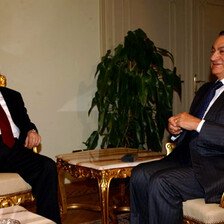
Palestinian President Mahmoud Abbas meets with Egyptian President Hosni Mubarak in Egypt, 26 February 2007. (POOL/PPO/MaanImages)
CAIRO, 14 July (IPS) - In the immediate wake of last month’s takeover of the Gaza Strip by Palestinian resistance faction Hamas, Egyptian President Hosni Mubarak condemned the action, describing it as “the overthrow of Palestinian legitimacy.” Since then, however, Cairo appears to have tempered its position, reiterating the need for peaceful dialogue between Hamas and its US-backed rival Fatah.
“Egypt wants dialogue with all sides — including Hamas — in order to achieve reconciliation between the Palestinian people and the realization of a Palestinian state,” Mohamed Basyouni, former Egyptian ambassador to Israel and head of the Shura Council (upper parliament house) committee for Arab affairs told IPS. “These goals cannot be achieved in the absence of Palestinian unity.”
The day after the 14 June Gaza upset, Cairo — in step with Israel, the US and the EU — made clear its support for Fatah, placing blame for the dangerous turn of events squarely on Hamas. In a statement, the foreign ministry urged “Palestinians of all factions to rally around the legitimate leadership” of Fatah-affiliated Palestinian President Mahmoud Abbas and his newly appointed government.
In a further indication of Egyptian partiality, Cairo also announced the transfer of its security delegation from Hamas-controlled Gaza to the Fatah-dominated West Bank. First established in Gaza in 2005 as part of a temporary security arrangement in the wake of Israeli withdrawal from the territory, the delegation was made a permanent fixture earlier this year.
On 18 June, foreign minister Ahmed Aboul-Gheit went so far as to accuse “Iranian elements” of complicity in the Hamas takeover. Quoted in the local press, the minister stated that “since Gaza is only a stone’s throw from Egypt,” the new political dynamic constituted “a danger to Egypt’s national security.”
Meanwhile, officials associated with Mubarak’s ruling National Democratic Party (NDP), quoted widely in state media, warned of the emergence of an “Islamic emirate” next door. “Parliamentarians reject the establishment of a religious petty state on the border,” read the headlines of government daily al-Gomhouriya on 22 June.
Official Egyptian partiality towards Fatah — and disdain for Hamas — is nothing new. Ever since the Islamist group won a landslide victory in Palestinian legislative elections early last year, Cairo — with the blessing of the US — has openly supported Fatah, providing it with financial and logistical assistance and training its security cadres.
Cairo, which signed a peace treaty with Israel in 1979, sees the Hamas movement’s code of perpetual resistance to Israel as a challenge to its own popular legitimacy. What’s more, Hamas is a close relative of the Egyptian Muslim Brotherhood, which — as the largest opposition force in the country — remains Cairo’s foremost domestic concern.
“There’s no proof of a direct relationship between Hamas and the Muslim Brotherhood, but there’s a high degree of sympathy between them,” Gamal Zahran, political science professor at Suez Canal University and speaker for the independent bloc in parliament told IPS. “And the Arab street shares this sympathy for symbols of resistance, like Hizballah and Hamas, which worries the so-called moderate Arab governments.”
On 25 June, Egypt hosted a conference at the Red Sea resort city of Sharm el-Sheikh attended by leaders of the “moderate” Arab camp led by Egypt, Jordan and the Gulf States, as well as Abbas himself and Israeli Prime Minister Ehud Olmert. Tellingly, Hamas representatives were not invited to participate.
The summit was widely expected to produce Arab expressions of support for Abbas and further calls to isolate Hamas. Mubarak, however, surprised observers by calling for Palestinian unity and stressing the need for “dialogue between rival factions.”
Contradicting earlier foreign ministry statements, Mubarak told state television the next day that Hamas control of the Gaza Strip “does not pose a threat to Egypt’s national security.” When asked specifically about a possible Syrian or Iranian role in the Gaza upset, he added: “There are a lot of rumors, but in the absence of any strong evidence we can’t make any accusations.”
Diplomatic sources confirm Cairo’s commitment to dealing with all parties to the inter-Palestinian conflict.
“Mediation efforts are still under way with all Palestinian factions, including Hamas,” said Basyouni. He went on to stress that “Egypt isn’t biased against one party at the expense of another.”
Diaa Rashwan, a senior analyst at the government-run Al-Ahram Center for Political and Strategic Studies, attributed the seeming change in Egypt’s position to official confusion immediately following Fatah’s downfall.
“The foreign minister made unclear statements, while NDP parliamentarians and the state press vociferously attacked Hamas,” Rashwan told IPS. “This gave the false impression that Egypt’s official position was completely against the Islamist group.”
“But at Sharm, Mubarak, speaking more prudently, clarified Egypt’s stance,” he added. “And that stance stresses the need for dialogue with Hamas.”
In a further indication of Cairo’s willingness to deal with the Islamist faction, government officials announced last week that the Egyptian security delegation would return to Gaza “imminently.”
“The delegation’s mission will focus on opening channels of communication between the leadership of the Hamas movement in Gaza and the Fatah leadership in the West Bank,” al-Gomhouriya reported on 8 July.
All rights reserved, IPS - Inter Press Service (2007). Total or partial publication, retransmission or sale forbidden.
Related Links