The Electronic Intifada 28 June 2007
DAMASCUS/BAGHDAD, 27 June 2007 (IRIN) - The plight of Palestinian refugees fleeing violence in Iraq and stranded in camps on the Syrian-Iraqi border is continuing to deteriorate as the summer heat intensifies and a solution remains elusive.
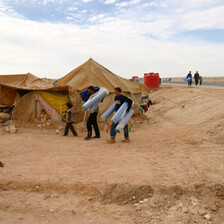
There is currently one camp on the Syrian side of the border, one in no-man’s land and one on the Iraqi side of the border housing Palestinian refugees.
As the summer heat has increased, with temperatures now reaching 50 degrees Celsius, living conditions in the desert have become increasingly hazardous with snakes, scorpions and sand storms.
“The weather is very, very hot and people are becoming very nervous and upset,” said one Palestinian in al-Tanf camp, situated on no-man’s land between Iraq and Syria. “We can’t live here, it’s too difficult. We need help, particularly air coolers.”
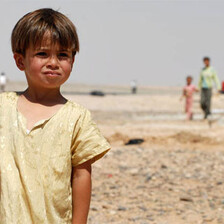
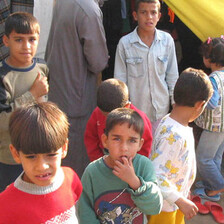
“Children in particular are developing medical conditions that they’ve never had before simply because of the high heat and dust storms,” said Sybella Wilkes, spokesperson for the UN High Commissioner for Refugees (UNHCR) in Syria.
The refugees are becoming increasingly desperate.
“The morale of the camp is so low and it’s only going to get worse,” said Wilkes. Nonetheless, conditions in al-Tanf continue to be better than in neighboring al-Walid camp on the Iraqi side of the border. While the 389 refugees in al-Tanf are entirely reliant on humanitarian aid, their basic needs, including food and medical assistance as well as a secure environment are being met by the UNHCR.
A third camp, al-Hol, in northeastern Syria, houses another 300 refugees. However, conditions in al-Hol are markedly better most notably in that the refugees have been allowed access to Syria itself and so are not stranded in no-man’s land like at al-Tanf.
Al-Tanf camp
It is now more than a year that refugees have been confined to al-Tanf camp without a solution to their plight.
In a statement on 26 June, the UNHCR said urgent medical care as well as an immediate humanitarian solution was needed for the Palestinian refugees stranded in camps on the Iraqi-Syria border.
“The situation of more than 1,400 Palestinians is deteriorating by the day. We urge countries in the region — and further afield — to help end their suffering,” UNHCR spokesperson Jennifer Pagonis said in a statement on 26 June.
Al-Walid camp
Last week, a UNHCR team visited al-Walid camp on the Iraqi side of the border and identified four children and one young man in urgent need of medical care, the statement said.
The UNHCR has established a small infirmary at al-Walid and the visiting team delivered a month’s supply of multivitamins for 120 children and distributed 300 sun protection umbrellas. “But the seriously ill — some of whom are in danger of dying — need hospital treatment.”
The Palestinians were also threatened by local armed groups early last week, the statement added.
Health and security officials in the western city of Ramadi, where the al-Walid refugee camp is located, said on 27 June that they do not have enough resources to help the stranded Palestinians.
“We don’t have enough police and army troops to be sent to the borders to protect their camps,” said a police officer in Ramadi who asked to remain anonymous as he fears reprisals from militants.
“Whatever force you send there, it will definitely face problems with militants as they roam the desert day and night,” he added.
Dr Ahmed al-Dulami of Ramadi General Hospital said the city’s health directorate has no “extra ambulances or employees to lose”.
“The refugees are increasingly scared and frustrated, trapped in the middle of nowhere,” Pagonis said.
Family stranded on border
Mukhlis Khalid Mohammed, a 62-year-old Palestinian refugee in Baghdad, said his family had been stranded on the border with Syria since last January and the last time he had heard from them was in May.
“Their letter, which was sent by a taxi driver, told of many tragedies as they were experiencing very severe conditions — especially the kids — but we are convinced that staying there is better than living in fear in Baghdad,” Mohammed said.
This item comes to you via IRIN, a UN humanitarian news and information service, but may not necessarily reflect the views of the United Nations or its agencies. All IRIN material may be reposted or reprinted free-of-charge; refer to the copyright page for conditions of use. IRIN is a project of the UN Office for the Coordination of Humanitarian Affairs.
Related Links