The Electronic Intifada 12 June 2007
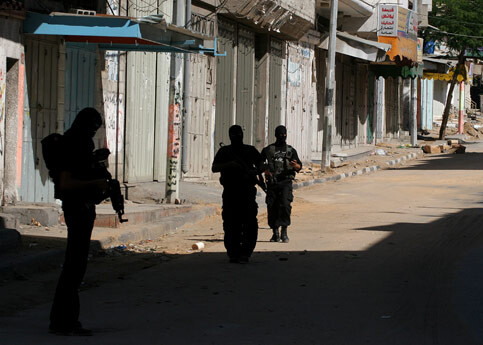
Palestinian militants from the Hamas Islamist movement take posistion in the empty streets of Gaza City, 12 June 2007. (Wissam Nassar/MaanImages)
TEL AVIV, 12 June 2007 (IRIN) - Patients are dying in crossfire as hospitals have been overrun by gunmen in a new wave of Gaza violence, which the UN has warned is jeopardising the delivery of essential humanitarian aid.
The violence has claimed 17 lives and ambulance teams are being prevented from evacuating the wounded from combat zones by checkpoints manned by armed fighters across the Strip, medical organisations said.
Hamas stormed the hospitals because it was worried Fatah would target its wounded fighters. Gaza hospitals have often been the scenes of firefights as the wounded from both sides receive treatment.
Four patients, including one in the operating theatre, died and 10 more were injured in a hospital in Beit Hanoun, northern Gaza Strip, in violence that has led to the hospital’s effective closure, the International Committee of the Red Cross (ICRC) said.
At Shifa Hospital, the biggest in Gaza City, Hamas and Fatah gunmen traded fire throughout 11 June and into 12 June but the hospital continued to function, Palestinian doctors said.
The European Hospital in Rafah, on the border with Egypt, and Nasser Hospital in the southern city of Khan Younis have also witnessed fighting, the doctors told IRIN.
Bid for ceasefire
“Bullets are being fired into patients’ wards and the fighters have told doctors the only way they are going to be allowed to leave is if they are killed. The situation is bad and it’s impossible to talk to the factions at the moment,” said a medical official in Gaza City, who requested anonymity.
The ICRC said it was maintaining operations in Gaza to help with humanitarian evacuations and ensure medical personnel and supplies could reach the wounded.
“It’s extremely difficult but we are trying to evacuate the wounded and that is our main task. We are also trying to coordinate ceasefires between Fatah and Hamas and we have been successful in some areas,” said Iyad Nasr, an ICRC field worker in Gaza.
He added that fighters from both factions now only trusted ICRC ambulances to transfer the wounded.
“Medical facilities and staff must be allowed to function at all times but particularly in times of crises,” said Claudia Locher, deputy head of the ICRC’s sub-delegation in Gaza in a statement.
Other medical organisations said their ambulances simply could not pass through the streets. “There are hundreds of checkpoints and we cannot move at all,” said Dr Abdel Hadi of the Medical Relief organisation in northern Gaza.
Food supplies in jeopardy
The food supply to almost a million registered Palestinian refugees is also in jeopardy after three of the five food distribution centres run by the UN’s Relief and Works Agency (UNRWA) were forced to close as fighting raged nearby and on occasion spilled over into UNRWA premises.
Seven of UNRWA’s 18 medical centres were also closed amid the violence.
“Some 850,000 people now depend on us for food. If we can’t get the food to them, they won’t have any food. It’s now very difficult to move about. Never has the humanitarian need in Gaza been greater, and never has the challenge of getting that aid to the people been greater,” said John Ging, UNRWA’s director in Gaza.
“Our staff are doing a heroic job but we cannot deliver food and medical services in the crossfire. We hope that the armed men will realise what they are putting the people of Gaza through and lay down their guns,” he added.
About 80 percent of Gaza’s refugee population is now totally dependent on aid, including food parcels, UNRWA said. The densely populated Strip’s economy has collapsed following the international community’s economic boycott of the Palestinian Authority (PA), which has lasted 15 months and is aimed at forcing Hamas, part of the PA, to recognise Israel and renounce violence.
This item comes to you via IRIN, a UN humanitarian news and information service, but may not necessarily reflect the views of the United Nations or its agencies. All IRIN material may be reposted or reprinted free-of-charge; refer to the copyright page for conditions of use. IRIN is a project of the UN Office for the Coordination of Humanitarian Affairs.
Related Links