Electronic Lebanon 3 June 2007
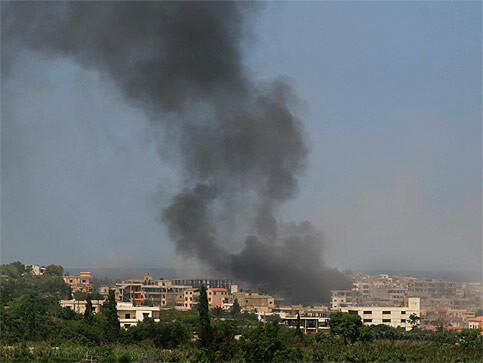
Thick black smoke has poured from buildings across Nahr al-Bared camp as troops and militants exchanged fire. (Hugh Macleod/IRIN)
NAHR AL-BARED, 3 June 2007 (IRIN) - Aid agencies and emergency services have been unable to access the besieged Nahr al-Bared Palestinian refugee camp in northern Lebanon for three days to either evacuate the injured or deliver vital supplies of water and food to trapped residents.
“If we don’t get into camp today or tomorrow the situation will be really critical,” Dr Yousef Assad of the Palestine Red Crescent (PRC) told IRIN on Saturday. The PRC is the only emergency service that has been evacuating civilians from inside the camp. “We are sure there are lots of civilians injured and we need to help them. This is our only concern. Our distribution network for medical supplies inside the camp has completely broken down.”
Assad added they had reports that around a hundred civilians had been trapped under rubble in an underground bunker after their building was hit and collapsed on top of them.
Up to 8,000 civilians are caught in the midst of the most intense fighting so far of a two-week standoff between the Lebanese army and Fatah al-Islam, a radical Islamist group based in the camp that has up to 200 armed men of various Arab nationalities.
Heavy artillery, tanks and a naval gun boat have encircled the camp, pounding rooftops and bases suspected to be held by Fatah al-Islam militants. Thick black smoke has poured from buildings across the camp as troops and militants exchanged barrages of machine gun fire while an army helicopter has fired rockets on targets towards the coastal edge of the camp.
Lack of access
Since the Lebanese army began heavily bombarding Nahr al-Bared camp early on Friday, the PRC had been unable to access the camp until Sunday, when it took advantage of a brief lull in fighting to evacuate one injured person in the morning. It was making efforts in the afternoon to evacuate 15 pregnant women.
Other aid agencies have also been unable since Thursday to deliver vital water and food to thousands of people who have been without electricity and running water for two weeks.
Before clashes began on 20 May, the UN’s relief organisation for Palestinian refugees (UNRWA) put the total population of Nahr al-Bared at 31,000 though estimates from the Palestinian Popular Committee inside the camp put it nearer 40,000.
According to UNRWA’s latest figures, 27,635 Palestinians have been displaced from Nahr al-Bared since the beginning of the conflict, the huge majority to Beddawi camp, 10km south.
Lebanese officials feel that civilians still in Nahr al-Bared were given adequate time to leave.
“The beginning of the end”
“No-one is leaving the camp. The army captains say they’re even shooting down the mosquitoes,” said Mazen Fakih, head of the Civil Defence Unit that has been evacuating injured soldiers from the camp. “You can feel this is the beginning of the end. The army feels they gave the people inside more than enough time to escape.”
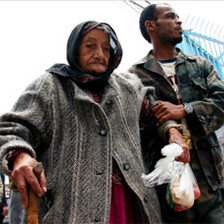
According to testimonies from those inside the camp, many of the civilians who remain are the sick and elderly, either too frail or stubborn to leave home.
“The people who remain in the camp are not sympathisers of Fatah al-Islam. They are either wanted criminals who would face arrest if they left or they are mostly old men and women who would prefer to die in their homes than be made refugees again — as they were by the creation of Israel in 1948,” Abu Jaber, a Palestinian social worker who has stayed in Nahr al-Bared throughout the two-week siege, told IRIN by telephone yesterday.
At least 110 dead
At least 110 people have now died from the two-week conflict; 44 soldiers, at least 35 militants and at least 20 civilians.
With Lebanese special forces having been moved into forward positions in apparent readiness to storm the camp, security analysts predict the death toll to increase dramatically in what would be the army’s first major military operation in over a decade.
Though a 1969 Arab agreement prevents the army from entering Lebanon’s 12 Palestinian refugee camps, home to the majority of the country’s 400,000 Palestinian refugees, analysts predict an imminent full-scale ground assault.
“The army has the guts and the morale to do this but lack specialist training for this kind of urban warfare and they will take more casualties,” said Timor Goksel, a long-time advisor to the UN forces in Lebanon who has worked closely with the Lebanese army.
Since Friday’s onslaught began, the International Committee of the Red Cross (ICRC) has called on all parties involved to spare civilians not taking a direct part in the hostilities and to refrain from attacking civilian infrastructure.
This item comes to you via IRIN, a UN humanitarian news and information service, but may not necessarily reflect the views of the United Nations or its agencies. All IRIN material may be reposted or reprinted free-of-charge; refer to the copyright page for conditions of use. IRIN is a project of the UN Office for the Coordination of Humanitarian Affairs.
Related Links