The Electronic Intifada 22 March 2007

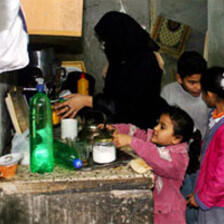
Palestinians receive supplies donated by the European Union and distributed by world food Programe (WFP) in the West Bank city of Hebron, July 9, 2006. (MaanImages/Mamoun Wazwaz)
RAMALLAH, 22 March 2007 (IRIN) - One-third of Palestinians in the West Bank and Gaza Strip are food insecure, according to a report by the United Nations World Food Programme (WFP) and Food and Agriculture Organization (FAO).
About 34 percent of Palestinians cannot afford a balanced meal and another 12 percent are at risk of reaching this state, the organisations found in a Comprehensive Food Security and Vulnerability Assessment published this month. Most affected is the Gaza Strip, where 51 percent of the population suffers from food insecurity.
“The poorest families are now living a meagre existence totally reliant on assistance, with no electricity or heating and eating food prepared with water from bad sources,” according to a statement by Arnold Vercken, the WFP country director for the occupied Palestinian territories (oPt). But an Israeli spokesperson said Palestinian authorities should take more responsibility.
“The problem is there is a government that does not recognise Israel or the agreements that constitute the relationship between us and the Palestinians,” said Shlomo Dror, spokesman for the Government Coordination Unit, which covers the humanitarian situation in Gaza and the West Bank.
“Why don’t the Palestinians help themselves? They have enough money to arm themselves to the teeth so why don’t they use it for the benefit of their people?”
He added that Israeli nutritionists had suggested ways to include more vitamins in UN Relief and Works Agency (UNRWA) and WFP food packages to ensure Palestinian children had a better diet.
The new FAO/WFP Crop and Food Security Vulnerability Assessment, last conducted in 2003, will help the UN food agency design beneficiary profiles to fine-tune food aid distribution.
The poorest families are now living a meagre existence totally reliant on assistance, with no electricity or heating and eating food prepared with water from bad sources.
Poverty is rising in the West Bank and Gaza because of international sanctions, compounded by Israeli restrictions on the movement of Palestinian goods and labour related to security concerns. The Palestinian Authority (PA) cannot pay its civil servants because the international community has refused to fund the PA unless the Palestinian government, which includes Hamas, recognises Israel and renounces violence.
Some PA salaries are being paid through a Temporary International Mechanism supported by the European Commission. About 80 percent of Gazans receive aid from WFP or UNRWA.
“Without a political resolution - and particularly removal of restrictions on movement - improvement in the humanitarian situation is unlikely and millions will remain dependent on assistance,” noted the FAO/WFP report. “A substantive injection of aid and social transfers has partially cushioned the declining humanitarian situation in Palestine, but aid cannot fully compensate for the loss of self-reliance.”
Belt-tightening
According to the WFP and FAO, 84 percent of Gazans and 60 percent of West Bankers have reduced their spending. Family and friends have kept food on Palestinian tables, but many now have nothing left to share, the report found.
“Solidarity has reached its limits. Families are becoming increasingly dependent on food aid,” said WFP spokeswoman Kirstie Campbell in Gaza.
Households are using several coping mechanisms such as reducing food portions; eating only one meal a day; buying lower-quality food; and eating less fruit, vegetables and fresh meat. Other means to maintain living standards include taking loans from family, friends and local merchants and selling assets such as land and jewellery.
In our house … we rarely bring [red meat] home. I bake my own bread to save money to buy gas for cooking and I never give my children money any more.
“No one knows what happens behind doors, but I can tell you that in our house … we rarely bring [red meat] home,” the report quoted the head of a household in Burqeen in the West Bank Jenin Governorate as saying. “I bake my own bread to save money to buy gas for cooking and I never give my children money any more - not even one shekel [coin] to buy sweets or [Coca-Cola].”
An unchanging diet and reliance on carbohydrates as the bulk food intake will affect the wellbeing of the population, 46 percent of whom are children, according to UN agencies. A nutrition survey found that chronic malnutrition is rising steadily. Iron deficiency (anaemia) is estimated to affect one-third of women and children. More than 22 percent of children aged between one and five had a vitamin A deficiency - levels higher than 20 percent are considered a severe public health problem.
Lack of work
Fewer Gazans have been able to enter Israel for work since the beginning of the Al Aqsa intifada in 2000, leaving hundreds of thousands of Gazans unemployed. A senior Israeli Ministry of Defence official told IRIN on condition of anonymity that no Gazans were allowed to work in Israel and he thought it highly unlikely that would change during 2007.
Many men have not been able to find reliable long-term work inside Gaza to replace the construction or agricultural jobs they had in Israel. A small number earn food from the WFP by working on community projects in Gaza, such as road cleaning.
Fishing and farming restricted
The Israeli human rights organisation B’tselem said the Israeli military had forbidden the movement of fishing boats off the Gazan coast.
“The prohibition has seriously harmed the fishing sector, which provides a livelihood for many residents of the Strip. Fishermen who violate the prohibition risk being shot at by Israeli navy craft,” said Antigona Ashkar, a researcher at B’tselem.
Restrictions on movement have also affected farmers’ access to their land in the West Bank, which in turn has affected food security. “In the old days, we used to cultivate our lands quite far from the centre of town. Now, because we cannot reach these lands, some of us are cultivating whatever lands we have next to our homes … We plant lands with vegetables that we use for our own consumption,” a farmer from Kufr Ni’ma in the Ramallah Governorate was quoted as saying in the report.
Productive capacity in oPt is likely to be permanently restricted not only through limitations on access to land and water, but by the poor quality of water sources and lack of inputs, according to the report.
The Palestinians’ livelihoods need to be protected, said the WFP and FAO, suggesting employment schemes, development of micro enterprises, and supporting Palestinian production of poultry, meat, vegetables and olive oil. Food-for-work, school feeding and food-for-training should be encouraged.
This item comes to you via IRIN, a UN humanitarian news and information service, but may not necessarily reflect the views of the United Nations or its agencies. All IRIN material may be reposted or reprinted free-of-charge; refer to the copyright page for conditions of use. IRIN is a project of the UN Office for the Coordination of Humanitarian Affairs.
Related Links