The Electronic Intifada 16 March 2007
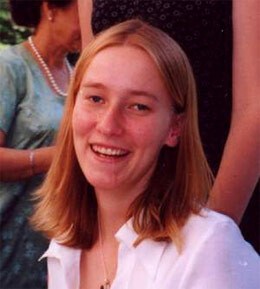
Rachel Corrie
Corrie, a member of the International Solidarity Movement, a pro-Palestinian group, had gone to Rafah in Gaza to help defend the houses of Palestinian refugees that were being demolished by the Israeli army. As a student at Evergreen State College in Olympia, Washington, Corrie had participated in anti-war and environmental movements on campus. She was young and idealistic. She thought she could make a difference.
Four members of the International Solidarity Movement, from England and the United States, who were with Corrie at the time of her death, said she stood in front of the Caterpillar bulldozer, waving to the driver to try to get him to stop. They testified that the driver and soldiers in a nearby Israeli tank knew of her presence. Corrie was crushed when the bulldozer went over her body twice. She died at a hospital of her injuries.
While in Rafah, Corrie wrote frequent e-mails to her family describing the living conditions in Palestine. After her death, British actor Alan Rickman and writer Katherine Viner used her letters and journals to create the play “My Name Is Rachel Corrie.” It premiered in London and had a sold-out run for more than a year. Then, it was scheduled to open at the New York Theater Workshop. Six weeks before the opening, however, it was postponed indefinitely.
This sudden postponement of the play ignited a rallying cry against artistic censorship. On March 22, 2006, a letter signed by many Jewish writers including Nobel-prize winner Harold Pinter was published in The New York Times expressing their dismay at the cancellation. They asked “So what is it about Rachel Corrie’s writings, her thoughts, her feelings, her confusions, her idealism, her courage, her search for meaning in life — what is it that New York audiences must be protected from?”
In the end, the theater made meek attempts to defend its decision. It cited Israel Prime Minister Ariel Sharon’s coma, the controversial circumstances of Corrie’s death and the recent election of militant Hamas party representatives to the Palestinian Legislative Council. Months later, the play finally found a stage at the Minetta Lane Theater in New York and Corrie’s voice could once again be heard.
In an e-mail to her mother dated Feb. 27, 2003, Corrie wrote about the daily struggles of Palestinians who lost their lands, and of the Israeli-built wall which forced them to drive for 12 hours to get from one city to another when that same trip used to take only 40 minutes.
Corrie’s is one of few voices to get the Palestinian point of view expressed in the U.S. In a 2004 documentary, “Thomas L. Friedman Reporting,” the New York Times columnist explored the effect of Israel’s wall. He left one to question whether the wall has provided safety for Israel or has it served as a symbol of Israel’s ability to take action with impunity, which serves to escalate hatred and hinder the peace process.
More recently, former President Jimmy Carter has been attacked over the publication of his book Palestine: Peace Not Apartheid. It is hard to believe that someone who has worked so hard to bring peace to the Middle East would find himself being called an anti-Semite.
In his book, Carter writes that the U.S. stands almost alone in its unwavering backing of Israel. He condemns terrorist acts on the part of Palestinians against Israelis. Equally he condemns the excessive civilian casualties and destruction inflicted on the Palestinian homeland by Israelis. But Carter’s message is being lost, buried under a torrent of ridicule and controversy.
Regardless of past rights and wrongs, what is happening to the Palestinians and the millions of refugees who now live in Jordan and other areas, should be of interest to all of us. It is a humanitarian crisis of catastrophic proportions.
Today, as I honor the memory of Rachel Corrie, I will continue to wonder if the peaceful solution to the Israeli-Palestinian conflict will happen during my lifetime … perhaps, if both sides of the conflict are given equal voice.
Bessy Reyna is a free-lance writer whose column appears monthly in the Hartford Courant, where this article was originally published on 16 March 2007. She can be reached at bessy_reyna@hotmail.com.
Related Links
