Badil 10 March 2007
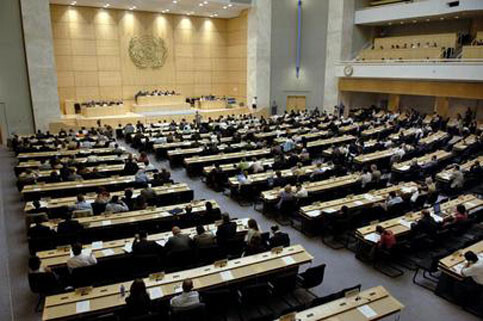
A wide view of the Human Rights Council in Geneva, Switzerland. (Photo: UN/Jean-Marc Ferre)
Israel’s ongoing policies against the Palestinian people of land expropriation, house demolition, population transfer, colonial settlement expansion, denial of freedom of movement, and expropriation of water and other resources, present the Human Rights Council with one of the longest-standing, yet urgent cases of denial of internationally-recognized human rights. Indeed, Israel’s practices that victimize the indigenous Palestinian people, constitute a violation of every one of the most fundamental human rights embodied in the Universal Bill of Human Rights: the rights to life, to freedom of movement, to civil, political, religious and cultural rights, to the due process rights of the ICCPR, and to virtually all of the economic, social and cultural rights of the ICESCR.
The most recent authoritative documentation on these Israeli practices available to the Council includes Special Rapporteur John Dugard’s report on the Occupied Territories, (Report of the Special Rapporteur on the situation of human rights in the Palestinian territories occupied since 1967, 29 January 2007) which labels Israel’s actions ‘apartheid.’
SR Dugard’s thorough report draws sufficient parallels between the South African apartheid regime and Israel’s as to make the term appropriate for use against Israel today. Israel’s historical policy of institutional discrimination is at the root of its regime of occupation, colonization and apartheid. Israel’s discriminatory and racist policies, favoring “Jewish nationals”, including settlers, over Palestinian citizens of Israel, protected civilians in the occupied territories, and refugees has created a two-tier system whereby the special and distinct status of “Jewish nationals” prevents the fundamental right to equality of Palestinians.
Under Israeli law and policy, only “Jewish nationals” exclusively enjoy a range of economic, social and cultural rights, including the “Law of Return” that allows free immigration for Jews, but denies the same to the Palestinian indigenous population tracing its ties to the land for thousands of years. “Jewish nationals” are also privileged to acquire, control and exclusively use the properties and national assets that belong to Palestinians, including the 6.8 million refugees and others displaced since 1948. This discriminatory regime thus prevents the return of Palestinian refugees and internally displaced persons to their homes of origin, and leads to ongoing population transfer in both Israel and the occupied Palestinian territories. Amongst others whose very existence is threatened are the Bedouin communities in the Nakab (Negev) and the occupied West Bank.
Enforcing international law: the need for further action
States have a duty to protect the right to self-determination of the Palestinian people, denounce discrimination, racism, and colonization, and find a durable solution to Palestinian refugees and internally displaced persons based on their right to return and restitution. Moreover, the United Nations and member states must act urgently to prevent further population transfer within Israel and the occupied Palestinian territories.
Unless a rights-based approach to the conflict that addresses Israel’s discriminatory practices becomes the basis of international community actions, the conflict will continue to deepen, affecting the peace and security of all nations. The urgent need for action by the Human Rights Council, and through it, the United Nations bodies, cannot be overemphasized. It is with this hope that Badil request the Council to consider the legality and implications of Israel’s historical policies of institutional discrimination being applied in both Israel and the occupied Palestinian territories.
This action is particularly urgent considering that the number of Palestinians killed in 2006 represents a 215 percent increase compared to the 2005 figure. According to UN OCHA and Defense for Children International (DCI), 678 Palestinians were killed, including 124 children, in the occupied Palestinian territories as a result of the ongoing conflict. Since the beginning of the intifada in September 2000, over 4,300 Palestinians have been killed and 31,000 injured. These casualties continue to mount while successive UN Resolutions designed to bring the illegal occupation to an end remain ignored by Israel.
Badil calls upon members of the Human Rights Council to initiate a request for the International Court of Justice to issue an advisory opinion on The Legality of the Israeli Occupation in the Occupied Palestinian Territories; call all upon states to bring claims against Israel in the International Court of Justice under the principle of state responsibility, to ensure that Israel complies with its obligations under international human rights and humanitarian law; preserve the mandate of the Special Rapporteur on the Situation of Human Rights in the Palestinian territories Occupied since 1967; appoint a Special Rapporteur or expert to examine discriminatory practices affecting Palestinians and other minorities in Israel; consider urging states members of the UN to take measures such as economic sanctions and diplomatic boycott against Israel for its breach of international law and non-implementation of UN Resolutions, as outlined by the International Court of Justice in its 9 July 2004 Advisory Opinion on The Legal Consequences of the Construction of a Wall in the Occupied Palestinian Territory and endorse a call to the United Nations political bodies to act to provide international protection for the Palestinian civilian population through United Nations forces on the ground.
This is a statement submitted by Badil Resource Center for Palestinian Residency and Refugee Rights, an NGO with special ECOSOC status to the fourth session of the Human Rights Council which starts this week in Geneva.
Related Links