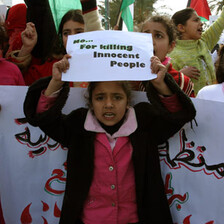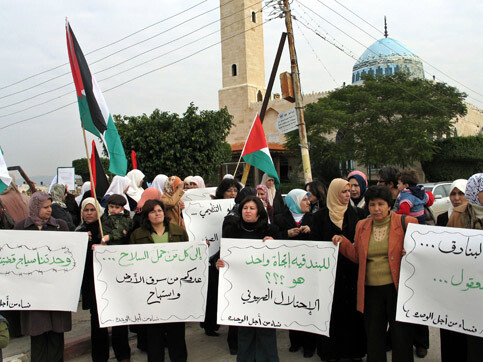
Palestinians demonstrate during a joint rally for Fatah and Hamas to deliver a message of unity between both factions in the West Bank city of Jenin, 9 January 2007. (MaanImages/Raed Abu Baker)
We left Dublin airport last Friday evening. This time it was harder to leave. Perhaps because each time I travel to the Occupied Palestinian Territory the situation has deteriorated in some unexpected way and I become more depressed about the lives of friends and colleagues.
Perhaps it was just because there was a taste of something lingering that I didn’t want to leave behind. Anyway, some suprise, then, when I arrived in Gaza. It took us (myself and Aine Bhreathnach, Middle East Emergency Programme Officer) two days to reach Gaza.
On Saturday the Israeli military hadn’t ‘processed’ our applications, so we weren’t allowed in. Luckily for us they spent 11 hours processing it on Sunday. Unfortunately for us, we had to spend seven of those hours physically sitting at the Erez checkpoint in to Gaza.
We reached Gaza tired and already depressed — the long walk through the cages at Erez is a deeply humiliating experience. Humiliating not because we have to go through it but because we see people on wheelchairs being pushed through, we see children cowering through, we see women and men covered in bandages hobbling through. The humiliation is because I can’t bear to see one set of people being treated like this by another.
Anyway, all that was a long way of saying that we reached Gaza, tired and depressed. We were immediately kidnapped, in the best sense, by staff from Trocaire’s partner the Palestinian Centre for Human Rights.
And here comes the surprise. It’s a good one.
For the past few months the biggest issue for people in Gaza has become the security situation caused by the the clashes between Hamas and some ‘leading lights’ in the decrepit Fateh party. People felt unsafe to leave their home. One friend lives near a hot spot — her house has bullet holes through it. Her children are so afraid that even when no fighting is happening they are crawling from room to room. In the centre of Gaza City, in the square of the Unknown Soldier a movement has sprung up. Partially out of desperation, partially out of a desire to end the violent internal clashes and provide some protection for Palestinian civilians.
Ten people, six women and four men have decided to go on hunger strike. They are artists, doctors, human rights lawyers, poets and independent political activists. For the past eight days they have refused food and vowed to continue doing so until such time as a national unity government is formed and the internal clashes come to an end.
Civil society, the business community and people from all walks of life have gathered around to support them. They have been given tents, blankets, chairs, heaters (for Gaza at night is bitterly cold). Petitions are being circulated, the ‘Oud is being played, national poems are being sung and recited through the night. Thousands of ordinary people have passed through in support.
Their slogan is simple: ‘NO - to internal fighting.’ We spend some time talking to Doctor Miriam who began organising the strike. She tells us, “This is the first step for fighting the occupation. We must be united as a people in order to achieve our rights and our dreams. Internal fighting can not bring us there. We have not hung any flags other then Palestinian flags here. We do not welcome guns into this area. We want real national unity to struggle for the human rights ofthe Palestinian people.”
We move from the tent she shares with three other hunger strikers into the main tent. Over a hundred chairs are gathered around in a circle. A man is sitting, surrounded by his children, he is an ordinary man. He holds a microphone in his hands and talks about his desire that the clashes will end so his kids will be safer going to school. Over the course of hours the microphone passes through many hands — anyone can speak and express their feelings, for as long as they need to. It is a truly open affair.
The microphone passes to one Palestinian woman. She is resplendent in her handwoven black, red and yellow dress. An elderly lady, with a lived-in face. Her name is Um Jaber Wishah. She begins to tell her own story. The story explains the lines on her face, and at times her eyes well with tears as she describes her journey in 1948 when she and her family were expelled from their village inside what is now the state of Israel. She talks about the pain of mothers who see their sons taken to prison, or killed. She reminds us that “the prisoners are calling for calm on the streets of Gaza and we must honour their desires. We must behave as Palestinians, with dignity and respect towards each other. Not to divide ourselves into Hamas or Fateh.”
Her words are powerful and they move the crowd to applause and cheers. The evening in the tent reminds me of the words of Martin Luther King who, the night before he died, said, “You know, whenever Pharaoh wanted to prolong the period of slavery in Egypt, he had a favorite, favorite formula for doing it. What was that? He kept the slaves fighting among themselves. But whenever the slaves get together, something happens in Pharaoh’s court, and he cannot hold the slaves in slavery. When the slaves get together,that’s the beginning of getting out of slavery. Now let us maintain unity.”
The work of these hunger strikers and their friends and fellow strugglers in human rights organisations such as those supported by Trocaire is for unity. They are doing it by creating real people power, by encouraging people to take back the streets and take back the responsibility for democracy and accountability themselves. This, indeed, is what democracy looks like.
I can only hope that they succeed.
Eoin Murray is a Programme Officer for Trocaire.
Related Links