The Electronic Intifada 15 January 2007
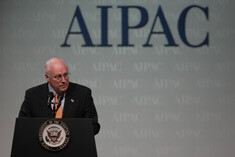
Not a bipartisan issue: US Vice President Dick Cheney at the AIPAC Policy Conference 2006: “The President and I are grateful for your counsel and your commitment to the security of our country and for all you do on behalf of America’s friendship with Israel.” (AIPAC)
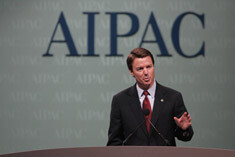
Meanwhile, echoing the neoconservatives, democratic former Vice Presidential Candidate and Senator John Edwards called Iran’s nuclear ambitions the single greatest security threat, not only to Israel, but to the United States. (AIPAC)
There is a misperception in various world locales of Washington’s debate on the Israeli-Palestinian conflict. Namely, that substantive debate exists at all. In fact, the debate in the power corridors of Washington is highly constrained, almost non-existent. Should we engage with President Mahmoud Abbas now or require him to leap through several more hoops — including civil war — first? Serious argument on the injustice of Israel’s long-running occupation simply does not take place other than at the margins.
The reason for the silence has become increasingly clear with the publication of President Carter’s courageous book, Palestine Peace Not Apartheid. CNN’s Glenn Beck labeled the former president a “fathead”. The Anti-Defamation League’s Abraham Foxman went so far as to call Carter “bigoted” while Martin Peretz of The New Republic maintains that history will recall Carter “as a Jew hater”. This is extraordinarily vicious language to direct at a former president who brokered Israeli-Egyptian peace.
In this climate, few Americans are prepared to say what they think. Why be denounced (falsely) as an anti-Semite when you can keep your mouth shut or work on other concerns? Religious communities in the United States are frequently unprepared to handle this divisive matter and instead resort to tiptoeing around the issue. Critical interfaith work is thought to be at risk if Israel’s occupation of the Palestinian territories were to become a matter of serious dispute.
Tremendous grassroots work — as done here by the African National Congress regarding apartheid South Africa — is the greatest necessity in expanding the debate parameters. Any substantive change in approach to the conflict will certainly not be initiated by Congress.
The shortcomings of the Democratic Party on Middle East issues will soon be exposed as the party retakes leadership of the House and Senate. Debate will permit Democrats to challenge President Bush on his disastrous foray into Iraq. Yet in doing so, many Democrats will feel compelled to cover their national security flanks by directing inflammatory rhetoric at Iran. As for Israel-Palestine, Democrats will likely urge more talks to distinguish themselves from Bush. Yet this will be more about “peace process” process than substance. Democrats are no more apt than Republicans to denounce the Maskiot settlement or apartheid practices in the West Bank.
Indeed, with Rep. Tom Lantos assuming chairmanship of the House Foreign Affairs Committee there is no reason to expect better of House Democrats. Lantos has long been an apologist for oppressive Israeli actions directed at Palestinians. Last month, I saw him at the Ritz-Carlton in Washington, DC just moments before Israeli Minister of Strategic Issues Avigdor Lieberman was to address the Saban Forum audience. I quietly urged Lantos to challenge Lieberman on his racism. He walked away from me without saying a word. His silence spoke volumes.
There are, however, signs of an improving atmosphere in which the most optimistic can place some small hope. Muslim- and Arab-American organizations are slowly gaining a much-needed foothold in Washington in spite of lingering bigotry directed at them. Furthermore, Carter’s book and the Mearsheimer-Walt piece on the “Israel lobby” have sent a jolt through American understanding of the conflict. A growing number of Christians and Jews are with painstaking slowness finding their voices.
Nonetheless, AIPAC appears virtually unshaken even while forced to manage a potentially explosive scandal related to classified documents and recently fired employees. Politicians do not seem to be distancing themselves, certainly not on policy grounds. Too many are either intimidated or perfectly content to follow AIPAC’s legislative lead despite the obvious downward spiral in both the region and American regional standing.
Nancy Pelosi, the new speaker of the House, spoke to AIPAC in 2005. Her statement then makes clear just how little will change in Washington with Democrats retaking the House and Senate. “There are those who contend that the Israeli-Palestinian conflict is all about Israel’s occupation of the West Bank and Gaza. This is absolute nonsense. In truth, the history of the conflict is not over occupation, and never has been: it is over the fundamental right of Israel to exist.” Her emphasis is squarely on Israel’s existential concerns; the blinders remain regarding Palestinian suffering under the occupation.
Two years remain to President Bush in office. With the Iraq Study Group and Democrats ascendant, he may feel obliged to push for Israeli-Palestinian talks. They will be strictly limited. Abbas will be told that if he wants to remain relevant he must play ball. Enormous political and economic pressure will be brought to bear on Abbas and the Palestinians to accept a truncated Palestinian state as Bush seeks one Middle East legacy free of the violence in Iraq he will bequeath his successor.
One thing is for certain: The limited parameters of debate in Washington will feed directly into the highly restrictive boundaries pushed by the Bush administration for the envisioned Palestinian Bantustan.
Michael F. Brown is a fellow at the Palestine Center in Washington, DC. His views are his own and do not necessarily reflect those of the Center. Previously, he was executive director of Partners for Peace and Washington correspondent for Middle East International. He is on the board of Interfaith Peace-Builders. This article was originally published by Bitter Lemons International on 11 January 2007 and is republished with the author’s permission.
Related Links