The Electronic Intifada 18 December 2006
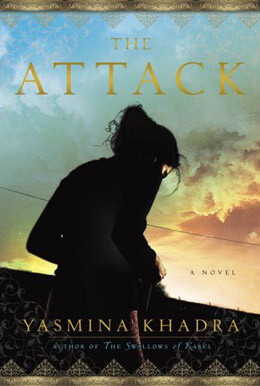
Reading The Attack, I wondered the same thing. While there is little description of surroundings, and Khadra is a very capable writer, I doubted he had ever been there. This doesn’t weaken the book so much as emphasise that his narration is an outsider’s voice. This is apt given that his main protagonist, through whom the story is told in first person, behaves very much like a neutral observer in the raging Israeli-Palestinian conflict - that is, until a horrifying event forces painful re-examination.
Dr Amin Jaafari is a Palestinian with Israeli citizenship. He is an incredibly successful surgeon, awarded numerous honours and living a seemingly idyllic life with his beloved wife, Sihem. They have a beautiful house, but no children. They have strong friendships with Israelis, absorbing a lifestyle that rejects a traditional approach; they’re not practising Muslims. Amin and Sihem are ostensibly the best examples of integration, and despite some tension in the hospital, Amin is blissfully unaware of differences. If we are to believe him, his wife is generally satisfied too.
For Amin, the conflict is senseless and when long ago forced to pick a side, he chose the side of his “ability”, making his convictions his “allies”. Such decisions show Amin’s character: thirsty for success, respect and to live free of conflict, nothing would stand in his way, especially not bloodshed. “I don’t think I ever, not ever once, broke the rules I set for myself”, he tells us.
He sees himself as a healer; his role in the conflict is to fix what each side continues to break. As a surgeon, he can be neutral; he is a saviour rather than a killer: “… the only battle I believe in, the only one that really deserves bleeding for, is the battle the surgeon fights, which consists in recreating life in the place where death has chosen to conduct its manoeuvres”. He refuses to “support” war and reprisal. He has the ability, he thinks, to choose, naively believing he has chosen neither side.
And then the unimaginable happens. A suicide attack occurs and his wife’s body is among the dead. Amin soon finds out that Sihem is identified as the suicide bomber.
Many Palestinians would consider Amin a traitor, and now his Jewish neighbours feel the same about him. He has lost his world, his societal status, but worst of all, his wife - and to a conflict he doesn’t want to acknowledge. Amin doesn’t recognise his existence: Sihem’s act was, for him, personal. He determines to understand how his kind, loving wife could possibly carry out such an attack by setting out to investigate the secret life she lived outside of their marriage.
The reality for Amin, who has lived in a bubble, is more excruciating given his lack of understanding of what is happening around him, his culture and the family he has left behind. He cannot understand that his wife could not live a happy existence while her own people were suffering.
Amin is naive; he saves lives, but he isn’t selfless, and he views the conflict in simple terms, even though Khadra attempts to do the opposite. It’s a philosophical novel, and what courses through this story most effectively are the futility of war and the impact of stealing life. By the end of The Attack you see that Khadra is attempting to illuminate both sides.
Amin’s journey takes the reader through an emotional wasteland, a war-ravaged existence that yearns for recognition and solution. And Amin’s complex discoveries force the reader to consider the lost narrative of the Palestinian who has lost his land, his livelihood, and his family.
“We’re not Islamists, Dr. Jaafari,” one man tells him. “And we’re not fundamentalists, either. We are only the children of a ravaged, despised people, fighting with whatever means we can to recover our homeland and our dignity.”
Khadra offers very descriptive narrative — the effects of suicide bombing and Israeli revenge attacks, and Amin’s confusion and inner turmoil about Sihem’s end are all told in, at times, distressing detail. The book is translated from the original French, and retains a lyrical quality, but the prose is, at times, rather purple - Khadra’s storytelling, while poetic, sometimes verges on the melodramatic, perhaps something getting lost in translation. But the language is evocative and emotional and certainly colours the horror of the conflict. More importantly, the tone enhances Amin’s anguish and the emptiness of those who are victims of the war.
The Israeli-Palestinian conflict has continued for years, barely pausing for moments of clarity, and refusing to bend to hope for a solution. It’s strange then that there isn’t more artistic interpretation on the tragic situation. Khadra’s exploration is a thoughtful, poignant analysis. It is as heartbreaking and wretched as the conflict itself. The ending will leave you questioning how the oppressed manage to even hold on to their dreams.
Amal Awad is an editor based in Sydney, Australia and an editorial assistant for The Electronic Intifada.
Related Links