Institute for Middle East Understanding 29 November 2006
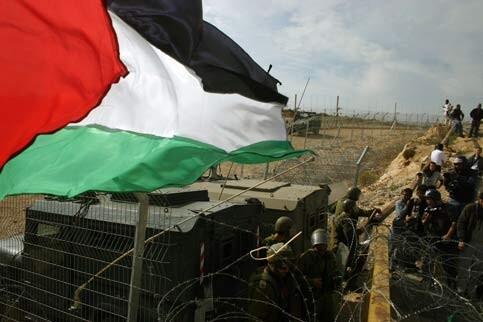
A Palestinian flag waving over Israeli soldiers during a demonstration against the controversial separation wall in the West Bank village of Bil’in west of Ramallah, November 24, 2006. (MaanImages/Fadi Arouri)
Former President Jimmy Carter’s new book, “Palestine: Peace Not Apartheid,” is igniting controversy for its allegation that Israel practices a form of apartheid.
As a South African and former anti-apartheid advocate who visits the Palestinian territories regularly to assess the human rights situation for the U.N. Human Rights Council, the comparison to South African apartheid is of special interest to me.
On the face of it, the two regimes are very different. Apartheid was a system of institutionalized racial discrimination that the white minority in South Africa employed to maintain power over the black majority. It was characterized by the denial of political rights to blacks, the fragmentation of the country into white areas and black areas (called Bantustans) and by the imposition on blacks of restrictive measures designed to achieve white superiority, racial separation and white security.
The “pass system,” which sought to prevent the free movement of blacks and to restrict their entry to the cities, was rigorously enforced. Blacks were forcibly “relocated,” and they were denied access to most public amenities and to many forms of employment. The system was enforced by a brutal security apparatus in which torture played a significant role.
The Palestinian territories - East Jerusalem, the West Bank and Gaza - have been under Israeli military occupation since 1967. Although military occupation is tolerated and regulated by international law, it is considered an undesirable regime that should be ended as soon as possible. The United Nations for nearly 40 years has condemned Israel’s military occupation, together with colonialism and apartheid, as contrary to the international public order.
In principle, the purpose of military occupation is different from that of apartheid. It is not designed as a long-term oppressive regime but as an interim measure that maintains law and order in a territory following an armed conflict and pending a peace settlement. But this is not the nature of the Israeli occupation of Palestine. Since 1967 Israel has imposed its control over the Palestinian territories in the manner of a colonizing power, under the guise of occupation. It has permanently seized the territories’ most desirable parts - the holy sites in East Jerusalem, Hebron and Bethlehem and the fertile agricultural lands along the western border and in the Jordan Valley - and settled its own Jewish “colonists” throughout the land.
Israel’s occupation of the Palestinian territories has many features of colonization. At the same time it has many of the worst characteristics of apartheid. The West Bank has been fragmented into three areas - north (Jenin and Nablus), center (Ramallah) and south (Hebron) - which increasingly resemble the Bantustans of South Africa.
Restrictions on freedom of movement imposed by a rigid permit system enforced by some 520 checkpoints and roadblocks resemble, but in severity go well beyond, apartheid’s “pass system.” And the security apparatus is reminiscent of that of apartheid, with more than 10,000 Palestinians in Israeli prisons and frequent allegations of torture and cruel treatment.
Many aspects of Israel’s occupation surpass those of the apartheid regime. Israel’s large-scale destruction of Palestinian homes, leveling of agricultural lands, military incursions and targeted assassinations of Palestinians far exceed any similar practices in apartheid South Africa. No wall was ever built to separate blacks and whites.
Following the worldwide anti-apartheid movement, one might expect a similarly concerted international effort united in opposition to Israel’s abhorrent treatment of the Palestinians. Instead one finds an international community divided between the West and the rest of the world. The Security Council is prevented from taking action because of the U.S. veto and European Union abstinence. And the United States and the European Union, acting in collusion with the United Nations and the Russian Federation, have in effect imposed economic sanctions on the Palestinian people for having, by democratic means, elected a government deemed unacceptable to Israel and the West. Forgotten is the commitment to putting an end to occupation, colonization and apartheid.
In these circumstances, the United States should not be surprised if the rest of the world begins to lose faith in its commitment to human rights. Some Americans - rightly - complain that other countries are unconcerned about Sudan’s violence-torn Darfur region and similar situations in the world. But while the United States itself maintains a double standard with respect to Palestine it cannot expect cooperation from others in the struggle for human rights.
John Dugard is a South African law professor teaching in the Netherlands. He is currently Special Rapporteur (reporter) on Palestine to the United Nations Human Rights Council. This article comes courtesy of the Institute for Middle East Understanding and was published first in the Atlanta Journal-Constitution.