home electronic lebanon
about eifaqby topicget e-mail updatessyndicate eisubmit contentdonatecontact
An EI Project
for
EI Advanced Search
ELECTRONIC LEBANON

Human Rights/Development

A lasting legacy: The deadly impact of cluster bombs in Southern Lebanon
Report, OCHA, 19 September 2006

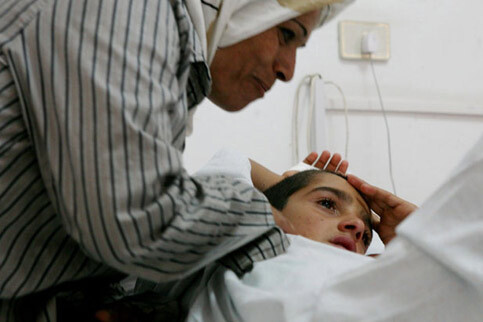
Hassan, 10, and a friend accidentally detonated a bomblet on their first day back in Aita Ech Chaab in the south (UNHCR/A. Branthwaite)

The sheer amount of unexploded ordnance that remains in south Lebanon, one of the poorest areas of the country, has implications for the future social and economic livelihood of the region. The quick destruction of remaining unexploded ordnance, particularly cluster bomb sub-munitions, is critical to restoring normalcy to the region and, ultimately, to a secure and lasting peace. It is vital that a social safety net be quickly established and that agricultural livelihoods are restored to prevent people from south Lebanon slipping deeper into poverty.

The Scale of the Problem

  • During the conflict, Israeli Defense Forces (IDF) delivered up to 3,000 bombs, rockets and artillery rounds daily, climbing to 6,000 daily towards the war's end.
  • Hizbollah launched around 100 daily, climbing to 240 daily before the war's end.
  • Around 90 per cent of all cluster bombs and their sub-munitions were fired by the IDF into south Lebanon during the last 72 hours of the conflict.
  • UNMACC has identified 516 cluster bomb strike locations.
  • The failure rate of these cluster bomb sub-munitions is estimated by UNMACC to be between 30 and 40 per cent.
  • Based on reports by IDF soldiers, as many as 350,000 unexploded cluster sub-munitions are scattered throughout south Lebanon. This excludes the cluster bomb firings by conventional artillery or dropped by Israeli aircraft.
  • A single artillery shell disperses sub-munitions over an area as large as two football pitches. Air delivered cluster shells saturate an area twice that size.
  • It could take up to 30 months to destroy the majority of unexploded cluster sub-munitions.
  • Israel's passing over the coordinates of the cluster bomb strikes, as requested by the UN, would greatly accelerate the clearance effort.

    The Victims

  • The density of cluster munitions in south Lebanon is higher than that witnessed in Kosovo and Iraq, with a greater concentration in built-up areas, according to UNMACC.
  • Unexploded cluster munitions have killed or wounded, on average, three people daily since 14 August.
  • At least 15 people have died and 83 others wounded since 14 August.
  • Most of these casualties have occurred as people checked their homes or fields.
  • Five civilians have been killed while herding or working their land and a further 16 have been injured.
  • One child has been killed and 23 others injured.

    The impact of cluster munitions on agricultural livelihoods

  • The south is among the poorest regions in Lebanon and has also been the hardest hit by the conflict.
  • Agriculture is the main source of income in south Lebanon - depended on entirely by half the working population and providing 70 per cent of household incomes.
  • The direct damage to agriculture caused by the conflict is more than $70m, excluding the cost of indirect economic losses, which the Ministry of Agriculture says are considerably higher.
  • Farmers have not been able to irrigate or harvest their current crops and are unable to plant the winter crop. Next year's agriculture cycle will also be affected.
  • Farmers have been burning off their fields after demarking the bomblets in an attempt to destroy them.
  • At least 6 per cent (94km2) of land used to cultivate citrus fruits and bananas - the highest-value crops - and 10 per cent (74km2) of land for field crops are contaminated. UNMACC expects the percentage of agricultural land contaminated to rise as new cluster bomb strike locations are identified.
  • Unexploded ordnance - the fear it may be there -- keeps farmers out of their fields and unable to prune their trees in preparation for next year's harvest.
  • More than 7 per cent (35km2) grasslands, used for animal grazing, is contaminated.
  • The banks and streambeds of 173 streams and rivers in south Lebanon are contaminated putting shepherds and farmers at risk.

    The Response to Cluster Bombs

  • By 27 September, UNMACC teams will be clearing munitions from farmers' fields.
  • The Lebanese army, UNIFIL, NGOs and UNMACC are disposing explosive ordnance and their capacity is increasing all the time.
  • Donors have supported the establishment of clearance capacity, and early indications are that sufficient funding should be available to sustain operations until December 2007.


    Related Links


    Latest articles on Electronic Lebanon:

    Lebanon : Human Rights/Development: Migrant workers' children face discrimination (15 October 2008)
    Lebanon : Human Rights/Development: Despair, trauma, discontent among Nahr al-Bared's impoverished Palestinians (30 September 2008)
    Lebanon : Human Rights/Development: "Incoherent" agreement spells the way forward (24 September 2008)
    Lebanon : Opinion/Editorial: Meet the Lebanese Press: Syria and the Salafis (2 September 2008)
    Lebanon : Human Rights/Development: Displaced Allawis find little relief in impoverished north (6 August 2008)
    Lebanon : Human Rights/Development: Months after Qatar talks, fighting continues in northern Lebanon (30 July 2008)
    Lebanon : Human Rights/Development: Women, non-Lebanese children get raw deal (24 July 2008)
    Lebanon : Opinion/Editorial: Meet the Lebanese Press: Free at last! (16 July 2008)
    Lebanon : Opinion/Editorial: The Israel-Hizballah prisoner deal (16 July 2008)
    Lebanon : Human Rights/Development: UNRWA's Nahr al-Bared appeal leaves out Palestinian participation (25 June 2008)

  • E-mail this Page
    Print this Page


    RSS Help | EI RSS Feeds


    EDITOR'S PICKS
    ELECTRONIC LEBANON
    ELECTRONIC INTIFADA
    Buy EI Merchandise

    RECENT EDITORIALS FROM ELECTRONIC IRAQ

    This webpage uses Javascript to display some content.

    Please enable Javascript in your browser and reload this page.


    HOME | ELECTRONIC LEBANON HOME | ABOUT EI | FAQ | BY TOPIC | SYNDICATE EI | SUBMIT CONTENT | DONATE | CONTACT

      The Electronic Intifada needs your ongoing help to offer information about the Israeli-Palestinian Conflict.

    ©2000-2007 electronicIntifada.net | a nigelparry.net website