The Electronic Intifada 24 May 2002

A rubber bullet shows as a round spot on the X-ray of 14-year-old Wael Imad. The Palestinian boy died of his injuries on 22 October 2000. (TIME)
The phrase “rubber bullets” is often used to describe what are more accurately termed “rubber-coated metal bullets”, heavy steel projectiles with a minimal coating of 1mm or 2mm of rubber, that are regularly used to lethal effect alongside — not instead of — live ammunition.
Rubber-coated metal bullets are fired from metal tubes placed on the end of high-velocity rifles such as the M-16s commonly used by Israeli troops. Tubes contain around 8 rubber-coated, cylindrical, steel projectiles, which are powered by blank rounds fired from the gun’s magazine.
Plastic-coated metal bullets (circular, with a 1mm or 2mm hard plastic coating) are fired in the same way, from “cannisters” with a wider diameter, holding around 15.
Range and velocity of both types are unknown. When fired, seen from the side at about 20 meters distance, the swarm of bullets are large enough to be perceived but move far too fast to avoid.
Both rubber and plastic-coated metal bullets are capable of entering the skull cavity and also breaking bones.
Israeli professor Michael Krausz and colleagues at the Rambam Medical Center in Haifa analysed the medical records of 595 casualties admitted to hospital during the October 2000 protests by Palestinians living inside Israel (typically described as “Israeli Arabs” by the media).
Of those, 152 were found to have been injured by rubber-coated metal bullets. Injuries were distributed randomly across their bodies but were most common on the patients’ arms and legs, and on their head, neck and face.
The doctors said their findings dismissed the theory that “rubber bullets” were safe.
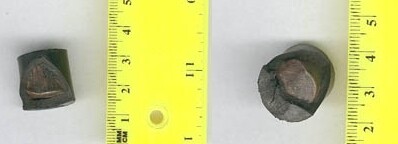
Rubber-coated metal bullets with some of their rubber coating removed, revealing their hard steel core. Fired at speeds of what must be several hundred feet a second, these are munitions that cause enough damage that their manufacturers feel compelled to describe them as only “less lethal”.
Writing in the medical journal, The Lancet, they said firing the bullets at civilians made it “impossible to avoid severe injuries to vulnerable body regions such as the head, neck and upper torso, leading to substantial mortality, morbidity and disability.”
They added: “We reported a substantial number of severe injuries and fatalities inflicted by use of rubber bullets when vulnerable upper-body regions such as the head, neck and upper torso were struck.
“This type of ammunition should therefore not be considered a safe method of crowd control.”
The study, ‘Blunt and penetrating injuries caused by rubber bullets during the Israeli-Arab conflict in October, 2000: a retrospective study’ (The Lancet, Volume 359, Issue 9320, Page 1795), also highlighted previous research which suggested that even plastic bullets may not be safe and may cause more severe head injuries.
Related Links:
Page last updated: 12 November 2002