Electronic Lebanon 20 July 2006

Smoke rises above a Lebanese port after an Israeli attack 17 July 2006. (Peter Speetjens/IRIN)
Eleven days ago, I walked through the familiar stone archway, descended steps worn smooth by the feet of others, and re-entered the paradise that is the American University of Beirut. It was my first trip back in 25 years. Here my father and four uncles were all endowed with the movable asset of education — enabling them to later flourish in the United States, even after their homeland, Palestine, was given to another people. As a junior in college in the early ’70s, I returned to this seat of enlightenment that had given so much to my family.
Now, strolling along shaded pathways with my kids, overlooking the intense blue of the Mediterranean Sea while breathing the pine and jasmine-scented air, I recalled my year there before Lebanon’s ruinous civil war. I pointed out the banyan tree under which I sat gathering signatures for a petition on some passionately contested issue of university governance. I showed them the classrooms where we debated social theory, the wall I vaulted to get back to my dormitory after university gates were closed for the night. I chuckled while my 17-year-old nephew gaped at gorgeous, stylishly dressed Lebanese female students. My daughter seemed equally impressed by Lebanese male students.
Beirut of 11 days ago was a city of growing, yet still guarded, confidence. The traits of the Lebanese people — hospitality, entrepreneurial ambition and conviviality — were as much in evidence as when I first arrived more than 30 years ago. The most acute physical and psycho-social wounds of the 15-year civil war no longer festered, although some of the factors that had led to it — socio-economic disparities, a political system that entrenches sectarian identity and power, a weak central government and subsequent vulnerability to the meddling of external powers — had never been fully resolved. Yet people took obvious pride in the reconstruction of their city and society, and were looking forward to the future.
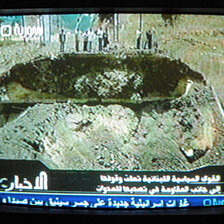
Little did we realize, as we departed for home through the gleaming halls of Beirut’s new airport and boarded what turned out to be one of the last flights out, that within days, as Israeli Chief of Staff Dan Halutz put it, the Israeli military would “turn back the clock in Lebanon by 20 years.” Hundreds of millions of dollars of investment, and untold ingenuity and effort, have been blown to rubble in Israel’s outburst of violence. The airport, highways, bridges, gas stations, power stations, the port, even the modern lighthouse on Beirut’s coastal promenade — all have been devastated in Israel’s lethal tantrum.
No one in Beirut believes that Israel’s primary objective is to free its captured soldiers. Israel still holds Lebanese prisoners it abducted years ago, and could have negotiated an exchange, as it has done in the past. Indeed, Israel initiated hostage-taking in Lebanon, kidnapping noncombatant Hezbollah leaders in 1989 and 1994. As recently as 2004, Israel and Hezbollah reached an agreement, brokered by Germany, for the exchange of prisoners and the remains of fallen soldiers.
No, say my Lebanese friends, who have watched Israeli jets streak over Beirut to deliver their deadly payload, Israeli military pride is at stake. Humiliated when Hezbollah drove it out of Lebanon in 2000 after a brutal occupation of 18 years, and stunned again by the recent Hezbollah and Hamas raids, the Israeli army is exacting revenge. It further hopes that a rain of death and destruction will turn the Lebanese people against Hezbollah, and pressure the Lebanese government to confront the stubborn resistance organization.
Yet Israel will harvest the future of conflict and violence it has sown, facing foes of ever-increasing sophistication and determination. Some Lebanese may resent being dragged into a firestorm by Hezbollah. But they know who their real tormentor is, and who has thwarted their country’s march toward peace and prosperity.
Lebanese and other Arabs also know the American origins of the weaponry Israel uses to kill their children and smash their homes. They will recall President Bush’s statement that Israel “has a right to defend herself,” a green light for the carnage they now face.
I hope it is not another stretch of years of insecurity that again keeps me from Beirut. When I return, I hope I can look my Lebanese friends in the eye, and explain to them why my country stood by while theirs was destroyed.
Related Links
George E. Bisharat, a professor of law at Hastings College of the Law in San Francisco, writes frequently on law and politics in the Middle East. This article was originally published by the San Francisco Chronicle and is reprinted with the author’s permission.