Electronic Lebanon 19 July 2006

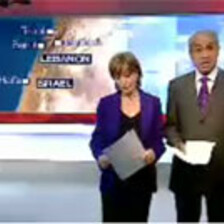
More newsworthy than Israeli fighter jets: An evacuation helicopter lands in Lebanon on the BBC

British students studying in Lebanon are interviewed by the BBC
Israel has opened “windows” for the foreign powers to evacuate their terrified nationals from Lebanon. Obligingly, the foreign media have turned these “windows” into an opportunity to avert their gaze further from the death and destruction in Lebanon, Gaza and the West Bank.
On BBC World, for example, we have been following the progress of one 12-year-old British boy fleeing Beirut. When he observed that he was worried for the Lebanese family members he was leaving behind, reporter Clive Myrie noted his was a “very mature attitude”.
If only the BBC was demonstrating such maturity.
I have to keep reminding myself that this is BBC World, not its domestic news service. You would hardly know it watching the coverage of the past couple of days.
On Tuesday, when at least 35 Lebanese were killed — possibly many more as no one seems to know who is lying under the rubble or has been incinerated in their fleeing cars — we had the BBC’s Ben Brown in Beirut giving a blow-by-blow account of every facet of the evacuation of foreign nationals in general and British nationals in particular.
If anyone doubted the racism of our Western media, here it was proudly on display. The BBC apparently considers their Beirut reporter’s first duty to find out what meals HMS Gloucester’s chef will be preparing for the evacuees. Lebanese and Palestinian civilians die unnoticed by the Western media (though not by the Arab channels) while we learn of onboard sleeping arrangements on the ship bound for Cyprus.
Did we really need to hear a lengthy live speech from the commander of HMS Gloucester telling us how “delighted” he was to be in Beirut? With the long minutes of rolling news to fill this might have been justified had the other minutes been stuffed with reports from the areas where civilians are dying by the dozen each day. But such reports are the mean filling in the thick sandwich of the main story of the evacuees.
In the 4pm GMT broadcast, I watched 45 mins of coverage, most of it dedicated to “live” footage of the British warship’s arrival and the relieved faces of the Brits about to leave.
Even so, the BBC still managed to squeeze in other bits of reporting in the lulls in the drama of evacuation. At different points there was a interview from Tel Aviv with former Israeli cabinet minister Yossi Beilin and a live link-up between Ben Brown and Lyse Doucet in Haifa. She informed us of the “barrage” of 50 Katyushas that had landed on northern Israel that day, killing one man. Supportively, Ben Brown, added that there was “shock” at the death and destruction spread by Hizbullah’s rockets and opined that what the Israeli army was “really after” was Hizbullah’s long-range missiles.
So we had the BBC in Haifa and Beirut speaking with one voice — that of Israel.
Back in Beirut, Brown repeated with bafflement statements by the British ambassador that some British nationals preferred to stay put for the time being and would not be taking advantage of Israel’s “window”. It occurred to neither of them that many of these British nationals have loved ones in Beirut and may not want to leave them in the coming desperate hours.
Ben Brown also told us that it was “understandable” that the British evacuees were “pretty scared” because they were not accustomed to this kind of bombing. Not like, he added, war correspondents such as himself or the people of Beirut, who had grown used to such assaults.
The outrageous racism implicit in this comment was clear the moment one paused to consider its possible meanings. Did Brown mean that the Lebanese do not mind being bombed? Did he mean that Lebanese children understand from birth that it is their fate to be attacked by Israel, that they get used to the explosions around them? Did he mean that their parents are less terrified than a British mother and father by the thought that their family might be obliterated at any moment? Or did he mean that Lebanon’s civilians will not be as traumatised by their experiences as other human beings would be?
This is the racist subtext of the foreign media’s evacuations story. That once the foreigners have been moved to safety, we in the West can leave those who understand only the language violence — the Israeli army and, apparently, the whole population of Lebanon — to carry on with their unfinished business.
And we can be sure that this is exactly what will happen as soon as Israel’s “window” is shut. When the foreign powers no longer have even a small vested interest in the safety of Beirut, can we expect the coverage to improve? Don’t hold your breath.
Related Links
Jonathan Cook, based in Nazareth, is the author of Blood and Religion: The Unmasking of the Jewish and Democratic State, published by Pluto Press and available in the US from University of Michigan Press. His website is www.jkcook.net.