Office of the High Commissioner for Human Rights (OHCHR) 21 June 2006
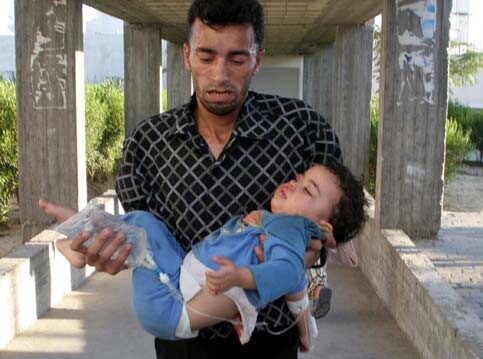
A Palestinian carries a wounded baby after an Israeli missile struck a house in the southern Gaza Strip. (MaanImages/Hatem Omar)
The UN Special Rapporteur on the right of everyone to the enjoyment of the highest attainable standard of physical and mental health, Professor Paul Hunt, reminded the donor community that it has a responsibility to provide humanitarian assistance to the population in the Occupied Palestinian territories (OPT).
While welcoming last weekend’s emergency aid plan, the UN health rights expert emphasised that the acute funding crisis in the OPT, which is jeopardising the delivery of basic health services to the sick and infirm, arises from the deliberate actions of the donors themselves.
“For many years, donors have provided indispensable support to the health sector in the OPT, amounting to almost 50% of the Ministry of Health’s budget,” Professor Hunt explained. “Five months ago, some major donors turned off their life-saving assistance without notice. They gave the Palestinian Authority no prior opportunity to put in place alternative funding mechanisms. In this way, they have seriously affected the ability of the Ministry of Health to deliver critical health care services and maintain public health programmes. Donors’ actions have threatened the most vulnerable - the sick, infirm, elderly, children, and pregnant women. In short, some donors have acted in breach of their responsibility to provide international health assistance in the OPT.”
Paul Hunt
The donors’ responsibility to provide health assistance to the most vulnerable arises from the United Nations Charter, the Universal Declaration of Human Rights, international human rights treaties, such as the International Covenant on Economic, Social and Cultural Rights, and several world conferences.
“Donors have promised to take measures to reduce poverty and alleviate suffering, especially of the most vulnerable”, he explained. “But, in the OPT, their policies are actually causing poverty and suffering.”
Professor Hunt recognised that donors are at liberty to re-direct their funding - but not without first giving the recipient a reasonable opportunity to make alternative arrangements. This is especially crucial when the lives and health of the sick and infirm are immediately at stake, and in relation to the OPT because of the multiple constraints imposed by a prolonged occupation.
Professor Hunt also argued that last weekend’s long-overdue emergency plan should be implemented – and expanded – as a matter of urgency. “At best, it is a temporary, incomplete fix. For example, while it will cover some essential supplies, it will not pay health professionals. How can a health system function without paid health professionals? Where is the logic in making available essential supplies while at the same time strangling the system that delivers them? Although a step in the right direction, the emergency plan does not fulfil the donors’ responsibility to provide health assistance in the OPT.”
Because of the weakness of international mechanisms of accountability, Professor Hunt urged national legislatures and civil society to hold donor Governments to account for their humanitarian actions in the OPT.
Related Links