The Electronic Intifada 27 April 2006
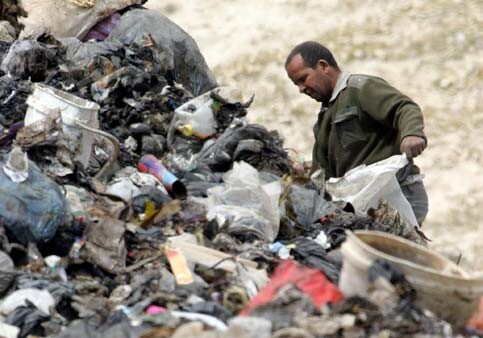
A Palestinian man searches for usable things to sell at garbage dump in the West Bank village of Zatara near Bethlehem March 27, 2006. As the Palestinian economy is deteriorating more people is forced to take desperate measures to survive. (MaanImages/Magnus Johansson)
The sudden ascent of Hamas to power after the January 25 parliamentary elections in the Palestinian Authority (PA) areas has put at risk two vital sources of Palestinian finance: an aid package by Western donors of about $1 billion a year in humanitarian, developmental and budgetary support; and a monthly transfer by Israel of about $55 million in customs and tax revenues that it collects on behalf of the PA.
With the recent announcement by the United States and the European Union that they would halt all direct aid to the PA, and an Israeli decision last February to suspend the transfer of funds, the new Hamas-led Palestinian government is currently facing an unprecedented money crunch with potentially grave consequences.
A quantitative assessment of what could be expected if this were to continue has been recently produced by the World Bank. According to the bank’s analysis, the adverse impact on Palestinian personal income, unemployment and poverty levels over a three-year period, between 2006 and 2008, could be very serious.
Preserving the status quo, where international aid and customs revenues transfers are maintained at their 2005 levels, would not prevent Palestinian economic conditions from deteriorating. By 2008, the World Bank projects GDP per capita income - which has already declined by 30 percent during the past five years - to decrease by 5 percent; unemployment and poverty will increase by 11 and 7 percentage points respectively, reaching 34 percent of the workforce and 51 percent of the population.
This outcome should not come as a surprise. Since September 2000, Western donors have doubled their annual aid to the PA, yet both unemployment and poverty in the West Bank and Gaza are now three times higher than their pre-2000 levels.
What has caused the ineffectiveness of international aid? And why does a PA that receives a hefty $1 billion of aid per year continue to face trouble in paying the salaries of its 140,000 employees?
Under normal conditions, international aid of this magnitude to a relatively small economy with a population of just 4 million should have been enough to transform it over time to a self-sustained economy. But in the past five years, conditions in Palestinian areas have been anything but normal.
After September 2000, as violence, political instability and a tightening of Israeli restrictions dominated the scene, Palestinian economic conditions rapidly worsened. Private investment plunged, jobs in Israel fell to record lows, and poverty and unemployment reached precarious levels. PA revenues dwindled as a result of the continued erosion of the domestic tax base, while pressure to provide basic services continued to rise, setting off recurrent budget deficits. International aid was subsequently deviated from development projects to fill the growing financing gap and to meet the humanitarian needs of an increasingly vulnerable segment of the Palestinian population.
At its core, then, the Palestinian financial predicament is the product of a suffocating economic crisis rooted in a deeply unfavorable political environment. Viewed as such, and in the absence of any real prospects for a political breakthrough, international aid can only help Palestinians to survive, without having a tangible impact on their economy.
Under these circumstances, from an economic standpoint it matters little whether money - international aid or customs and tax revenues - continues to be delivered directly to a Hamas-led government or through some other means. In both cases, and if nothing else changes, the Palestinian economy will continue to operate under stringent conditions and will continue its dangerous downward spiral as predicted by the World Bank.
For international aid to make a lasting difference, donors need to address whether political and territorial realties as they exist today in the PA allow external aid to be used in a way that enables Palestinians to transform their economy from one totally dependent on foreign assistance for survival, as is the case today, to one capable of generating sustained growth rates to provide decent living standards for an expanding population.
If this is not possible, the Palestinian fiscal crisis will worsen, in an endless vicious cycle: political conflict will lead to further instability and more restrictions, leading to further deterioration in the Palestinians’ economic conditions, making it increasingly difficult for the Hamas-led government, or anyone else, to meet the essential needs of the population. This will only increase Palestinian dependence on foreign handouts.
Clearly, this situation cannot go on forever. International aid can help mitigate Palestinian suffering, but it will not end it; nor will it enable Palestinians to build a self-sustaining economy. Only a fair, negotiated political settlement that fundamentally transforms the Palestinian conditions will resolve the economic calamity that has already started.
Dr. Mohammed El-Samhouri is a Palestinian economist and former economic adviser to the minister of planning (1995-2002) and the minister of foreign affairs (2002-2005) at the Palestinian Authority. He can be reached at msamhouri@yahoo.com.
Related Links