The Electronic Intifada 17 March 2006
Made in Palestine is the first museum quality exhibition devoted to the contemporary art of Palestine to be held in the United States. It is a survey of work spanning three generations of Palestinian artists who live in the West Bank, Gaza Strip, parts of Israel, Syria, Jordan, and the United States.
The exhibition was curated by James Harithas during a month long stay in the Middle East, aided in his mission by Palestinian artist Samia Halaby. Made in Palestine premiered at The Station Museum of Contemporary Art in Houston, Texas and in 2005 traveled to San Francisco, CA, and Montpelier, VT.
The exhibition opened in New York on March 14th, and held its gala opening on March 16th.

Before the preparation of the Bridge Gallery in the heart of Chelsea… (Photo: nigelparry.net)
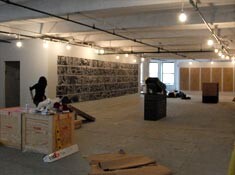
…and after. Volunteers from Al-Jisser did most of the work before the opening. (Photo: nigelparry.net)
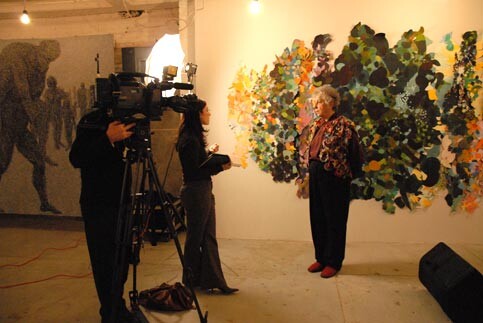
Producer Sharon Reich from Reuters TV interviews Samia Halaby, exhibit consultant and one of the artists. Born in Al-Quds (Jerusalem) in 1936, Halaby departed Palestine with her family for a few days only to find themselves denied their right to return to their home and places of work, losing all their possessions to confiscation and looting. After living in Beirut for over three years, Halaby emigrated to the US as a teenager. She graduated from Indiana University with a Master of Fine Arts in painting in 1963 and began teaching, including 10 years as professor at the Yale School of Art. (Photo: nigelparry.net)
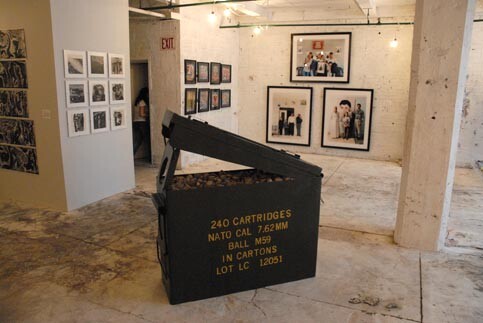
Artist Rajie Cook’s Ammo Box, one of the more tongue-in-cheek pieces in the show, filled only with stones. (Photo: nigelparry.net)
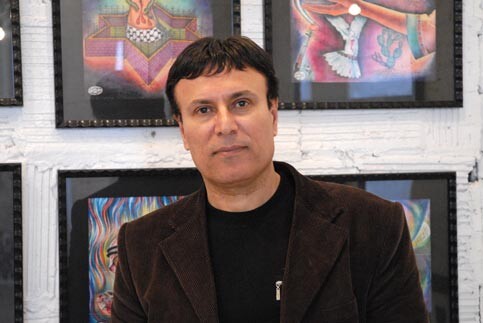
Zuhdi Al Adawi taught himself to make art while imprisoned in Ashkelon prison. His artwork was made from available materials, with pillow cases used for canvas and crayons for paint, and smuggled out of the prison by visitors. His expressionist drawings depict the psychological anguish and physical torture he endured there. Pictures such as the man trapped at the bottom of two steep, ravine walls evoke feelings of confinement. Other images, such as the image of a baby emerging from the face of an older man, convey an abiding optimism for the future. Al Adawi now lives in a refugee camp in Damascus, Syria. (Photo: nigelparry.net)
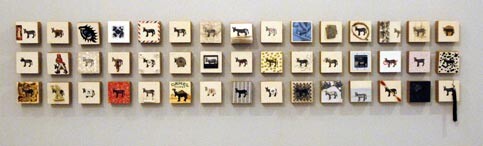
“I am Donkey/Made in Palestine” (1998-ongoing) by artist Ashraf Fawakhry, who lives in Haifa, Israel. The donkey, known for its toughness and obstinacy, is a comic symbol for the Palestinian people. These 48 rubber stamps on wood blocks are part of a serial work in which he casts the donkey in an enormous number of situations and permutations. They range from the whimsical to the poetic and they serve as reminders that the Palestinians living in Israel retain their older identity as Palestinians. (Photo: nigelparry.net)
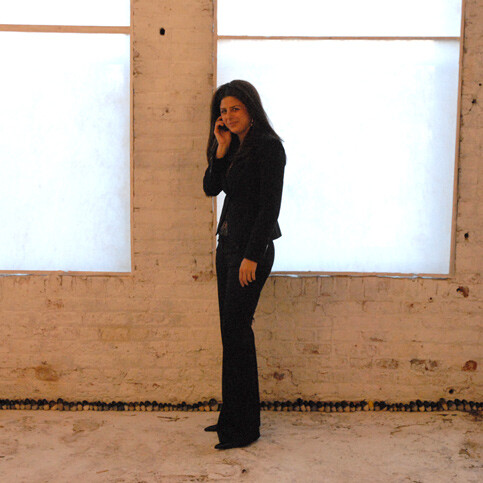
Palestinian Poet Nathalie Handal takes a break before the opening gala press conference to answer a phonecall. Running along the bottom of the wall by which she is standing, another humerous piece from the show, Nida Sinnokrot’s Rubber-coated rocks. (Photo: nigelparry.net)
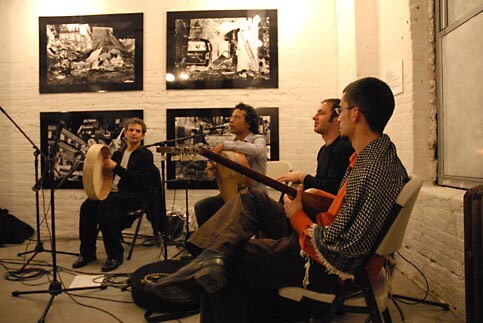
Musicians performing at the Gala opening. (Photo: nigelparry.net)
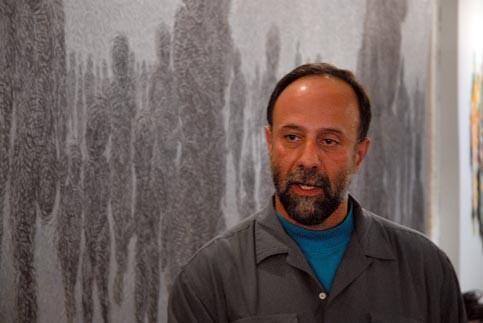
John Halaka, standing in front of his massive 87” x 272” piece, “Stripped of Their Identity and Driven from Their Land”. The forced marches of Palestinians from their homes during the Nakba recall the Cherokee ‘Trail of Tears,’ a similar exodus that bordered on genocide. It also challenges the wholesale historical revisionism, which has sought to erase their history from memory. By maintaining the cultural anonymity of the figures, Halaka underscores the universality of political displacement and invites the viewer to project his or her own cultural history and responsibilities as oppressed, oppressor, or both, onto the image. Halaka lives in San Diego, CA. (Photo: nigelparry.net)
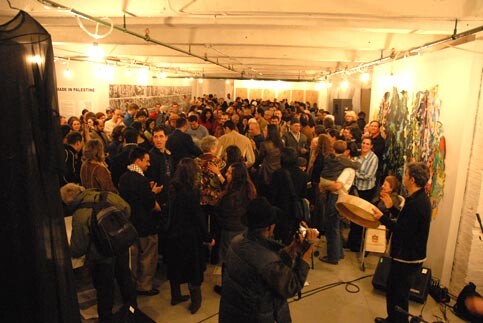
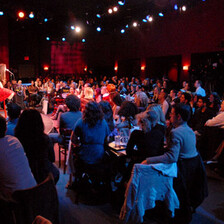
The crowd at the opening, where the atmosphere was charged with excitement. Traditional Palestinian food was served throughout the night from Tanoreen restaurant in Bay Ridge, and the mood was one of celebration and dancing. Almost 2,000 visitors were estimated to have attended the opening of the Made in Palestine exhibit, making the place feel, at times, as claustrophobic as Kalandia Checkpoint… minus Israeli soldiers with guns. (Photo: nigelparry.net)
Exhibition Dates
March 14th–April 22nd, 2006.
Open Tuesday to Saturday.
12.00pm–6.00pm.
Admission free.
Gallery Information
The Bridge Gallery
521 West 26th Street, 3rd Floor
(between 9th and 10th Aves)
New York, NY
Tel: 646-584-9098
More information
For more information about the exhibit, see www.madeinpalestine.net
Related Links
Nigel Parry is a co-founder of the Electronic Intifada and coordinated publicity for the Made in Palestine exhibit in New York through his company nigelparry.net.