Palestinian Center for Human Rights 15 August 2005
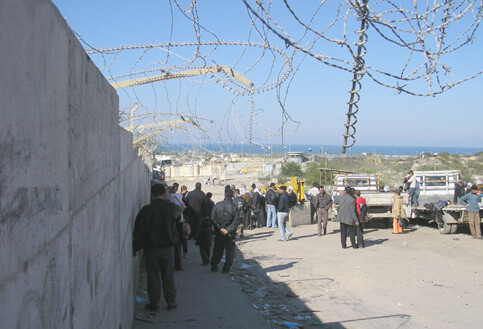
Al Mawasi, located between the sea and the Gush Katif settlement block. In this corner of the Gaza Strip some 6,000 Palestinians live completely cut off from the outside world. (Arjan El Fassed)
Location: Northern Gaza Strip: al Sayafa, a sealed Palestinian enclave between the Dogit and Elli Sinai settlements. Southern Gaza Strip: al Mawasi, a sealed Palestinian enclave inside the Gush Katif settlement bloc.
Chronology of Events
At midnight on Sunday the 14th of August IOF prevented further Israeli settlers and anti- ‘disengagement’ protestors from moving into the illegal settlements in the Gaza Strip by closing “Kissufim” Road (the settler only road that leads from Israel into the large Gush Katif settlement bloc). At the same time the IOF imposed increased closures across the OPT. On the first day of ‘disengagement’ these closures are severely restricting Palestinian civilian’s freedom of movement.
Further, as ‘disengagement’ dominates the international headlines, Israel continues its construction of settlements and the accelerated construction of the West Bank ‘Annexation’ Wall, especially around occupied East Jerusalem.
The two reports below represent just a fraction of the many stories of hardship and suffering inflicted on Palestinian civilians which PCHR’s fieldworkers have collected on the first day of ‘disengagement’.
Closures and Curfews Al-Sayafa is a Palestinian area located in between the Dogit and Elli Sinai settlements in the Northern Gaza Strip and is home to approximately 180 Palestinian. Its inhabitants have been subjected to severe restriction of movement including requiring prior coordination to enter and exit the area and restrictions on the movement of goods and services. On Monday morning, 15th of August 2005, IOF sealed off this area and prevented all Palestinian civilians living in the area from leaving it. According to information available to PCHR, a total of 150 civilians have remained in the area. 3 pregnant women were forced to leave al-Sayafa to avoid future difficulties in leaving the area when giving childbirth. In addition, 11 civilians have already left the area in order to be able to attend their jobs outside, while 4 Tawjihi (General Secondary Certificate) students have left in order to be able to attend their exams.
Recently, an electricity generator, a big fridge and some foodstuffs were brought into the area as a pre- emptive measure in case the area is closed for a long time during the implementation of the ‘disengagement’ plan. The concern surrounding the potential humanitarian crisis in areas such as al- Sayafa have lead United Nations operating in the area to pre-position foodstuffs and medical supplies.
Arrests and detention
Al-Mawasi is another enclave located in the Gush Katif settlement bloc that is home to approximately 5,800 Palestinians. Since the beginning of the second Intifada its residents have faced severe restrictions on their freedom of movement. At approximately 0330 on Saturday, the 13th of August 2005, IOF moved into al-Lahham quarter in al- Mawasi area in the west of Khan Yunis, raiding and searching a number of houses. They checked the identity cards of Palestinian civilians. They then took 8 civilians to a nearby military post, where they interrogated them for two hours. Seven of these civilians were released, while 18-year-old Ahmed Yousef al-Lahham has remained in custody.
International Law
Settlements and settlers are illegal under international law. The Fourth Geneva Convention, the primary document governing the OPT, stipulates in Article 49 that the transfer of the population of the occupying power into the occupied territory is in breach of international law. The International Court of Justice confirmed in its 2004 judgment that settlements and settlement activity is illegal.
Freedom of movement is a right afforded to Palestinian civilians under the Fourth Geneva Convention as well as under established international treaties on human rights. Preventing free movement of people and goods interferes with the right to work, the right to health, the right to education, the right not to be held as a prisoner without a free and fair trial.
Related Links