The Electronic Intifada 13 January 2005
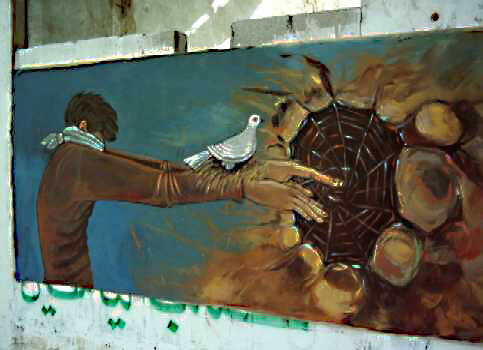
A mural in Gaza City commemorating Palestinian prisoners day. (Eóin Murray)
There is something about the art of war - not the methodology - but the art, that fascinates. People looking for a way of expressing the misery of warfare. It is, even if it deals directly with the topic of war, a way of escaping or, at the very least coping, with conflict. The real art of Gaza is on the streets, the art of resistance, the art of revolution and memory.
I have fond memories of a trip to Derry for my Dads birthday in which we stood by Free Derry corner and were amazed by the amazing power of the house murals which surrounded us. There was a real sense that these murals expressed the fears and memories of the people and, in so doing, assisted them in their struggle for human and civil rights, for peace and for justice. Last year, in April, peace activists and artists in Derry made some alterations to these famous murals as an expression of solidarity with the perpetual human rights abuses being committed by the Israeli forces.
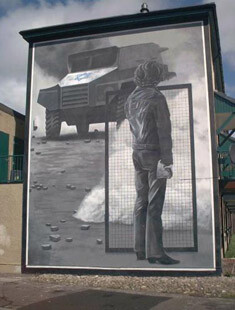
British occupation forces on a mural symbolize Israel.
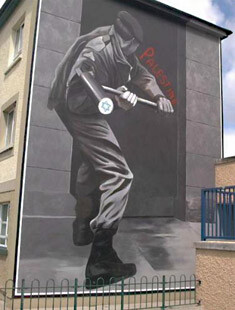
A mural in Derry altered to reflect Israeli occupation.
The street art here in Gaza focuses primarily on the human element of loss. On every street corner, in almost every shop (sometimes because they want to, sometimes because of social and political pressure) there are photographs and paintings of the dead, mostly young men but also women and children - people who have been killed by the Israeli army.
On my first visit to a Palestinian home I saw in the living room a huge portrait of a young man who looked similar to my host. When I asked who it was I was told “this is my younger brother, shot by the Israelis, he was 15.” Every building, public or private, in Gaza and I revisit the same conversation.
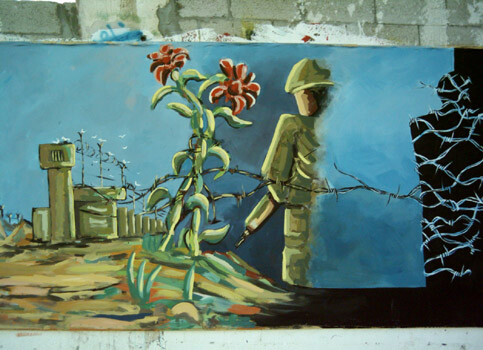
A mural in Gaza City commemorating Palestinian prisoners day. (Eóin Murray)
The street art celebrates the faces of martyrs and largely it is a simple form of painting, almost in pre-renaissance style with little attention paid to perspective or to any sense of a de Vinci-esque homage to human detail. However there are notable exceptions which appear periodically to commemorate particular events.
Take, for example, a mural outside the offices of the Palestinian Centre for Human Rights on Omar al Mukhtar street (the main ‘drag’ in Gaza, technically now renamed Yasser Arafat St.). The mural commemorated Palestinian prisoners day. It depicts scenes of horror and despair intimately wrapped up in the issue of the occupation and that of prisoners.
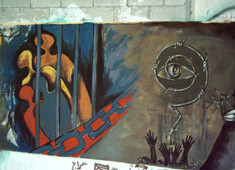
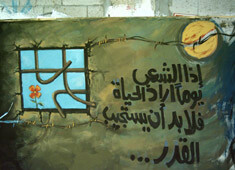
Palestinian artists, like to present their own community as harbingers and promoters of peace. They usurp symbols such as the dove or flowers - showing them as they wither away under the occupation. The collective suffering of the people is emphasised by the huddled crowds which appear on this and other murals. Of course, this is in stark contrast to the immediate sense of the individual one absorbs from the murals of the ‘martyrs’. These individuals faced their death alone and are celebrated alone, on large murals, or small posters, with a background of flowers and weaponry. Guns ‘n’ Roses.
Collectively, though, the murals join the bomb and the bullet as another means for the Palestinian resistance, what in Belfast was called the strategy of the “armalite, the ballot box and the paintbrush.” By placing the murals in prominent public positions mundane urban space is transformed into something heavily politicized and occasionally spectacular.
The daily process of involving oneself in public life, by virtue of this, is a process of re-enforcing the political realities of the occupation. If each time you step outside your door you are confronted with images of the dead it serves as a constant reminder.
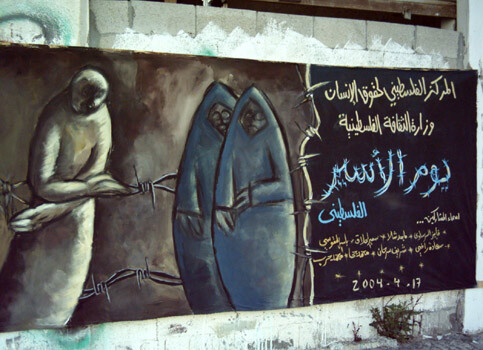
A mural in Gaza that depicts scenes of horror and despair intimately wrapped up in the issue of the occupation and that of prisoners. (Eóin Murray)
The fact that this agent of remembrance is in a public space ensures that a collective sense of memory becomes enshrined. This helps to sustain a sense of unique identity - it is a tool for nation building through the public affirmation of an imagined community.
The murals, or street art of any kind, carry a particular significance as a result of the space they occupy. As urban art forms they act as a method of reclaiming space from those who claim to control it. They are a sort of urban tattoo, acts of rebellion, individuality and celebrations of freedom.
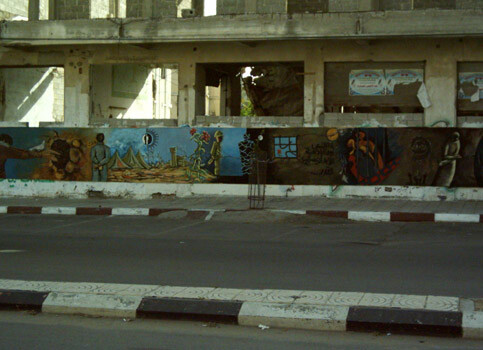
A wide view of a mural on Omar al Mukhtar Street in Gaza City. (Eóin Murray)
In the first Intifada, when the streets of Gaza were patrolled by Israeli forces, this may have had more relevance. But even today when Sharon claims to be pulling out of Gaza (he is in fact still retaining control of the land, sea, air and essential services such as electricity, water and gas supplies. ie. still remaining an occupying power) there is a sense of the necessity to reclaim the streets of Gaza, to insist on ownership and independence - even if it flies in the face of all reality.
Related Links
Eóin Murray is an Irish Human Rights worker, based in Gaza City. He is researching on the position of Human Rights Defenders in the occupied Palestinian territories for Front Line, the International Foundation for the protection of Human Rights Defenders.