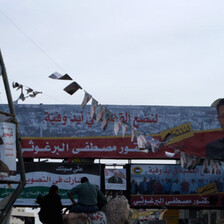
Al Jazeera 23 December 2004
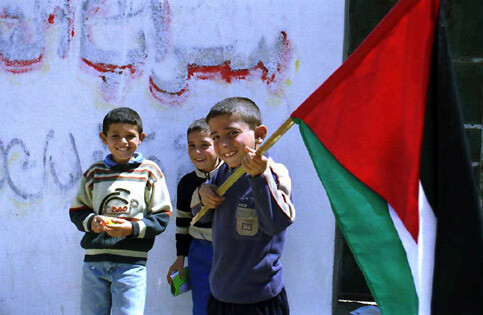
More than 140,000 Palestinians in the West Bank are heading to 26 ballots on Thursday to elect mayors and municipal councils for their towns and villages. Helga Tawil)
Like most Palestinians in the West Bank and Gaza Strip, Muhammad Qaisiya, a 45-year-old taxi driver, is quite satisfied that a municipal election will finally take place in his small town of Dahiriya, some 17km south west of Hebron, on Thursday. The last local election in the Israeli-occupied Palestinian territories took place in 1976.
Palestinian Liberation Organisation (PLO) supporters won the mayoral election, prompting the Israeli occupation government to freeze the democratic process indefinitely and adopt a policy based on appointment rather than election.
Needless to say, the appointed mayors were answerable, first and foremost, to the local Israeli military governor and detested by the bulk of the people who viewed them as collaborators serving the interests of their masters.
The policy of appointment persisted even after the creation of the Palestinian Authority (PA) in 1994, mainly because the Palestinian leadership, along with Israel and the US, feared that supporters of the Islamic Resistance Movement, Hamas, would win if truly democratic elections were held.
“Israel and later the PA robbed us of our right to elect our representatives, even at the local level. We are glad that we have been able to reclaim that right,” says Qaisiya.
None the less, he, like many Palestinians, cautions against overexpectation.
He says Palestinians should constantly remember and remind others that the elections are held in the shadow of Israeli tanks and that the ability of any elected body, whether at the local or national level, will be determined by the Israeli occupier, not the Palestinian voter.
Hamas vs Fatah
As in most major Palestinian population centres, the run-up to the elections in Dahiriya is dominated by the competition by the Islamic Bloc for Change, which is supported by Hamas and the Fatah bloc. Earlier this month, the Israeli army arrested four Islamist candidates in Dahiriya, apparently in order to undermine their list’s chances of winning.
However, Rakad Abu Allan, an Islamist candidate, predicts that the midnight arrest would boomerang and make more people vote for the bloc. “I think many people are viewing the arrests as a certificate of good conduct for us. I am sure more people will give us their votes on the election day,” he said.
Tight contest
Abd al-Halim Atta, a leading Fatah candidate in Dahiriya, admits that the elections will be a close race between Fatah and Hamas.
He pointed out that the platforms of both Fatah and the Islamists were strikingly similar and that eventually such factors as personal charisma, character, social status, tribal weight and religiosity would be the determining factor. Atta recognised that the zeal for the municipal elections exceeded by far any enthusiasm for the presidential elections, scheduled for 9 January.
The rivalry between Hamas and Fatah, along with the more mundane concerns about local services, seems to explain the widespread preoccupation with the elections. “The outcome of the presidential election seems to be a forgone conclusion,” Atta said, suggesting that Fatah’s candidate Mahmud Abbas, also known as Abu Mazin, will be elected as president of the PA. Many ordinary Palestinians agree.
True opinions
Muhammad Halayka is a local election observer at the village of Shoyokh, northeast of Hebron, where municipal elections will take place on Thursday. He told Aljazeera.net that the local and legislative elections would be more reflective of the people’s political mood than the presidential election.
“I predict that the turnout in the presidential election will be much lower than in the upcoming municipal elections.”
Halayka, a journalist, voiced anxiety about the possibility that the election would be rigged or at least partially falsified at his small town of 8000. He said a Palestinian intelligence officer had been appointed to head the local election committee, which he argued was inconsistent with the principle of neutrality.
International scorn
One of the arguments put forward by Fatah against electing pro-Hamas candidates is that the international community, particularly the European Union and the United States, might consider them untouchables.
One Fatah activist in Dahiriya said during a news conference that a Hamas victory in the mayoral elections would prompt the EU and other international donors to stop aid to Palestinian towns, already devastated by four years of constant Israeli repression and economic devastation.
An older Fatah official, sensing the political incorrectness of his comrade’s remarks, intervened telling him that “saying such a thing publicly would be a public relations disaster for us”.
America’s darling
During Aljazeera.net’s tour of three Palestinian towns in the Hebron region where elections will take place on Thursday, it saw little infatuation with Abu Mazin. There was not a single portrait of him anywhere.
Fatah leaders sought to dodge this observation, arguing that Abbas was not yet a leader but that when and if he was elected, his picture would be everywhere. However, the unspoken words of many Fatah activists indicated that support for Abbas is lukewarm at best. One young man apparently could not keep his feelings suppressed.
Mixed feelings
He called Abu Mazin America’s candidate, adding that he would not vote for him on 9 January. The fact that the activist was not rebuked by the Fatah multitude is telling.
A middle-aged Fatah activist sought to explain what seemed to be a widespread ambivalence toward Abu Mazin, especially among the movement’s grassroots supporters and its younger generations. “Look, many people here are worried that Abu Mazin might deviate from our national constants.
“But I assure you that any Palestinian leader, even if elected, who chooses to compromise on these paramount issues will not live to regret his folly.”
Khalid Amayreh is a journalist based in the occupied West Bank. This article was originally published by aljazeera.net and reprinted on EI with permission.
Related Links