The Electronic Intifada 15 July 2004
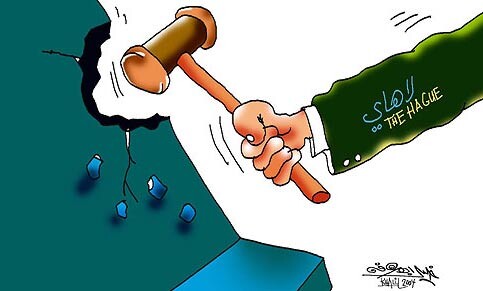
Cartoon by Khalil Abu Arafeh
The International Court of Justice has determined that Israel “has the right, and indeed the duty, to… protect the life of its citizens” but that “the measures taken are bound nonetheless to remain in conformity with applicable international law.” The Court found the present route of the separation fence or wall to be a serious and egregious violation of international law.
In an interview given last weekend, Israeli Chief of Staff Moshe (Bogie) Ya’alon contested the applicability of international law. Such a system was appropriate for the conditions of World War II, he declared, but not for the present war on terror. Apparently, as Ya’alon envisions it, in this war the armed forces are bound only by their own law. Indeed, a battle is being waged in the world today over the status of international law.
While the US and Israel are agitating for its nullification, the rest of the world understands that international law, as the framework that governs the conduct of states, is a necessary apparatus for the preservation of society. Even if it does not always function perfectly, without international law there is a danger that large segments of the human race will simply be wiped out, as we Jews learned through our own terrible experience during World War II.
The International Court’s ruling lists the numerous articles of the Fourth Geneva Convention that the present route of the barrier violates, noting that “there is also a risk of further alterations to the demographic composition of the Occupied Palestinian Territory resulting from…the departure of Palestinian populations from certain areas” (paragraph 122). In simpler language, the Court is warning of transfer.
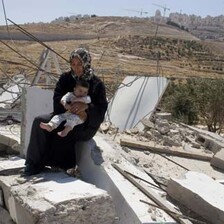
The word “transfer” evokes the collective memory of trucks arriving in the middle of the night to transport Palestinian villagers across the border, which happened in a number of places in 1948. But transfer on that model is not possible in today’s world. Now transfer must be accomplished more slowly and surreptitiously. The current barrier cuts off 400,000 Palestinians from their source of livelihood and imprisons them in isolated enclaves. With no means of subsistence, they will be forced to leave those enclaves over the next few years to seek employment at the peripheries of West Bank cities and towns. In this way, sections of the West Bank that border on Israel will be “cleansed” of Palestinians.
In Qalqilya and Tul Karm, where the fence was completed a year ago, it is already happening. It would have been possible to build the fence on the Israeli side of Qalqilya, as the original plan proposed. That is a much shorter route, and would have been easier to guard and protect than the present line, which surrounds Qalqilya on all sides and cuts through West Bank territory. But the builders of the barrier along its present route were guided not by security considerations but rather by the old vision of redeeming the land and purifying it of Arabs. The only difference is that today it is possible to hide this behind talk of a war on terror.
A year ago, the wall extended from Tul Karm and Qalqilya to the town of Mas’ha, near the Jewish settlement of Elkana. Like others before them, the people of Mas’ha were expected to sit and watch as their olive groves their source of income for centuries were transferred to the Israeli side of the wall. But the people of Mas’ha united to show that another way is possible. They erected protest tents next to the route of the bulldozers and called upon Israelis to join them. For months, Israelis and Palestinians sat together in the path of the wall that was being built day by day. Nazeeh Shalaby, a farmer from Mas’ha who lost all his land, was the moving spirit in the camp. “Until you arrived,” he told me this week, “I didn’t have any idea that there were Israelis who want to live with us in peace.”
The protest camp at Mas’ha didn’t succeed in stopping the wall. The encampment was evacuated and the army used live ammunition on the Israeli protestors who climbed and shook the fence. Gil Na’amati of Kibbutz Re’im lost there his knee. But now the International Court has ruled that Israel must immediately dismantle the sections of the wall that have been built inside the West Bank and move them to the Green Line. This should begin at once with the dismantling of the wall at Mas’ha.
Related Links
Prof. Tanya Reinhart is a lecturer in linguistics, media and cultural studies at the Tel Aviv University. She is the author of several books, including Israel/Palestine: How to End the War of 1948. This article was first published in Hebrew in Yediot Aharonot, on July 15, 2004. Translated from Hebrew by Edeet Ravel and Mark Marshall.