The Electronic Intifada 6 July 2004
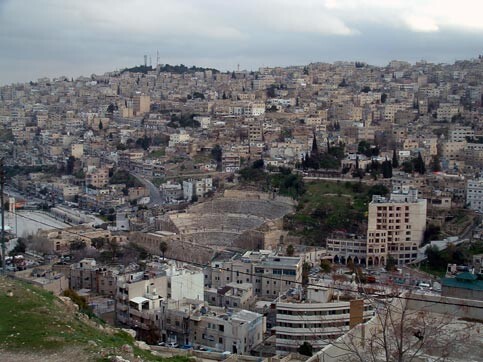
View of downtown Amman and the Roman Amphitheatre in winter. (Ali Abunimah/EI)
Amman, Jordan — Every time I visit Amman, the US embassy here seems to have around it more high walls, concrete barricades and armored cars with menacing machine guns mounted atop. The massive building, bristling with antennas and satellite dishes, evokes a 21st century version of the austere windowless castles built here by European crusaders in the Middle Ages, and holds as little charm as those fortresses did for the people of the region at that time.
A short distance away is the official residence of the Israeli ambassador, ensconced in its own high walls. These two buildings, huddled together, far away from the bustle of the city and its people, make a good metaphor for the way the United States is increasingly seen here. This is a tragedy, because Americans have always been welcomed in Jordan, and many I know have lived here happily for decades and still do. Jordan is no Saudi Arabia, and it remains a safe, cosmopolitan and tolerant society where one can live pretty much as one pleases as long as one shows respect for others.
Jordan, sandwiched between Palestine/Israel to the west and Iraq to the east, is cited by American leaders as a “moderate,” and “reforming” Arab country in part because of these features, but primarily because it is seen as compliant with US policies and has a peace treaty with Israel. Yet this image is incomplete and misleading. While the Jordanian government maintains very close ties to the United States, the views of ordinary Jordanians, cutting across social classes, have never been more angry at and mistrustful of America, a recent poll by the Center for Strategic Studies at the Jordan University has found. The Iraq war has ratcheted up these sentiments, but the central issue that drives them is decades-long American support for Israel’s policies at the expense of Palestinians.
In a recent interview on Irish television, President Bush rebutted the suggestion that US policy towards the Palestine-Israeli conflict needs to be more “even-handed.” Bush boasted “I’m the first American president to have called for the establishment of a Palestinian state,” adding, “that sounds like a reasonable balanced approach.” That may play politically in the US, but here it cuts no ice. I have not met anyone who is impressed by Bush’s lip-service to a Palestinian state. But disgust at open American support for Israeli prime minister Ariel Sharon’s intention to annex much Palestinian territory, and US inaction in the face of daily Israeli violence, house demolitions and settlement construction in Palestinian lands is heard everywhere. People want peace, but they want it to be based on fairness and international law, the two elements they see most lacking in American policy. The recent 407-9 vote in the US House endorsing Bush’s support for Sharon’s approach definitely doesn’t help.
Bush argues that desperately-needed democratization in Arab countries need not wait for a just solution to the Palestine conflict. But Jordan is a good example of why that logic fails. Here, political debate and criticism of the government about domestic issues like education, healthcare, agriculture or the role of women is normal. The one key topic on which the government severely limits public debate is its relations with Israel and the United States. Those who are too critical can find themselves in serious trouble. Since this is the one subject that everyone wants to talk about most (a majority of Jordanians has close family ties to Palestine and more than 1.5 million Palestine refugees live here), the government maintains onerous laws controlling the press, demonstrations and political activity by parties, students and professional associations. Opposition parties charge that electoral districts are gerrymandered to produce a docile and unrepresentative parliament.
Today, Jordan’s government faces a choice between maintaining deeply unpopular policies under American pressure, or listening to its people. Choosing to be pro-American, therefore, means in practice putting true democracy on hold. As a result, radical movements find ready audiences since they are the only ones who seem to address the public’s fundamental concerns forthrightly.
Despite all this, America as a country maintains a significant reserve of respect and affection in Jordan. Tens of thousands of Jordanians live in the United States and many are dual citizens, which means that many here have family ties to America as well. Many people I have spoken to say America remains a symbol of hope and possibility for them. Regular surveys by the Pew Research Center confirm that while Jordanians overwhelmingly reject US policies, they share many common values with Americans. When Jordanians could travel to the US with greater ease, to study, emigrate, or visit relatives, they nurtured human connections and brought back insights into the complexity of US society.
Now, with America slamming its doors, people are left only with over-simplified caricatures. Increasingly, many Jordanians feel that US support for Israel and the invasion of Iraq are part of a broader US campaign against Muslims. Nothing but a dramatic change in US policy will convince them otherwise.
But that seems depressingly unlikely when the Bush administration, Democratic challenger John Kerry and Congress refuse to have a real debate about policies that have led America astray in this region for decades.
Related Links
Ali Abunimah is co-founder of The Electronic Intifada and Electronic Iraq. A slightly abridged version of this article first appeared in The Chicago Tribune on 6 July 2004.