home the electronic intifada
about eifaqby topicget e-mail updatessyndicate eisubmit contentdonatecontact
for
EI Advanced Search
Human Rights

Latest donor update on the impact of Israel's separation barrier
Report, OCHA, 11 October 2003

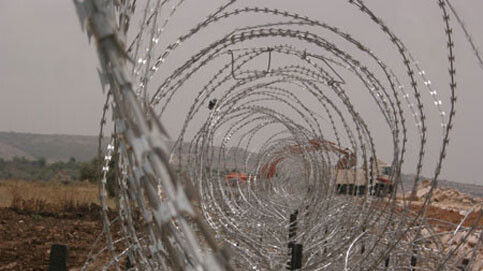
Photo: PENGON/Stop the Wall Campaign

The co-chairs of the Local Aid Coordination Committee (LACC) – the group of international donors to the Palestinians -- today released a report on the rapid expansion of Israel's "separation barrier" around East Jerusalem.

The report, The Impact of Israel's Separation Barrier on Affected West Bank Communities: The "Jerusalem Envelope" (PDF), focuses on the economic, social and humanitarian consequences for tens of thousands of Palestinians living in the affected area. It provides detailed information on the barrier's trajectory (with two maps) and reviews its economic and social consequences as well as the process of requisitioning land for construction.

The 35-page document is the second update of an original report released on April 30 that focused on the barrier's alignment in the central West Bank. That report emphasized the potential impact of physical separation and isolation on residents who might be cut off from their agricultural lands, irrigation networks and water resources, as well as from workplaces, schools, health clinics and other social services. The first update, released July 30, documented the impact the barrier's Phase II construction along the northern West Bank.


The reports are presented to the LACC's Humanitarian and Emergency Policy Group out of concern that the barrier could harm Palestinian livelihoods and the viability of local economies and impede the delivery of donor assistance. The original report and both updates can be found on the website of the UN Office for the Coordination of Humanitarian Affairs.

Key Findings

The barrier is dividing communities and families and threatens to seal Jerusalem off from the rest of the West Bank. Palestinians along the barrier's alignment face land loss and severely restricted access to jobs, markets, and essential social services. Among the findings:

Trajectory

  • The barrier ranges between 40 and 100 meters in width and consists of an electrified fence/concrete block wall, electronic sensors, trenches, military roads, barbed wire, buffer zones and watchtowers.

  • So far, 22.5 kilometers of the barrier have been built around Jerusalem. Between July 27 and August 24 Israel issued military orders requisitioning land along another 18 kilometers of the barrier's alignment to the east and southeast of Jerusalem.

  • The existing barrier and the newly requisitioned land all lie well beyond the Green Line (up to 5.5 km) and in some places also beyond Israel's Jerusalem municipal boundary of June 1967.
    Affected Population.

  • Completed construction has impacted ten communities (est. pop.84,775). This summer's land requisition orders have impacted another six communities (est. pop.35,495).

  • Residents of eight communities north and west of Jerusalem's municipal boundaries have already lost land to the construction (est. pop. 54,600). Another seven communities to the southeast have been affected, with many also losing land (est. pop. 63,800).

  • Depending on the barrier's ultimate alignment in the northeast, four West Bank communities (est. pop. 41,250) could find themselves inside the barrier and separated from the rest of the West Bank.

    Impact

  • Palestinian families and communities are being separated from each other. Communities adjacent to Jerusalem are being cut off from the city, which they rely on for commerce, work and essential social services.

  • The barrier will solidify and institutionalize the differences between those holding West Bank and Jerusalem IDs. West Bank ID holders who have accessed Jerusalem "illegally", usually for work, may no longer be able to do so. In addition, the barrier places some West Bank ID holders on the Jerusalem side, and some Jerusalem ID holders on the West Bank side. This is creating dilemmas of access and legal status, and an appreciable degree of future population movement cannot be ruled out.

    Response

  • Access points that permit a predictable flow of goods and people through the structure will be essential to reduce the barrier's negative socio-economic impact.

  • In August UNDP launched an $18 million emergency aid appeal to assist West Bank communities affected by the barrier; the Islamic Development Bank launched a similar $20 million initiative last month.

    Related Links:

  • The Impact of Israel's Separation Barrier on Affected West Bank Communities: The "Jerusalem Envelope" (PDF)
  • Stop the Wall Campaign

    For more information and to be referred to these spokespeople, please contact Mark Dennis, Senior Adviser, the Office of the United Nations Special Coordinator. cell: +972-55-627-807, email: dennism@un.org.


    Latest articles on EI:

    Palestine : Human Rights: Report: 348 Palestinians extra-judicially executed since Sept. 2000 (4 July 2008)
    Palestine : Diaries: Live from Palestine: Wall slices off al-Khader's famous vineyards (4 July 2008)
    Palestine : Opinion/Editorial: Unite to negotiate a real truce (4 July 2008)
    Palestine : Human Rights: Critics see vendetta in al-Arian's legal limbo (3 July 2008)
    Palestine : Opinion/Editorial: When you shoot the messenger (3 July 2008)
    Palestine : Development: Poll backs greater UN role in Mideast peace (3 July 2008)
    Palestine : Multimedia: Crossing the Line focuses on a possible Israeli strike on Iran (2 July 2008)
    Palestine : Multimedia: Photostory: The month in pictures, June 2008 (2 July 2008)
    Palestine : Human Rights: Israel's discriminatory water policies leave West Bank dry (1 July 2008)
    Palestine : Israel Lobby Watch: US hawks belie Iran's "existential threat" to Israel (1 July 2008)

  • E-mail this Page
    Print this Page


    RSS Help | EI RSS Feeds


    EDITOR'S PICKS


    NEWS & ANALYSIS
    THE MEDIA
    ACTION & ACTIVISM
    EI EXTRA
    Buy EI Merchandise

    KEY RESOURCES
    AID & DEVELOPMENT NEWS FROM ELECTRONIC IRAQ

    This webpage uses Javascript to display some content.

    Please enable Javascript in your browser and reload this page.


    HOME | ABOUT EI | FAQ | BY TOPIC | SYNDICATE EI | SUBMIT CONTENT | DONATE | CONTACT

      The Electronic Intifada needs your ongoing help to offer information about the Israeli-Palestinian Conflict.

    ©2000-2007 electronicIntifada.net | a nigelparry.net website