The Daily Star 3 October 2003
Rosh Hashanah, the Jewish New Year, begins a 10-day period known as the High Holy Days, or Yamim Noraim, a time of reflection, repentance, renewal and prayer that ends with Yom Kippur, the Day of Atonement.
During these days we are asked to examine our past deeds and ask forgiveness for our sins, to remember our history as Jews and to pray for Israel. We believe that on Rosh Hashanah, God has judged us and has recorded the judgment in the Book of Life. On Yom Kippur the Book of Life is closed and sealed. Those who have repented for their sins are granted a good and happy new year.
I love this holiday. It brings back memories of attending synagogue with my father. I would watch lovingly and with great respect as he prayed. He always observed the holiday with all of its rituals. Yet as the years have gone by, the holiday has taken on other memories.
In 1972, I was in Beirut during the holidays. I was there to learn more about the Palestinians and the Arab world. I made contact with the Jewish community and attended services at the Maghen Abraham Synagogue. I was in a refugee camp when word came that Israeli athletes had been killed at the Munich Olympic Games, and I witnessed Israel’s mighty retaliation against the refugee camps. I remember the destruction of innocent lives.
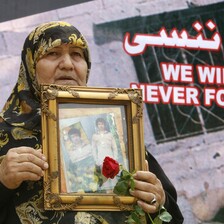
I was again in Beirut in September 1982. This time I had volunteered as a nurse in a hospital in the Sabra refugee camp following Israel’s invasion of Lebanon. It was on Rosh Hashanah that the Israeli Army, under the command of then-Defense Minister Ariel Sharon, stood watch over the camps of Sabra and Shatila as a grotesque massacre of Palestinian and Lebanese men, women and children by the Phalangists took place. The Israelis allowed the perpetrators to enter the camps, even using flares to light their way, prevented terrified camp residents from leaving, and lent the murderers a bulldozer to help bury the bodies.
After the medical workers were forced to leave the hospital, we were taken away and interrogated. Eventually we were turned over to the Israelis. I clearly remember watching as several soldiers prayed — it was both the Sabbath and the first day of Rosh Hashanah. A soldier offered one of the nurses a piece of honey cake — the symbol for a sweet year. In the end the massacre claimed over 800 lives. It also undermined the concept that the Israeli Army was highly moral and idealistic. The massacre at Sabra and Shatila will continue to follow Sharon for the rest of his days. Legal efforts to bring him to justice have so far failed.
Last year, 20 years after the massacre, I returned to Beirut to be part of the commemorative events. I was there during Yom Kippur. I tried to find the remaining Jews of Beirut, but could not. I wanted to spend this day with them. Instead I went to the Khiam detention center — a place where Palestinians and Lebanese were held during the Israeli occupation of the south, many of them tortured. It was fitting to be in a place where one could ask for forgiveness for the sins committed in this horrendous chamber of horrors by my people.
As the situation between Israelis and Palestinians has deteriorated, the Jewish voices of peace have gained momentum and become louder. “Al-Kheyt” is a prayer said repeatedly on Yom Kippur. It lists those sins we have committed and asks God for forgiveness. Each statement begins with “For the sin,” followed by the sin in question. Jewish and Israeli peace groups have adapted contemporary sins to be read during this holiday. Here is an example written by Rabbi Arik Ascherman, executive director of Rabbis for Human Rights in Israel: “And for the sin which we have sinned against You by narrow mindedness — feeling only our own pain, closing our minds to the agony of bereaved Arab mothers and fathers.”
I would like the Palestinians in Lebanon, in the refugee camps, to know that there are many Israelis who care, who remember and who want to bring about a just peace and an end to their suffering. My friend, Gila Svirsky, from the Coalition of Women for a Just Peace in Israel, told me that she “fervently hopes that we will be able to bring together Palestinian victims with empathetic Israelis.”
The High Holidays are different for me now. My parents are no longer alive. I think of them a lot during the services. I pray for them and honor their memory. I must differentiate between my religious beliefs, my history and Israel’s policies toward the Palestinians. Being Jewish does not mean that I have to support Israel’s oppressive policies towards the Palestinians, the occupation, the violation of human rights and assassinations.
The holidays fall around the same time every year. Each holiday I am haunted by the anniversary of the Sabra and Shatila massacre. Always, I remember, I reflect, I repent. I renew my commitment to what is right and just — to the cause of the Palestinians in the camps.
Ellen Siegel, a registered nurse in Washington, is an active member of the Jewish peace movement. She wrote this commentary for THE DAILY STAR.