The Daily Star 17 September 2003
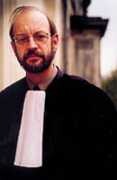
Luc Walleyn
In a week’s time, a court in Belgium will rule on whether the case can proceed or not. But the lawyers for the 28 Palestinian and Lebanese plaintiffs are not optimistic. Intense political pressure from the US — rather than the legal arguments of Israeli lawyers — has forced the Belgian government into making crucial changes to its law on universal jurisdiction which threaten to undermine the case against Sharon.
“We have had to face very important pressure since the beginning. Pressure on the judiciary and on the Belgian government,” Luc Walleyn, one of the three Belgian lawyers for the Sabra/Shatila victims, told The Daily Star in an interview.
Pressure, too, on potential star witnesses. Elie Hobeika, former warlord and minister, was killed in a car bomb explosion in January 2002, days after confirming to a visiting delegation of Belgian senators that he would cooperate with a judicial investigation into the Sabra/Shatila slaughter. Walleyn said he believed Hobeika was assassinated because of his promise to cooperate.
“He was killed at a very crucial moment for the case,” Walleyn said. “If he was serious in his announcement that he wanted to cooperate with the Belgian investigation, it could have been dangerous for some people.”
The lawsuit against Sharon was filed under a 1993 Belgian law on universal jurisdiction, allowing suspected war criminals to be tried in Belgium regardless of the nationality of the accused and victims and regardless of where the crime was committed.
On Feb. 12, the Brussels court ruled that Belgium had jurisdiction over the case and that a judicial investigation into the events surrounding Sabra/Shatila could begin. On May 10, the court confirmed its earlier ruling, dismissing an appeal by Sharon’s lawyers.
“The investigating judge confirmed that he was ready to start the investigation. It was at that moment that we had the political interference” from the US.
The US intervention was spurred by a flurry of lawsuits in the wake of the Iraq war filed in Belgium against US officials, including General Tommy Franks, the commander of US troops in the Gulf. The Belgian government had already tightened the law in April so that cases against non-Belgian citizens could be transferred to the relevant country so long as it had a fair legal system. That meant that lawsuits against US officials, for example, would be transferred to US courts.
The case against Sharon was unaffected by this legislation as it was impossible for the Sabra/Shatila survivors to receive a fair trial in Israel.
Despite the change in the law, the “frivolous” suits against US and British officials continued to arrive, mainly, Walleyn said, because they were geared toward political point-scoring rather than a genuine intent to prosecute.
“The reaction from the Americans was to say (to Belgium) ‘you must abandon the whole law.’ The pressure became very high,” Walleyn said. “The result … was not only to jeopardize our case but the whole system of universal jurisdiction in Belgium.”
In Belgium in June, US Defense Secretary Donald Rumsfeld warned that failure to amend the law could result in the US withholding promised funds for the construction of a new $350 million NATO headquarters in Brussels.
“I think the present American government has a basic problem with international justice. They don’t accept the idea that someone can judge a US citizen who is not a US judge,” Walleyn said. “Countries respecting international law should not be afraid of international justice. Of course, if a country claims that it has the right not to respect international law, then it’s logical also that it’s afraid of international justice.”
At the beginning of August, the Belgian government further tightened the law, with potentially fatal consequences for the Sharon case. The new law requires at least one of the plaintiffs to be of Belgian nationality when the lawsuit is filed. None of the Sabra/Shatila plaintiffs hold Belgian citizenship.
Just as it appeared that the case was lost, it emerged that another complaint against Sharon had been lodged by some Belgian citizens in 2001, only two weeks before the Sabra/Shatila plaintiffs filed their own suit. “Everybody had forgotten about this complaint,” Walleyn said. “It was sleeping for two years.”
The Sabra/Shatila lawyers took up the old complaint and on Sept. 10, the Supreme Court heard both cases. On Sept. 24, the court will decide if the two cases can be linked and if the “sleeper” complaint is eligible under the tightened legislation.
“I can’t predict what the court will say,” Walleyn said. Yet even if the court’s decision goes against the plaintiffs, it will not be the end of legal moves to bring Sharon to trial.
“Today there is a growing consciousness that very important international crimes against humanity cannot stay unpunished,” he said. “I think that sooner or later there will be a prosecution for that crime and I think our clients will not stop their action even if there is a negative result in Belgium.”