The Electronic Intifada 21 July 2003
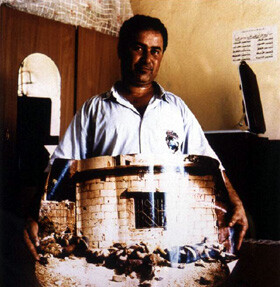
Sabra and Shatila massacre survivor Hamad Mohammed Shamas holds a famous photograph taken in the aftermath of the massacres. He lay injured under the bodies on the left of the frame for a day and night. (Philip Reynaers)
Only one trial has been conducted under this law, resulting in the conviction of four Rwandans for participation in their country’s 1994 genocide. But ever since survivors of the 1982 Sabra and Shatila massacres brought a case in Brussels against Ariel Sharon and other Israelis, Israel’s apologists have campaigned against it.
Last April, under strong US pressure, Belgium changed its law so any case against a foreign leader would first be referred to the authorities of the leader’s country. This was to reassure the US that Belgian courts would not be a venue for ‘political’ proceedings against American officials. But it did not.
US Secretary of Defence Donald Rumsfeld threatened to cut funding to NATO’s new Brussels headquarters if Belgium did not repeal the law entirely. As proof that its new safeguards were sufficient, the Belgian Justice Ministry in June dismissed war crimes complaints filed against George W. Bush and Tony Blair within 24 hours of receiving them.
But the US was still not appeased. Peter Moors, an adviser to Belgian Prime Minister Guy Verhofstadt said on July 13: “The abrogation of the 1993 law will allow us to improve our relations with certain allies,” adding: “The problem was becoming urgent.”
In a terrible blow for the plaintiffs in the Sabra and Shatila case, Moors stated that the change would “permit the cases under way to disappear,” except those “with an obvious Belgian interest.”
Whether Rumsfeld had Israel’s direct interests in mind when he bullied Belgium into submission, the result is that, once again, Israel is immune from accountability for its international crimes. Rumsfeld, who has already expressed his view that Israel had won the “so-called Occupied Territories” fair and square, would certainly not have been ignorant of Sharon’s legal predicament and Israel’s objections to the Belgian law. We can only speculate if this was a reason why Rumsfeld pushed Belgium to take measures far beyond what were needed to answer all the US concerns.
Belgium’s move sends a particularly damaging message because Sharon, along with Defense Minister Shaul Mofaz and Chief of Staff Moshe Yaalon, continue to order war crimes in the Occupied Territories on a regular basis. No wonder Israel celebrated the decision.
Aside from the Sharon factor, the Belgian story is almost a footnote in ongoing US efforts to destroy any sort of international system of justice to punish the worst crimes. In recent months, the US has bullied nearly 50 countries into signing agreements that they will not send US citizens to the International Criminal Court (ICC). According to Middle East International (June 27, 2003) two Arab countries, Egypt and Tunisia, signed secret agreements to the same effect. And in June, under US threats to veto all UN peacekeeping operations, the Security Council passed a resolution extending for another year the immunity of all US troops involved in such operations from ICC jurisdiction.
While the Bush administration actively campaigns to undermine universal jurisdiction - the principle that suspected criminals cannot hide from justice behind national sovereignty - the US has numerous laws that purport to apply to citizens of third countries anywhere in the world. The Iran-Libya Sanctions Act and the Helms-Burton Act, targeted at Cuba, are examples. The Financial Times noted in a recent editorial that, “US courts have assumed a right of jurisdiction over foreign countries that is very similar to the Belgian law.” These cases involve claims under the Alien Tort Act of 1789 that seek to judge actions “committed in violation of the laws of nations.” What seems to be at issue, therefore, is not the principle itself, but only that the principle should be applied to the mighty.
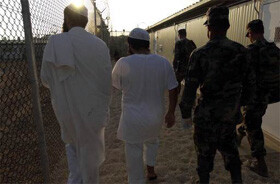
Detainees are shown to their new living quarters in a medium security facility at Guantanamo Bay, Cuba. The communal living environment allows greater freedom of movement and group recreation. (DoD/John F. Williams)
The fact that two of the six who face possible execution after secret trials are Britons has angered UK public opinion and exposed the total lack of influence Tony Blair has on his soul mate George W. Bush. What is taking shape on Guantanamo is in the hoary tradition of military tribunals and ‘State Security’ courts that Israel and other Third World regimes (not least, Arab ones) have used for decades to crush opposition and persecute those they rule. And as US conduct becomes increasingly lawless, there is no law on earth that can stop it.