The Electronic Intifada 13 January 2009
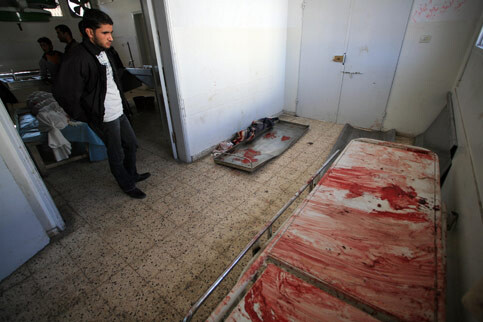
Since Israel has barred journalists and international observers from entering the Gaza Strip it has been difficult to determine if Israel is using weapons illegal under international law. (Wissam Nassar/MaanImages)
Concerns about Israel’s use of non-conventional and experimental weapons in the Gaza Strip are growing, with evasive comments from spokesmen and reluctance to allow independent journalists inside the tiny enclave only fueling speculation.
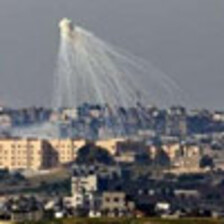
The most prominent controversy is over the use of shells containing white phosphorus, which causes horrific burns when it comes into contact with skin. Under international law, phosphorus is allowed as a smokescreen to protect soldiers but treated as a chemical weapon when used against civilians.
The Israeli army maintains that it is using only weapons authorized in international law, though human rights groups have severely criticized Israel for firing phosphorus shells over densely populated areas of Gaza.
But there might be other unconventional weapons Israel is using out of sight of the watching world.
One such munition may be DIME, or dense inert metal explosive, a weapon recently developed by the United States army to create a powerful and lethal blast over a small area.
The munition is supposed to still be in the development stage and is not yet regulated. There are fears, however, that Israel may have received a green light from the US military to treat Gaza as a testing ground.
“We have seen Gaza used as a laboratory for testing what I call weapons from hell,” said David Halpin, a retired British surgeon and trauma specialist who has visited Gaza on several occasions to investigate unusual injuries suffered by Gazans.
“I fear the thinking in Israel is that it is in its interests to create as much mutilation as possible to terrorize the civilian population in the hope they will turn against Hamas.”
Gaza’s doctors, including one of the few foreigners there, Mads Gilbert, a Norwegian specialist in emergency medicine working at al-Shifa hospital in Gaza City, report that many of the injuries they see are consistent with the use of DIME.
Wounds from the weapon are said to be distinctive. Those exposed to the blast have severed or melted limbs, or internal ruptures, especially to soft tissue such as the abdomen, that often lead to death.
There is said to be no shrapnel apart from a fine “dusting” of minute metal particles on damaged organs visible when autopsies are carried out. Survivors of a DIME blast are at increased risk of developing cancer, according to research carried out in the United States.
Traditional munitions, by contrast, cause large wounds wherever shrapnel penetrates the body.
“The power of the explosion dissipates very quickly and the strength does not travel long, maybe 10 meters, but those humans who are hit by this explosion, this pressure wave, are cut in pieces,” Dr Gilbert said in a recent interview.
This is not the first time concerns about Israel’s use of DIME have surfaced in Gaza. Doctors there reported strange injuries they could not treat, and from which patients died unexpectedly days later, during a prolonged wave of Israeli air strikes in 2006.
A subsequent Italian investigation found Israel was using a prototype weapon similar to DIME. Samples from victims in Gaza showed concentrations of unusual metals in their bodies.
Yitzhak Ben-Israel, the former head of the Israeli military’s weapons development program, appeared familiar with the weapon, telling Italian TV that the short radius of the explosion helped avoid injuries to bystanders, allowing “the striking of very small targets.”
Israeli denials about using weapons banned by international law would not cover DIME because it is not yet officially licensed.
It will be difficult to investigate claims that non-conventional weapons have been used in Gaza until a ceasefire is agreed, but previous inquiries have shown that Israel resorts to such munitions.
The Israeli human rights group B’Tselem has recorded numerous occasions when the Israeli army has fired flechette shells, both in Lebanon and Gaza. The shell releases thousands of tiny metal darts that cause horrible injuries to anyone out in the open.
A Reuters cameraman, Fadel Shana, filmed the firing of such a shell from an Israeli tank in Gaza in April, moments before its flechettes killed him.
Miri Weingarten, a spokeswoman for Physicians for Human Rights, said they were watching out for use of a new flechette-type weapon the Israeli army has developed called kalanit (anemone). An anti-personnel munition, the shell sends out hundreds of small discs.
Israel appears to have used a range of controversial weapons during its attack on Lebanon in 2006. After initial denials, an Israeli government minister admitted that the army had fired phosphorus shells, and the Israeli media widely reported millions of cluster bombs being dropped over south Lebanon.
There are also suspicions that Israel may have used uranium-based warheads. A subsequent inquiry by a British newspaper found elevated levels of radiation at two Israeli missile craters.
Sarit Michaeli, a spokeswoman for B’Tselem, said her organization had not yet been able to confirm which weapons were being used in Gaza in the current attacks. She added, however, that Israel’s denials about using non-conventional munitions should not be relied on.
“It is true, as the army spokespeople say, that weapons such as phosphorus and flechette shells are not expressly prohibited. But our view is that such weapons, which do not distinguish between combatants and non-combatants, cannot be used legally in a densely populated area like Gaza.”
Reports this month revealed that the US has been organizing massive shipments of arms to Israel, though a Pentagon spokesman denied they were for use in Gaza.
Jonathan Cook is a writer and journalist based in Nazareth, Israel. His latest books are Israel and the Clash of Civilisations: Iraq, Iran and the Plan to Remake the Middle East (Pluto Press) and Disappearing Palestine: Israel’s Experiments in Human Despair (Zed Books). His website is www.jkcook.net.
This article originally appeared in The National published in Abu Dhabi and is republished with permission.
Related Links