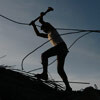
TYRE, Lebanon, 18 December (IPS) - Kamel Mohammed was pruning lemon trees last winter when his red electric saw detonated an unexploded cluster bomb, blasting shrapnel all over his body. After an operation to remove the metal shards from his chest, Mohammed, a 44-year-old father from the nearby Palestinian refugee camp of Rashidieh in south Lebanon, went straight back to work cultivating fields and chopping wood for coal. Not so lucky was his neighbor and fellow family man, Ahmad Huwaidi, 36, killed instantly when the remaining explosives in an old metal rocket he was cutting to sell ignited from the heat. Read more about Palestinians brave a hazardous profession
At a workshop conducted at Birzeit University (BZU) on December 13 by AMIDEAST (American-MidEast Educational and Training Services) for Palestinian universities through its Faculty Development Program, the talk turned from the announced topic of the workshop (Palestinian-American University Partnerships) to the question of Palestinian-Palestinian university partnerships or the lack thereof. The occasion had brought together important representatives (at the level of Deans and VPs) from every Palestinian West Bank University. Gaza was unrepresented, however. Rima Merriman reports. Read more about Palestine's universities: partners or prisoners?
I am feeling optimistic about Palestine. I know it sounds crazy. How can I use “optimistic” and “Palestine” in the same sentence when conditions on the ground only seem to get worse? Israeli settlements continue to expand on a daily basis, the checkpoints and segregated road system are becoming more and more institutionalized, more than 10,000 Palestinian political prisoners are being held in Israeli jails, Gaza is under heavy attack and the borders are entirely controlled by Israel. We can never forget these things and the daily suffering of the people, and yet I dare to say that I am optimistic. Hannah Mermelstein comments. Read more about The end of Israel?
For 365 days each year, the Electronic Intifada (EI) team works hard to tell the stories of the people of Palestine and to provide a forum for them to speak for themselves. We are determined to ensure that they are not silenced, nor are their lives and struggles forgotten. As the year draws to a close, we count on many of our readers to make a donation to allow us to continue our educational work for another year. Without that support EI simply could not exist. As the leading online publication in English on the Palestinian-Israeli conflict, EI receives over sixty thousand visits each month from readers in virtually every country in the world. Read more about EI Reader Appeal: You count on us, can we count on you?
This slideshow is a selection of images from the month of November 2007. The month in pictures is an ongoing feature of the Electronic Intifada. If you have images documenting Palestine, Palestinian life, politics and culture, or of solidarity with Palestine, please email images and captions to photos AT electronicintifada DOT net. Read more about Photostory: The month in pictures, November 2007
A major meeting of non-governmental organizations and activists fell into disarray when the Palestinian delegation announced its withdrawal just days before the event. “The Palestinian civil society delegation to the forum for a Just Peace in the Middle East, planned for 14-16 December in Madrid, has decided not to participate in the forum due to serious last-minute violations,” a December 13 statement issued by the Palestinian NGO network (PNGO) read. Read more about Palestinian NGOs pull plug on Madrid forum
JERUSALEM, 13 December (IRIN) - The isolation of the Gaza Strip is “intolerable” said a senior World Health Organization (WHO) official on 10 December, urging better access for Gazans to medical care outside the boxed-off enclave. Ambrogio Manenti, head of the WHO in the West Bank and Gaza Strip, urged medical professionals to take a stand against the current situation which, he said, was having a negative impact on the health of residents. Manenti was speaking at a WHO symposium with the Physicians for Human Rights-Israel organization and the Gaza Community Mental Health Programme. Read more about Concern rises regarding Gaza health care access
WASHINGTON, December 12 (IPS) - US Jews appear to have become more opposed both to Israel’s making key concessions in renewed peace talks with Palestinians and to the US carrying out a military attack against Iran’s nuclear facilities, according to the latest in an annual series of surveys of Jewish opinion released here this week by the American Jewish Committee (AJC). The poll, which was carried out during November before the formal resumption of Israeli-Palestinian peace talks in Annapolis late last month, also found continued skepticism in the Jewish community over both the war in Iraq and the “war on terror” as conducted by the administration of President George W. Bush. Read more about US Jews tilt rightwards on Israel
The first Palestinian intifada (uprising or shaking off) erupted dramatically on 9 December 1987 after twenty long years of brutal Israeli military occupation. The Palestinians had had enough. Not only had they been dispossessed of their homeland and expelled from their homes in 1948 to make way for the boatloads of European Jewish immigrants flooding into Palestine on a promise of a Jewish state, they had been made to suffer the indignities of a people despised and rejected by the whole world. Sonja Karkar comments for EI on the anniversary of the beginning of the first intifada. Read more about The first intifada 20 years later
The Palestinian Ministry of Higher Education and Scientific Research produced a report in August 2002 with financial and technical assistance provided by the World Bank. The paper has two objectives. The first is to provide an analytic rationale for donors wishing to finance higher education in Palestine, and the other, thornier one, is to “build stakeholders consensus on the rationale and mechanism for financing reform.” Given the nature of the document, it is taken for granted that the answer to the challenges higher education faces in Palestine is “a compelling financial strategy” and that’s what the document provides. Rima Merriman comments. Read more about Towards first-rate university instruction