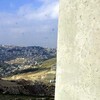
The Wall in Abu Dis has existed in one form or another since summer 2003. From late December to early January 2004, Israel built a larger 27ft (8m) wall that cuts off Abu Dis from Jerusalem, separating thousands of residents from the Palestinian capital, and dividing the village itself. Photographer Musa Al-Shaer visited Abu Dis on 18 January 2004 as the final stages of construction had been completed and Israel had renamed the Wall the “terror prevention fence”, a laughable phrase given the number of Palestinians trapped on the Israeli side of the Wall. Read more about Photostory: The Wall in Abu Dis, 18 January 2004
SANFRANCISCO - It is a tragic irony that, more than 55 years ago, one desperate people seeking sanctuary from murderous racism decimated another - and continue to oppress its scattered survivors to this day. In 1948, about 700,000 Palestinians were expelled from their homeland, their land and possessions taken by the new Jewish state of Israel. This included the Jerusalem home of my grandparents, Hanna and Mathilde Bisharat, which was expropriated through a process tantamount to state-sanctioned theft. George Bisharat comments. Read more about Right of Return: Two-State solution again sells Palestinians short
“The struggle for justice in Palestine would be stronger if Tom were still with us. Yet I believe that his selfless actions and the ultimate price he paid for believing in humanity sparked a desire to know, struggle, and act. He will live on by helping to bring about a revolution in perception and action concerning Palestine. Tom made a choice. It is people like him, Rachel, and many others who personify a new generation unwilling to blindly accept the world as it is, but who instead take risks and work together to forge new protest movements.” Activist Miriyam Aouragh remembers ISM member Tom Hurndall and his impact on a new generation of human rights activists. Read more about An open letter to the family and friends of Tom Hurndall
Israeli historian Benny Morris crossed a new line of shame when he put his academic credentials and respectability in the service of outlining the “moral” justification for a future genocide against Palestinians. How can one explain Morris’ knowledge that the ethnic Darwinism that was used to justify the murder of millions of non-whites, including Black African slaves, Native Americans, Arabs, and others, was also used to justify the attempt to exterminate Jews? Gabriel Ash takes a closer look at Morris’ thinking and the tradition to which it belongs. Read more about Diagnosing Benny Morris: the mind of a European settler
The Israeli army has destroyed hundreds of thousands of Palestinian olive and citrus trees throughout the Occupied West Bank and Gaza Strip in recent years. Yet in a startling admission, a staffer at the Jewish National Fund for Israel (JNF) has written that, “it is against Jewish halachic law to uproot fruit bearing trees.” EI’s Ali Abunimah explains how the JNF has been essential to the ethnic cleansing of Palestine, and the destruction of its landscape. Read more about If it's against Jewish law, then why is Israel doing it?
“Like Twenty Impossibles” is the work of Annemarie Jacir, co-written with Kamran Rastegar. Jacir is a Palestinian filmmaker, activist, and poet living between New York City and Palestine. The 17-minute short mockumentary tells the story of a journey in a country where checkpoints and a sinister patchwork of controlled areas make freedom of movement itself impossible, aptly portraying the complexities of oppression with a cast and crew that understand it. It is shot on location in Palestine, and the images of guns and power overwhelm the viewer as well as the waylaid film crew. Read more about Film Review: Like Twenty Impossibles (2003)
When does the banishment of an entire people become morally justified? That such a question can even be posed in today’s Israel is dismal testament to the transformation of Zionism into what it claims to abhor. EI’s Ali Abunimah comments on two recent, extraordinary documents — an article in The Guardian and an interview with Ha’aretz — in which Israeli historian Benny Morris approves of Israeli “ethnic cleansing” of the Palestinians in 1948, calls it “necessary” and prepares the ground for Israel to justify any future atrocity including renewed expulsion of all the Palestinians from their homeland. Read more about Moral decay and Benny Morris
Apartheid South Africa, which Israel increasingly resembles in the eyes of the world, taught an important lesson: the nuclear weapons which the apartheid regime developed with Israeli assistance were no defence against a majority population struggling for its freedom. EI contributor Hasan Abu Nimah argues that none of the excuses for the world ignoring Israel’s weapons of mass destruction hold water, and Middle East disarmament should begin with the one state that possesses deployed nuclear weapons aimed at its neighbors. Read more about Putting Israel's weapons above the law
The youth who play football on the small streets and narrow alleys of Bourj El Barajneh represent an entire generation of Palestinian refugees in Lebanon who live in a day-to-day low intensity war. This is a war waged against Palestinian refugees by the Lebanese government. It is not waged through military campaigns as in the Lebanese civil war, but through policies and laws which are slowly choking the life from Lebanon’s Palestinian refugee camps. Stefan Christoff reports from Beirout. Read more about Living War: Palestinians Refugees in Lebanon
While state department officials and historians assemble on Washington DC this week to discuss the 1967 war in the Middle East, Admiral Thomas Moorer, who was Chairman of the Joint Chiefs of Staff from 1970 to 1974, is compelled to speak out about one of U.S. history’s most shocking cover-ups. On June 8th, 1967, Israel attacked our proud naval ship — the USS Liberty — killing 34 American servicemen and wounding 172. Those men were then betrayed and left to die by our own government. Admiral Moorer believes the American people deserve to know the truth about this attack. Read more about A Legacy of Betrayal