The Electronic Intifada 3 December 2025
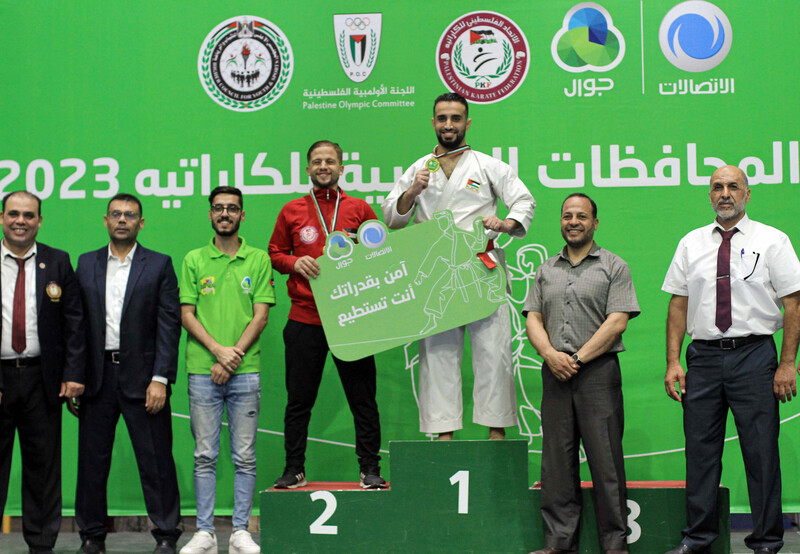
Medal winners pose during the Southern Governorates Karate Championship in Gaza City, on 6 October, 2023. On the far right is Bahjat Tantish.
APA imagesOn 18 March 2025, as Israel prepared to unilaterally end a ceasefire that had lasted since January, the Israeli military began warning Gaza residents to evacuate their areas.”
Those who had returned to what remained of their homes and lands during the past months were yet again forcibly displaced as Israel started the next phase of its genocide.
Among them was Bahjat Tantish, 56, a lieutenant colonel in the police and the vice president of the Palestinian Karate Federation, universally known in Gaza simply as Captain Bahjat.
A father of six, Tantish had his house in the al-Shymaa neighborhood in Beit Lahiya in the northern Gaza Strip, an area that is now dissected by Israel’s constantly moving yellow line and largely unreachable for its residents.
Unprepared for the hasty evacuation orders, Bahjat, his two sons – Hasan, 17, and Hussein, 9 – and his brother Amjad Tantish, 45, returned to their house four days later on 22 March.
They tried to retrieve some belongings: a tent, tarpaulins, a water barrel, planks, nails – the kind of things they might need to better cope with another stint in displacement.
“When we reached our homes, the occupation forces opened heavy fire,” Amjad, a swimming coach, told The Electronic Intifada.
Realizing they needed to leave promptly, he said, they grabbed what they could and turned back.
“Bahjat and I walked together. His two sons went ahead of us.”
Then they were struck with what Amjad believes was a tank shell.
“I felt the world spinning and a loud ringing in my ears. When I regained my senses, I saw my brother lying on the ground. He wasn’t moving.”
Amjad crawled to his brother but found him unconscious with a head wound. They called an ambulance, but Tantish died en route to the hospital.
Amjad believes his brother saved his life.
“Bahjat took the shell instead of me. He stood between me and death. He was closer to the impact site, so he received the fatal blow. He saved me, but at the cost of his life.”
A pillar
For many years, Tantish had been a pillar of the Palestinian karate community, dedicating his life to serving the sport in Gaza.
Under his leadership, karate in Gaza flourished as Tantish worked tirelessly to promote the sport throughout Gaza while also training a promising generation of practitioners and coaches.
Tantish began his journey in karate in middle school in 1984.
He then travelled to Libya to study at university, where he was trained under a Japanese sensei – or coach – and became Libyan champion several times between 1988 and 1992.
Tantish returned to Gaza in 1993 and continued his passion for sports.
He opened the first karate training club in Beit Lahiya, the Beit Lahiya Youth Karate Club, where he began to establish himself in the Palestinian sports community.
He won the Palestine championship several times and also represented Palestine in international competitions, including the 1996 Arab Police Karate Championship in Syria, where Tantish won the bronze medal.
He remained active as a coach for 30 years, eventually becoming vice president of the karate federation.
Tantish’s killing is yet another blow to Palestinian sports.
According to the Euro-Med Human Rights Monitor, Israel has killed 664 athletes in Gaza since October 2023.
Appeals by Palestinian sports officials for international sports bodies to suspend Israel – most recently from Jibril Rajoub, head of the football federation in September – have so far fallen on deaf ears, despite the swift action taken against Russia over Ukraine.
This despite what Rajoub described as Israel’s “flagrant” violations of international law in a press conference in August.
Rajoub also pointed to the 288 sports facilities – including 264 in Gaza – that Israel has destroyed over the past two years. These include Tantish’s Beit Lahiya karate club, now reduced to rubble as a result of Israel’s genocidal aggression.
Nonetheless, Asaad al-Majdalawi, vice president of the Palestinian Olympic Committee, said Tantish’s legacy was secure.
Tantish was one of the “most important leaders” of the Palestinian sports community, al-Majdalawi told The Electronic Intifada.
“For five decades, Captain Bahjat contributed greatly to Palestinian sports in general, and to karate in particular,” al-Majdalawi said. “Thanks to him, many of our karate practitioners reached the podium in local, Arab and international competitions. He left behind a legacy worthy of pride that will last for generations.”
Legacy
That legacy was not confined to sports, said Muhammad Tantish, 38, Tantish’s nephew.
Tantish was a vocal advocate of reuniting the Palestinian people – divided between the Hamas-run Gaza and the Palestinian Authority-controlled West Bank since 2007 – and his efforts bore fruit through sport.
“One of the achievements my uncle was most proud of was that he managed to ensure that a championship was held bringing together players from the West Bank and Gaza for four consecutive years from 2018 to 2022.”
Indeed, in April, the Karate Federation announced that a course in the West Bank city of Jericho to license coaches and referees would be renamed “The Martyr Bahjat Tantish Course” in his honor.
Tantish was also a farmer. During this year’s January fragile ceasefire, one of his main motivations for returning to Beit Lahiya was to check on his land and his trees.
The farm, Amjad recalled, had been full of trees, citrus, vegetables and olives. “It had over 1,000 trees and once stretched across 10,000 square meters.”
But the Israeli military had destroyed most of the area by the time Tantish returned.
Tantish was desperately disappointed, his brother Amjad said.
“When Bahjat finally returned to Beit Lahiya and saw his house and farm, he was devastated. The house was completely destroyed, and the farm had been bulldozed. The trees that were not bulldozed had dried out and died, with only a few remaining alive.”
The two months he had back at Beit Lahiya were spent trying to make life grow again.
“True to his character, he kept trying despite the immense hardships and obstacles,” Amjad said. “He attempted to revive whatever trees were left by removing weeds and hauling water from distant locations.”
Tantish’s legacy will also be preserved more directly.
Tantish coached his oldest son, Rizq, 28, and played a key role in helping him rise to the ranks of an internationally recognized karate athlete.
Based in Turkey since 2019, Rizq competes in international competitions, consistently earning top honors, most notably winning third place at the 2020 Eurasia Championship in Istanbul.
“After God, I owe everything I am today to my father,” Rizq told The Electronic Intifada over WhatsApp. “He wasn’t just a father. He was a brother, a friend and finally a coach. He supported me through every step, always involving me in discussions as if I were a grown man. That shaped my personality greatly.”
He was a strict coach, though.
“I was never his son in training. He made me a strong athlete. He built my body in the best way possible and taught me karate in all its details. Today, I proudly represent Gaza and Palestine,” Rizq said.
Ahmad Majd is a writer in Gaza.