The walls and outposts of the Zionist enterprise are becoming ever more conspicuous, so too are the contradictions inherent in the 57-year-old experiment of establishing a state that is both “Jewish” and “democratic” in pluralistic Palestine. The recent, albeit short-lived, decision of Britain’s Association of University Teachers (AUT) to impose an academic boycott on Bar-Ilan and Haifa Universities attests to the growing realization abroad that Israel’s policies adversely affect Palestinians on both sides of the Green Line. Read more about One Hand Clapping: Applauding Tolerance and Pluralism in Israeli Academia
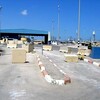
These 10 photos were taken on 22 May 2005 and show the passage from the point of arrival at the border of Gaza to the point of entry into Gaza. A sign at the entrance to the passage says in faulty Arabic: “Continuing with violence results in the withholding of ease of access and luxury for the people.” The passage is similar to the design developed by Temple Grandin (an assistant professor at Colorado State University) for the routing of cattle as they are led to slaughter. The Israelis are on the scene through remote control. When a person exiting from Gaza approaches the turnstile, a disembodied voice, rough and rude, tells him or her to drop bags to the floor, to lift up clothes, turn around, etc. Read more about Photostory: The Erez Crossing Point in Gaza
Governments should be allowing Palestinians the opportunity to claim political asylum, but they are failing to do so and mistreating Palestinians in the process. In this article, the writers consider international law in relation to this. They also examine the case of Khalil, who has — contrary to international law — not been given an effective opportunity to claim refugee status in the Netherlands and instead has been confined to a bureaucratic ‘no man’s land’, with severe personal consequences. Read more about No man's land: Government mistreatment of Palestinian asylum seekers
Last week, an obscure UN body called the Committee on Non-Governmental Organizations decided to “defer” the application from the Badil Resource Center, a Palestinian organization working for Palestinian refugee rights based in Bethlehem. Badil was asking for “consultative status” that would allow it to make statements at official UN gatherings. The committee was supposed to decide if Badil’s work was consistent with the purposes of the UN. Germany demanded that Badil provide a copy of every statement it has ever made on terrorism. The US demanded to hear Badil’s position on the land issue in the Israeli-Palestinian conflict. Then the US asked if Badil had anything to do with the International Solidarity Movement. Read more about At the UN, Palestinian democracy tests American and Israeli limits
Moving away, but only for a moment, from the issue of Nakba-denial in the academy, there are arguably very good reasons for a general boycott of Israel, in such areas as trade, sports and so on. Here, parallels with South Africa are not out of place. Such a boycott is separate from one directed against Nakba-denial in the Israeli academy. When academics are included in a general boycott, it is as a result of their belonging to a population which is boycotted because its various activities nourish a criminal state. Read more about Academic boycott will lead to Israeli self-examination
A boycott decision — like that passed by Britain’s Association of University Teachers to boycott two Israeli universities — naturally raises a hue and cry among Israelis. Why us? And why now just when negotiations with the Palestinians might be renewed? In the eyes of the world, the question is what can be done when the relevant institutions do not succeed in enforcing international law? The boycott model is drawn from the past: South Africa also disregarded UN resolutions. At that time as well, the UN (under pressure from the United States), was reluctant to impose immediate sanctions. Read more about Why Us? On the academic boycott
Two years ago a US magistrate judge pronounced al-Arian “a model of civic involvement” but denied him bail, substituting a nationalistic play for a real assessment of flight risk. The problem, evidently lost on the judge, is that Palestine cannot offer al-Arian or any other of its refugees safe haven; the Israeli military has occupied the Palestinian areas for 38 years and prohibits their return. Under US Supreme Court precedent, this flight risk makes al-Arian’s two-year pretrial stay in a Florida maximum-security prison, with 23 hours a day in solitary confinement, a constitutional administrative measure, not punishment. Read more about The Clash of Democratic Ideals
Those who follow Palestinian activism, from the McCarthyist “Campus Watch,” to the intrepid Jews Against the Occupation, are aware that Labor For Palestine (LFP) has emerged over the past year as a new campaign in labor internationalism. Yet as LFP prepares for its first national conference in Chicago on July 23, 2005, few know how it began. Officially, LFP was born in June 2004 when I met Michael Letwin in Manhattan’s Union Square to discuss drafting the Open Letter, LFP’s founding document. But the notions behind LFP were in the works long before this. They started in South Africa, where an international divestment movement threw a wrench in apartheid’s brutal turbines. Read more about Reconstructing Internationalism with Labor For Palestine
Day and night, for three days in September 1982, a massacre took place in Sabra Street and Shatila refugee camp in a popular residential area of Lebanon’s capital Beirut. Even today, few people are aware of the scale and extent of the killings that took place for 43 consecutive hours some 23 years ago. Palestinians were the target of this massacre, but they were not the only victims. Arabs of other nationalities, Turks, Bangladeshis and Iranians were also killed in their homes, in the streets, or marched to Sports City where they were shot in hastily-dug death pits. Read more about Book Review: Sabra and Shatila 1982
A fresh study by a Geneva-based institution confirms a growing consensus that Israeli land grab will be the foremost factor leading to an ignoble collapse of the Zionist colonial project. Centre for Housing Rights and Evictions, a respected Swiss human rights group warns that the continued existence of Israel on the basis of “two-states” has become a practical impossibility. And all due to the Jewish state’s continuing plundering of Palestinian property. It spells out that the rate of land confiscations underway and the continued construction of the apartheid wall - which Israel refers to as its “security barrier” - will leave Palestinian territory within the Occupied West Bank and Gaza reduced to less than eight percent of Mandate Palestine. Read more about Occupation will lead to collapse of Zionism