Ishmael Khaldi has been all the rage amongst Israel advocacy groups in the United States, especially in the liberal San Francisco Bay Area. An Arab Bedouin who embraces his Israeli citizenship and has worked for the Israeli police as well as Israel’s occupying army, he was a dream come true for the Israeli consulate, which decided to hire him as Deputy Consul to San Francisco in December 2006. Yaman Salahi reports on Khaldi’s private talk to a group of University of California, Berkeley students organizing “Israeli Apartheid Week.” Read more about Israeli foreign ministry's token Arab
HEBRON, WESTBANK, 10 February (IRIN) - A recent cold snap with sub-zero temperatures has caused farmers in the West Bank to incur losses of nearly US$14.5 million, according to initial estimates by the Palestinian ministry of agriculture (MoA) set out in a 6 February joint “fact sheet” with the UN Food and Agriculture Organization (FAO). The winter cash crop is the most profitable and “[as] a direct result of the frost, thousands of farmers have lost their main source of income for the next [few] months,” the “fact sheet,” which was emailed to IRIN, said. Read more about Damaging frost compounds farmers' woes
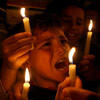
As Israel tightened its siege on the Gaza Strip, Palestinians and solidarity activists demonstrated their support for the people of Gaza. The above images were sent to The Electronic Intifada from around the world and document various actions, demonstrations and vigils in solidarity with Gazans under siege. Read more about Photostory: Solidarity with Gaza
“The next logical step” for the Israeli government “will have to be a decision whether to target the top political leadership” of Hamas. So said an Israeli official quoted in The Jerusalem Post. Tzahi Hanegbi, a senior member of Prime Minister Ehud Olmert’s Kadima party and chairman of the Knesset Foreign Affairs and Defense Committee, echoed the call, arguing that “There’s no difference between those who wear a suicide suit and a diplomat’s suit.” Ali Abunimah comments. Read more about Israel's "next logical step"
Much debate on conflict in the Middle East is beset by contradictions and unanswered questions. In his second book, Nazareth-based English author Jonathan Cook seeks to cut these Gordian knots, and in the process proposes an uncompromisingly grim diagnosis of what is happening in the world’s most unstable region, and why it is happening. Raymond Deane reviews for EI. Read more about Book review: "Israel and the Clash of Civilisations"
January 2008 saw a tightening of Israel’s siege of the Gaza Strip following Hamas’ routing of Fatah there the previous June. Palestinians in Gaza have been cut off from the outside world and Israel has banned or severely restricted the import of basic needs such as fuel, medicine and medical equipment, food, school supplies and cement. In January, electricity cuts lasted more than 12 hours per day as lack of fuel forced the closure of the region’s sole power plant.The above slideshow is a selection of images related to the breaking the Gaza siege in January 2008 taken by MaanImages photographer Wissam Nassar. Read more about Photostory: The month in pictures, January 2008
When I agreed to participate in the Turin Book Fair, which I have done before, I had no idea that the “guest of honor” was Israel and its sixtieth birthday. But this is also the sixtieth anniversary of what the Palestinian call the Nakba: the disaster that befell them that year, when they were expelled from their villages, some killed, women raped by the settlers. These facts are no longer disputed. So why did the Turin Book Fair not invite Palestinians in equal numbers? Tariq Ali comments. Read more about Why I will not participate in the Turin Book Fair
There are lots of “One Issue Voters” out here: those who decide to support a candidate based on the sole criterion of abortion, or taxation, or gun control, or crime. For those of us who fall into the “Pro-Palestinian Rights” category of One Issue Voter-hood, it’s a particularly lonely and dispiriting time. It’s as though there’s this big progressive celebration going on, but we haven’t been invited. Laurie King-Irani comments. Read more about The loneliness of the One-Issue Voter
“His very name scatters fire through ice,” wrote Byron of an 18th-century revolutionary leader, and so it has always been with the name of that extraordinary Palestinian, George Habash. Habash died an impoverished refugee in enforced exile in Amman last weekend. What, then, can this revolutionary of a bygone area provide us with now to address today’s bleak geopolitical predicament? Karma Nabulsi comments. Read more about Rebel from a bygone era
Israeli leaders, incensed that Egyptian President Hosni Mubarak had not resurrected the felled border wall and stopped the Gazans from entering, began suggesting that they would relinquish control of the strip altogether, leaving Egypt responsibile for the 1.5 million inhabitants of Gaza. “We need to understand that when Gaza is open to the other side, we lose responsibility for it,” said Israel’s deputy defense minister Matan Vilnai. “So we want to disconnect from it.” Read more about Israel threatens further supply cuts to Gaza