“It is true, and it must be recognised, that without immense US pressure, the Sharon government would not have endorsed the roadmap. But it is also true that by endorsing the dozen or more reservations that Israel conditioned its acceptance upon, Washington has rendered the Israeli acceptance of the roadmap meaningless. What followed from that point on has been totally futile, obstructive, even dangerously counterproductive.” Hasan Abu Nimah comments. Read more about The road to peace needs no map
A law forbidding Israeli citizenship for Palestinians from the Occupied Territories who marry Israelis passed its first reading in the Knesset on June 18. This is another milestone on Israel’s road to open, institutionalized apartheid, explains EI’s Ali Abunimah. Read more about Israel takes another leap towards institutionalized apartheid
“In an unprecedented act of interference in a sovereign state’s judicial and political processes, the US government yesterday forced the Belgian government to gut Belgium’s admirable and progressive universal jurisdiction legislation (anti- atrocity law), which had already undergone careful reconfiguration in Belgium’s parliament two months ago. The US feared that this law, which incorporates international law into Belgian national law, might lead to the prosecution of US military or governmental officials, or their possible arrest in Belgium. Numerous legal impediments to these possibilities exist. Belgium outlined all of them in an attempt to deflect US pressure, but to no avail in the face of US Secretary of Defense Donald Rumsfeld’s strong-arm techniques of persuasion.” Laurie King-Irani explains. Read more about On learning lessons: Belgium's universal jurisdiction law under threat
“Not only Palestinians are desperately trapped now in the Israeli-Palestinian conflict, but Jews are, too. Fear and anxiety are unshakeable daily companions. The outward manifestation of this mental landscape is the many infrastructural projects erupting everywhere along the seam between East and West Jerusalem. These public works projects are not about the ‘public’; they will not improve or enhance common spaces, but rather, will only further constrict shared spaces by diverting traffic, housing, commerce, and socializing according to racial distinctions. Walls and barricades are omnipresent, marring Jerusalem’s beauty and cutting into its soul, wounding all who see it, Palestinians and Israelis, Arabs and Jews, locals and foreigners.” EI co-founder Laurie King-Irani reports on a recent visit to Jerusalem. Read more about Escaping what entraps us: reflections from Jerusalem
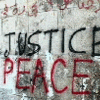
On 6 September 2002, EI’s Arjan El Fassed drove with Dr. Dima Amin through the empty streets of Ramallah. Israeli occupying forces had imposed a curfew on the city and residents were forced to stay inside their homes. The only other moving vehicle was an ambulance. Graffity on the walls spell the words “apartheid” and “no peace, no justice”. Read more about Curfew in Ramallah
Since the outbreak of the second Intifada posters of Palestinian martyrs are common on the walls of Palestinian towns. In Nablus, there is one poster that people stop to stare at. On 6 May 2002, EI’s Arjan El Fassed visited Nablus and filmed the devastation left behind after Israeli forces ended their brutal invasion of April 2002. This particular footage includes the martyrs’ poster of the al-Shubi family. Read more about Nablus: Shubi family - demolished and killed
The right of return of Palestinian refugees is a legal and a political right. But it is also a moral one, explains Raja Halwani, associate professor of philosophy at the School of the Art Institute of Chicago, in this essay for The Electronic Intifada. Read more about On the right of return
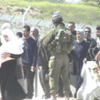
Qalandia checkpoint is one of the largest Israeli military checkpoints in the occupied West Bank. This checkpoint is not located on a border, but between the Palestinian town Ramallah, Qalandia refugee camp, and the Palestinian town of ar-Ram. It separates Ramallah residents from southern Palestinian towns and the northern Palestinian neighbourhoods of Jerusalem. Israeli soldiers check identity cards. Read more about Hell on earth: Qalandia checkpoint
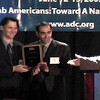
Two Electronic Intifada and Electronic Iraq co-founders, Ali Abunimah and Nigel Parry, were at the 20th National Convention of the American-Arab Anti-Discrimination Committee in Washington DC on 14 June 2003 to accept the ADC’s Voices of Peace Award on behalf of the founders of EI and sister site Electronic Iraq. The award was presented to EI and eIraq “in recognition of its commitment to bringing the concerns, voices, and experiences of the Iraqi and Palestinian peoples to audiences the world over via the Internet.” Read more about EI "Voices of Peace" acceptance speech at ADC conference
There is no work this summer for the majority of people in Bourj el Barajneh refugee camp. Less work than last summer, I am told, when local NGOs estimated unemployment rates were around 60- 80% for those Palestinians living here. With hope of Return looking bleaker under current negotiations, people here—especially the young men—are doing whatever they can to leave. Jordan Topp reports from Bourj el Barajneh Refugee Camp, Beirut, Lebanon. Read more about Promises of an unpredicatable future