How is Israel able to strangle the Gaza Strip when there is supposed to be an international crossing between Gaza and Egypt not controlled by Israelis? David Morrison looks at how the Agreement on Movement and Access, signed more than two years by Israel and the Palestinian Authority, allowed Israel to control the border without being physically present through the the agreement’s European Union third party mechanism. Read more about How the EU helps Israel to strangle Gaza
JERUSALEM, 11 February (IRIN) - A UN special appeal for the Gaza Strip has managed to bring in only a small percentage of the US$9.8 million needed for urgent food aid and cash assistance for the enclave’s most vulnerable refugees. On 6 February, UNRWA, the UN agency for Palestinian refugees, began to distribute food aid in Gaza funded by a $100,000 donation from the United Arab Emirates (UAE) Red Crescent Society. The money came in response to the special appeal issued by UNWRA in late January. Read more about UNRWA Gaza appeal making very slow progress
Recently, Israeli Prime Minister Ehud Olmert was reported to have suggested that the question of Jerusalem would be “left to last” in negotiations with the Palestinians. This was apparently on account of the issue being “too sensitive and complex,” as well as fears that talks on Jerusalem would cause the departure of religious right-wingers from Olmert’s ruling coalition. Domestic political considerations will certainly have played a part in the prime minister’s thinking, but there is another possible motivation for leaving this “final status issue” for further down the road. Ben White analyzes for EI. Read more about Jerusalem off the radar
Ishmael Khaldi has been all the rage amongst Israel advocacy groups in the United States, especially in the liberal San Francisco Bay Area. An Arab Bedouin who embraces his Israeli citizenship and has worked for the Israeli police as well as Israel’s occupying army, he was a dream come true for the Israeli consulate, which decided to hire him as Deputy Consul to San Francisco in December 2006. Yaman Salahi reports on Khaldi’s private talk to a group of University of California, Berkeley students organizing “Israeli Apartheid Week.” Read more about Israeli foreign ministry's token Arab
HEBRON, WESTBANK, 10 February (IRIN) - A recent cold snap with sub-zero temperatures has caused farmers in the West Bank to incur losses of nearly US$14.5 million, according to initial estimates by the Palestinian ministry of agriculture (MoA) set out in a 6 February joint “fact sheet” with the UN Food and Agriculture Organization (FAO). The winter cash crop is the most profitable and “[as] a direct result of the frost, thousands of farmers have lost their main source of income for the next [few] months,” the “fact sheet,” which was emailed to IRIN, said. Read more about Damaging frost compounds farmers' woes
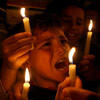
As Israel tightened its siege on the Gaza Strip, Palestinians and solidarity activists demonstrated their support for the people of Gaza. The above images were sent to The Electronic Intifada from around the world and document various actions, demonstrations and vigils in solidarity with Gazans under siege. Read more about Photostory: Solidarity with Gaza
“The next logical step” for the Israeli government “will have to be a decision whether to target the top political leadership” of Hamas. So said an Israeli official quoted in The Jerusalem Post. Tzahi Hanegbi, a senior member of Prime Minister Ehud Olmert’s Kadima party and chairman of the Knesset Foreign Affairs and Defense Committee, echoed the call, arguing that “There’s no difference between those who wear a suicide suit and a diplomat’s suit.” Ali Abunimah comments. Read more about Israel's "next logical step"
Much debate on conflict in the Middle East is beset by contradictions and unanswered questions. In his second book, Nazareth-based English author Jonathan Cook seeks to cut these Gordian knots, and in the process proposes an uncompromisingly grim diagnosis of what is happening in the world’s most unstable region, and why it is happening. Raymond Deane reviews for EI. Read more about Book review: "Israel and the Clash of Civilisations"
January 2008 saw a tightening of Israel’s siege of the Gaza Strip following Hamas’ routing of Fatah there the previous June. Palestinians in Gaza have been cut off from the outside world and Israel has banned or severely restricted the import of basic needs such as fuel, medicine and medical equipment, food, school supplies and cement. In January, electricity cuts lasted more than 12 hours per day as lack of fuel forced the closure of the region’s sole power plant.The above slideshow is a selection of images related to the breaking the Gaza siege in January 2008 taken by MaanImages photographer Wissam Nassar. Read more about Photostory: The month in pictures, January 2008
When I agreed to participate in the Turin Book Fair, which I have done before, I had no idea that the “guest of honor” was Israel and its sixtieth birthday. But this is also the sixtieth anniversary of what the Palestinian call the Nakba: the disaster that befell them that year, when they were expelled from their villages, some killed, women raped by the settlers. These facts are no longer disputed. So why did the Turin Book Fair not invite Palestinians in equal numbers? Tariq Ali comments. Read more about Why I will not participate in the Turin Book Fair