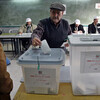
Polls have closed across Gaza and the occupied West Bank and the vote count has begun, after the first Palestinian parliamentary elections in a decade. Election officials say over 70 percent of the more than one million eligible voters turned out despite rain and cold winds to cast their ballots at more than 1,000 polling stations. East Jerusalem witnessed the highest turnout, between 80 to 90 percent, prompting the Central Elections Committee to extend voting until 9 p.m. An 81 percent turnout was registered in the Gaza Strip in comparison to 74 percent in the West Bank. A strong Hamas showing would indicate the movement’s call for change and reform clearly resonated with many voters, who were disappointed with the long-time rule of Fatah. Read more about Photostory: Palestinian Elections
Elections are a normal practice in any democratic and free society. People go voluntarily to the voting polls to freely choose their political representatives. This democratic practice should be conducted in an open, transparent, regular and systematic manner. Unfortunately, most nations in the Middle East have not yet had the chance to enjoy this right on a regular basis. Ironically, the only countries in the region that do practice this right, with a reasonable degree of transparency, are Israel, Iran, occupied Iraq and occupied Palestine. Read more about Palestinian Elections: Imposing a sense of normalcy on a highly abnormal situation
Sixteen constituencies in the West Bank and Gaza Strip will choose 132 members of the Palestinian parliament, known as the Palestinian Legislative Council or PLC, which will sit for four years - though it has been 10 years since the last parliamentary election. Only Palestinians resident in the West Bank, Gaza Strip and East Jerusalem can vote. Palestinians with Israeli citizenship are not eligible to vote, nor are the estimated 6 million Palestinians and their descendants who live as refugees in other countries. The vast majority of the 100,000 eligible voters living in East Jerusalem are not allowed to vote in their own city. Dozens of individuals and parties will contest the election. However the two biggest groups will be Palestinian President Mahmoud Abbas’s Fatah movement and the Islamic movement Hamas. Read more about Photostory: Palestinian Elections Campaign
With about 80 percent of eligible voters registered, and more than 700 candidates running in a hotly contested campaign, the stage is set for what is being packaged as an impressive exercise in democracy when Palestinians in the occupied territories. But writes EI contributor Saree Makdisi, the talk of elections is part of an attempt to impose a sense of normalcy on a highly abnormal situation: not just the endless occupation, but the unresolved future of the Palestinian people, two-thirds of whom are excluded from the electoral process because they do not live in the occupied territories but rather in refugee camps or in the diaspora, or as second-class citizens of the state of Israel. Read more about Illusion of democracy: The Palestinian Elections
Palestinians in the occupied territories are gripped to see who will enjoy the majority of the seats in the council — the ruling party Fateh or the Islamist opposition movement Hamas. Fateh has lost a great deal of support after ten years of failed negotiations with Israel, a drastic deterioration of the severe humanitarian situation endured by West Bank and Gaza Palestinians, and widespread corruption in the Palestinian Authority (PA) and failure to uphold the rule of law that has spilled out into the streets with sharpened lawlessness and vigilantism. Read more about Palestinian legislative elections: A vote for law and order
Some 30 meters away from election campaigning by the largest Palestinian parties, the ruling Fatah and Hamas, in the refugee camp of Maghazi, central Gaza Strip, the house of Kamal Taha, 55, is located in one of the camp’s alleys. About 400 Palestinian candidates in the West Bank, Gaza and Occupied East Jerusalem are competing in an election campaign that began on January 3 and would end by January 24, to be elected as members of the Palestinian Legislative Counci. Kamal had used to work in Israel as a porter prior to the outbreak of the al-Aqsa Intifada in September 2000, and since then he has been unemployed due to closure by Israeli authorities of the occupied Palestinian territories. Read more about Palestinian Elections: The need for social justice
The 38-year Israeli military occupation of Palestine and 57 years of ongoing Palestinian dispossession at the hands of the State of Israel has brought us to a point of total despair. Today, in 2006, Palestinians have been condensed into pockets of caged-in communities, taking on varying shapes and forms. Over 50 percent of the Palestinian population lives in exile and squalid pockets called refugee camps. Having being forced out of their homeland, they eke out a meager existence in the land and countries surrounding Israel and yearn to return home. All of the political activity in the West Bank and the Gaza Strip completely ignore these pockets of people living outside of Israel/Palestine. The end result will be that the majority of Palestinians, those living as refugees and in exile, will not be part of any organized process of governance, and thus the chance for any stability at all has been reduced dramatically. Read more about Ring Around the Rosy, Pockets Full of Palestinians
Paradise Now won the Best Foreign Language Flm category in today’s 63rd Annual Golden Globe Awards. The film was directed by Palestinian Hany Abu-Assad from a screenplay he cowrote with Bero Beyer, the film’s Dutch producer, both of whom ascended to the podium to collect the award. Paradise Now chronicles the 48 hours before two best friends in Nablus are sent on a suicide mission to Israel. The New York Times said it “accomplishes the tricky feat of humanising the suicide bombers depicted in the film”. The paper dubbed the film “a taut, ingeniously calculated thriller”. Read more about "Paradise Now" wins Golden Globe for Best Foreign Language Film
“What’s going on in that head and that mind?” an American news commentator asks during a montage of media reports on the kidnapping of eleven Israeli athletes by the Palestinian Black September group. The astonished newsman is questioning the Palestinian hostage takers who end up murdering their eleven captors during Germany’s botched rescue attempt. But Munich’s director Steven Spielberg, for now, is more interested in what’s going on in the mind of the Israeli agent in charge of the state’s response to the Munich killings. However, whether we really get into the minds of the unlikely group of Israeli Mossad agents who are assembled by Israeli Prime Minister Golda Meir to avenge the killings is debatable. It is mostly Spielberg’s moral dilemmas that we access, but not all the questions necessary to resolving his moral dilemma are posed. Read more about "Munich": Spielberg's thrilling crisis of conscience
The Israeli military is using dogs as a reconnaissance tool in its actions against Palestinian people in the Occupied Palestinian Territory, including the Balata refugee camp in Nablus. The dogs’ actions are controlled remotely through sophisticated technology; commands are issued by way of a radio transmitter. This evokes much fear and deepens the alienation of Palestinians. The way Israel is using dogs is yet another dehumanising step, taking place under the “cover” of war. The dogs follow the orders of their military masters. In no way should the international community permit the Israeli government to escape its responsibility for these barbaric practices in enforcing its brutal occupation of the Palestinian territories. Read more about Dogs - Reconnaissance tool of the Israeli occupation