JERUSALEM, 14 October 2007 (IRIN) - Some 580 women living in the occupied Golan region are disconnected from their families in Syria as they are not allowed to cross from the occupied zone to their homeland, a new women’s organization has said. “All the Arabs of the Golan have some family in Syria. But these women are disconnected from their mothers, fathers and brothers and sisters,” said Souha Munder, a lawyer who works with the new group, which calls itself The Women of the Occupied Arab-Syrian Golan. Read more about Separation of families "priority humanitarian issue"
DAMASCUS, 10 October (IRIN) - Most of the over 300 Palestinian-Iraqi refugees stranded for the past 18 months at the makeshift al-Tanf refugee camp on the Syrian side of the Iraq-Syria border have rejected an offer of asylum in Sudan. The Sudanese government made an offer 8 October to take in the 310 Palestinian refugees, who are living in pitiful conditions at the camp. “The [Sudanese] president agreed to the request of both Hamas and Fatah to accommodate them and we are going to inform the Arab League and then make our preparations,” said a Sudanese Foreign Ministry official. Read more about Stranded Palestinians turn down Sudanese asylum offer
In a recent article on the openDemocracy website, the rewritten Palestinian Authority policy document that replaced “muqawama” (resistance) with “popular struggle” was hailed as having “the potential to dramatically transform a conflict whose just resolution has continually eluded diplomats and militants.” EI contributor Ben White comments that the writer Maria Stephan may be admired for her optimism about the possibility of large-scale mobilization in the Occupied Palestinian Territories for a program of nonviolent resistance, but there is a twofold failure of contextualization that compromises her analysis. Read more about Nonviolent resistance a means, not the end
BRUSSELS, Oct 10 (IPS) - Representatives of the European Union’s two most powerful institutions remained silent this week on new efforts by Israel to expropriate Palestinian villages, triggering accusations that the bloc’s Middle East policy suffers from double standards. During a 10 October debate in Brussels, speakers from the Portuguese government, which holds the Union’s rotating presidency, and the European Commission did not refer directly to the Israeli order to seize control of four Arab villages located between East Jerusalem and the West Bank city of Jericho. Read more about EU quiet over Israeli land expropriation
Ghada Karmi’s latest book Married to Another Man: Israel’s Dilemma in Palestine opens with the problem European Zionists faced over a century ago when they first mooted the idea of a Jewish state in Palestine. They found then that there was already a well-established Palestinian society existing in the land they wished to claim as their own. Hence the message sent back to Vienna by the two rabbis who made the discovery: “The bride is beautiful, but she is married to another man.” EI contributor Sonja Karkar reviews. Read more about Book review: "Married to Another Man"
The recent death of Haider Abdul-Shafi could not have come at a worse time. Bearing in mind the grim shortcomings of the Palestinian leadership and the lack of any serious attempt to rectify the situation, the loss of this unique and iconic leader feels all the more acute. Ramzy Baroud remembers the life of the late Palestinian leader. Read more about Passing undefeated: Remembering Haider Abdul-Shafi
Palestinian Authority President Mahmoud Abbas and his lackeys are offering Palestinians a simple and false choice: either you are with “us” (i.e., the PA and Fatah) or you are with the “terrorists” (i.e., Hamas and Iran). In the United States, Abbas has been aided in this effort by the American Task Force on Palestine (ATFP), a fledgling organization that professes to represent Palestinian-American interests. EI contributor Osamah Khalil finds the implications of these tactics on Palestinian advocacy and aspirations in the current political climate bear further scrutiny, as do the organizations and individuals which employ them. Read more about Politics of fear
JERUSALEM, 3 October (IRIN) - The UN has expressed renewed concern over the state of the Gaza Strip’s border crossings, saying that, if realized, the Israeli threat of increased restrictions would most likely lead to a humanitarian crisis in the impoverished enclave. “In the last three months, the arrival of 106 truckloads of supplies per working day has ensured that there has not been a humanitarian crisis among the Gazan population. This could not be guaranteed with increased restrictions on the border crossings,” a recent statement by UN Office for the Coordination of Humanitarian Affairs (OCHA) said. Read more about "The noose is tightening around Gaza"
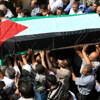
This slideshow is a selection of images from the month of September 2007. The month in pictures is an ongoing feature of the Electronic Intifada. If you have images documenting Palestine, Palestinian life, politics and culture, or of solidarity with Palestine, please email images and captions to photos@electronicintifada.net. Read more about Photostory: The month in pictures
Many members of the Palestinian Canadian community have been working hard to establish a truly representative Palestinian National Voice (PNV) organization for our community. Laith Marouf, identifying himself as the chapter coordinator for the student group Solidarity for Palestinian Human Rights (SPHR), on 14 September 2007 published an article attacking this effort (see Palestinian Diaspora: With or against collaboration?). James Kafieh responds. Read more about Working towards a Palestinian national voice