The Electronic Intifada 2 December 2025
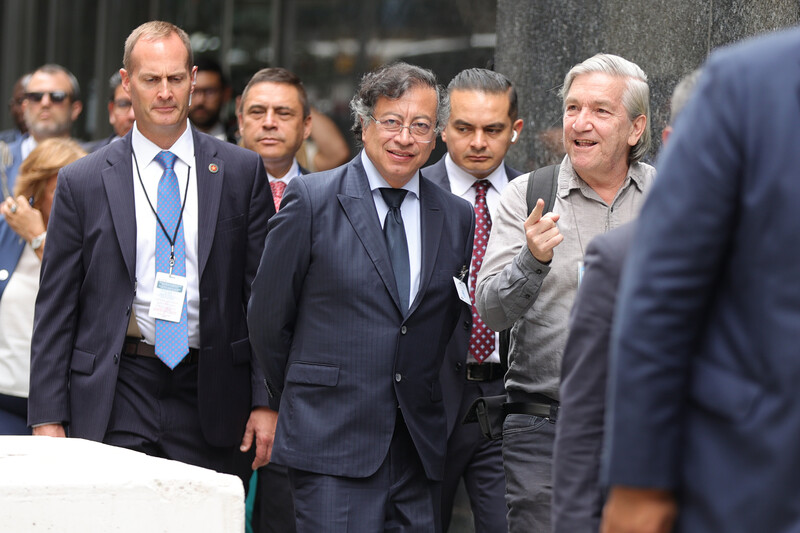
Colombian president Gustavo Petro on his way to participate in a meeting outside the United Nations headquarters in New York City on 28 September after speaking at the General Assembly. Following his attendance at the rally, the US State Department announced it would revoke Petros visa.
EuropaNewswireDid the UN Security Council bulldoze the prospect of Uniting for Peace in Palestine?
Enough words, Colombian President Gustavo Petro had declared at the United Nations General Assembly (UNGA) on 23 September.
“I invite nations of the world, and their people, most importantly, as an integral part of humanity, to bring together weapons and armies to defend Palestine.”
Echoing the words of Simón Bolívar, the revolutionary and military leader who led the nations of Colombia, Venezuela, Ecuador, Bolivia, Peru and Panama to victory against their Spanish colonizers in the early 19th century, Petro was proposing a significant shift toward ending Israel’s genocide based on UN Resolution 377 A, also known as Uniting for Peace.
First adopted in 1950 to override the Soviet veto during the Korean War, Uniting for Peace is a UNGA resolution that in theory enables collective action “to maintain international peace and security” when the UN Security Council (UNSC) is deadlocked due to the veto powers of its permanent members.
The US has vetoed six resolutions calling for an immediate ceasefire in Gaza since October 2023 alone, providing the UNGA with ample legal standing to convene an emergency special session and invoke Uniting for Peace.
For now, however, that prospect is moot. The UN’s stamp of approval for the US-brokered ceasefire-that-is-not-a-ceasefire has put the brakes on any such attempt.
“Colonial outrage”
On 17 November, the UNSC deadlock was broken when, with 13 votes in favor and two abstentions (Russia and China), members adopted a US draft resolution (UN Resolution 2803) to establish a Board of Peace as a “transitional authority” to oversee Gaza reconstruction and the deployment of an International Stabilization Force (ISF) with a mandate lasting until end of year 2027 – “subject to further action” by the Security Council.
The ISF will work “in close consultation and cooperation with the Arab Republic of Egypt and the State of Israel,” the resolution said.
“I assume that the US, at Israel’s urging, was very unhappy about the prospect of Uniting for Peace,” and “that a lot of pressure was brought to bear on the UN and on the members of the Security Council to vote as they did,” said Richard Falk, President of the Gaza Tribunal Project, a civil society initiative promoting an alternative model to implement international law in Gaza, and from 2008 to 2014 a former UN Special Rapporteur on human rights in the occupied Palestinian territories.
But, he told The Electronic Intifada, “it’s a very strange context in which the perpetrator of genocide and its principal supporter are rewarded by presiding over a supposed peace process,” he said. “That’s very perverse.”
Meanwhile, “[Palestinians] have been excluded from these post-high-intensity genocide negotiations altogether. They’ve had no role in shaping their own future or shaping the intended future of Gaza,” he said.
The resolution has received public condemnation from pro-Palestine advocates, including experts in international law.
“[Resolution] 2803 puts Gaza in the hands of a puppet administration, with the US as the new manager of an open-air prison, further crushing Palestine’s right to self-determination and any path to peace,” wrote Francesca Albanese, current UN Special Rapporteur on the occupied Palestinian territories.
It’s “a US colonial outrage, a ratification of genocide, and a flagrant abdication of UN Charter principles,” wrote Craig Mokhiber, an international human rights lawyer and former UN official who resigned due to the organization’s failure to respond to a “textbook genocide” in Gaza.Whither the West Bank?
The US resolution makes no mention of the occupied West Bank, where over 1,000 Palestinians have been killed since 7 October 2023, 20 percent of them children.
Falk argued this reflects Israeli influence.
“The West Bank is crucial to the Zionist plan for the long term: a combination of regional hegemony and the surrender of the Palestinians in terms of their political aspirations. It’s still seeking a genocidal outcome that allows it to shape the future in collaboration with the US and now the symbolic quasi-support of the UN.”
Some people, he added, “have used the formulation ‘incremental genocide’” to describe the situation in the Israeli-occupied West Bank.
By contrast, if adopted with a two-thirds majority at the UN’s General Assembly, the Uniting for Peace resolution for Gaza could have bypassed any Security Council veto, creating a multinational protection force for Palestine in both Gaza and the West Bank.
With such a mandate, and upon invitation by the government of Palestine, Colombia and its allies could have called on states to implement comprehensive sanctions and a military embargo against Israel, enforce the suspension of Israel from the UNGA, reactivate UN anti-apartheid mechanisms, mandate a criminal tribunal to address Israeli war crimes, and make appropriate recommendations “in the case of a breach of the peace or act of aggression” for the use of armed force “to maintain or restore international peace and security.”
Having preempted efforts to adopt “Uniting for Peace,” however, the US ceasefire plan has derailed long-term efforts, said Ubai Aboudi, head of the Bisan Center for Research and Development in Ramallah, and a member of the steering committee for the Palestinian NGOs Network (PNGO), the largest coalition of civil society groups in Palestine.
Trump and the PA
Calls for international protection are not new, Aboudi told The Electronic Intifada.
In April 2025, “we called for international protection and we called for international forces to come, forcefully impose a ceasefire and guarantee the opening of all crossings to Gaza for the flow of humanitarian aid and personnel to save the population of Gaza,” Aboudi said.
Following a PNGO statement in August, specifically calling on the UNGA to adopt the Uniting for Peace resolution, Colombia wanted to push the idea forward.
“We already had a draft proposal by the Colombian government,” Víctor de Currea-Lugo, Middle East advisor to Colombia’s President Petro, told The Electronic Intifada, that was “ready to be presented” in the General Assembly.
“We organized a strategy to visit different countries and to mobilize our embassies, our consulates and our mission before the United Nations [meet] in New York. The problem was, at that moment, Trump presented his plan for the pacification of Gaza,” de Currea-Lugo said.
Adding to the obstacles, according to Aboudi, “the Palestinian Authority weren’t really pushing for it.”
“They still were betting on US intervention and involvement: that it would end the genocide, that it would give them the path for a Palestinian state and for the recognition of Palestinian rights. This gamble did not pay off,” he said.
PNGO has unequivocally condemned UN Resolution 2803.
State of compliance
The recent vote marks the latest stage of Trump’s 20-point plan to end the genocide in Gaza, which in addition to the establishment of a foreign-controlled Board of Peace to rule Gaza and an international stabilization force, also foresees the demilitarization of Hamas, which is precluded from any future governance role, a “vetted” Palestinian police force and an “economic development plan to rebuild and energize Gaza.”
The PA almost immediately welcomed the UN vote endorsing Trump’s plan, stating its “full readiness to cooperate with the US administration, members of the Security Council, the Arab and Islamic states, the European Union and its member states, the United Nations, and all parties of the international coalition and partners in the New York Declaration, in order to ensure the implementation of this resolution.”
Hamas, however, rejected any prospect of an “international guardianship mechanism” for Gaza and the demand for its military wing to disarm.
Israel, meanwhile, has opposed the advancement of Palestinian statehood. National security minister Itamar Ben-Gvir threatened that such a move could lead to the “targeted assassinations of senior Palestinian Authority officials.”
Despite Russia’s initial attempt to challenge the US draft, Moscow ultimately decided to abstain from the 17 November vote.
In laying out Russia’s position at the UN, Ambassador Vassily Nebenzia blamed a combination of a lack of time given to respond and bad faith “arm twisting,” as well as the support shown by Ramallah and other Arab countries, as the reason Moscow did not introduce its own draft.
What next?
Falk suggested Moscow also had an eye on Ukraine.
“I accepted this idea that Russia had a primary interest in not antagonizing Trump at this point because of the possible usefulness his diplomacy could have in bringing the Ukraine conflict to an end.”
But the resolution means that “instead of international forces coming to protect Palestinians from genocide and ethnic cleansing, we are seeing international forces being deployed with the aim of policing Palestinians and disarming them,” Aboudi told The Electronic Intifada.
“Nobody is talking about holding [Israel] to account or the need, even, to disarm it,” he said. “The only ones that are being held to account for anything are the Palestinians.”
In Gaza, meanwhile, and despite Washington’s UN Ambassador Mike Waltz claiming ahead of the Security Council vote that “we have a ceasefire that is holding,” Israel continues daily to violate its terms. From the start of the ceasefire on 10 October until 1 December, Israel has breached the ceasefire agreement at least 591 times, killing at least 356 people, according to Gaza’s ministry of health.
Aboudi predicted that the Trump plan “will implode upon itself because it does not deal with the root cause of the problem.”
“We are calling on states to openly reject this new resolution by the UN Security Council, [and] to continue mobilizing for the deployment of internal protection forces for the West Bank and Gaza.”
So what about Uniting for Peace?
“The legal timing is not the best right now but that doesn’t mean we cancel the initiative. We continue pushing with this idea,” de Currea-Lugo told The Electronic Intifada.
And ultimately what happens next comes down to political will.
“Israel is a pariah state in the judgment of many informed commentators around the world,” said Falk. “We can assume that Israel could resist compliance at any point, giving the UN the kind of credibility to act coercively against its preferred course of behavior,” he told The Electronic Intifada.
Despite a general refusal to learn from the past, Falk pointed out, “in all the anti-colonial wars,” from Vietnam to Algeria, “the weaker side militarily has, in the end, prevailed politically, even though at great costs.”
Ana Maria Monjardino is an independent journalist based in London.